Judge Rules Trump Unlawfully Targeted Noncitizens Over Pro-Palestinian Speech
Zach Montague The New York Times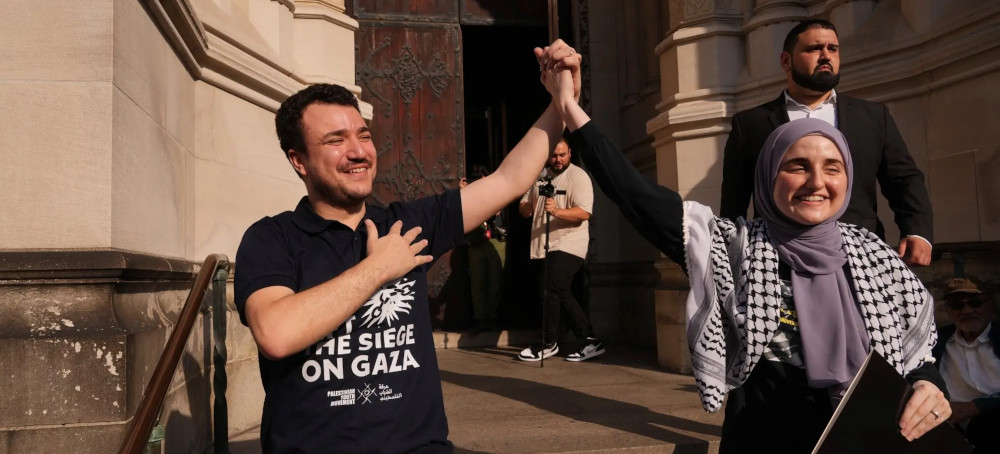 Mahmoud Khalil and his wife, Noor Abdalla, in New York after he was released from detention in June. Mr. Khalil was one of several students the Trump administration sought to deport. (photo: Adam Gray/The New York Times)
In a blistering opinion, a federal judge in Boston said the Trump administration used the threat of deportations to systematically intimidate certain campus demonstrators into silence.
The remarkable ruling was a hard-fought win for a coalition of academic and civil rights organizations that had sued to block future deportations of foreign students, arguing that the government had used the threat of “ideological deportation” to punish people for criticizing Israel’s government and its war in Gaza.
Describing the question before him as “perhaps the most important ever to fall within the jurisdiction of this district court,” Judge William G. Young, an appointee of President Ronald Reagan, released a scathing rebuke of President Trump, whose administration he said had worked outside the law to curtail First Amendment protections for noncitizens.
Despite finding that the Trump administration had unlawfully trampled noncitizens’ constitutional rights, Judge Young did not immediately block the government from attempting further deportations. Sticking to his usual process, he wrote that he would weigh in on a way to respond to the government’s policy against student demonstrators after another hearing at a later date.
The ruling was the latest from a growing number of district court judges who have excoriated the government’s actions. The administration has appealed a series of such adverse rulings, in some cases succeeding in appeals courts or at the Supreme Court.
Still, in an exhaustive and winding 161-page opinion, Judge Young struck out at Mr. Trump’s government across multiple fronts.
Looking back to January, he cataloged attempts this year by the president and top officials, including Secretary of State Marco Rubio, to make examples of pro-Palestinian demonstrators on campuses such as Columbia, Tufts and Georgetown, and to “strike fear” into their supporters. He assailed Immigration and Customs Enforcement agents for wearing masks, which he argued was a tactic “to terrorize Americans into quiescence” and evoked “cowardly desperados and the despised Ku Klux Klan.”
To emphasize the political atmosphere that informed his thinking, he pasted atop the opinion a scanned image of an anonymous threat that had been sent to his chambers in June, as he considered the case, that ominously read, “Trump has pardons and tanks. … What do you have?”
His legal finding, Judge Young indicated, was his response — something derived from shared values under “our magnificent Constitution.”
The case, Judge Young wrote, “squarely presents the issue whether noncitizens lawfully present here in United States actually have the same free speech rights as the rest of us. The court answers this constitutional question unequivocally, ‘Yes, they do.’”
“The First Amendment does not draw President Trump’s invidious distinction, and it is not to be found in our history or jurisprudence,” he added. “No one’s freedom of speech is unlimited, of course, but these limits are the same for both citizens and noncitizens alike.”
The Knight First Amendment Institute, which helped represent the American Association of University Professors and the Middle East Studies Association in the case, hailed the opinion as a landmark win for noncitizens and freedom of expression more broadly.
“This is a historic ruling that should have immediate implications for the Trump administration’s policies,” Jameel Jaffer, the Knight Institute’s executive director, said in a statement. “If the First Amendment means anything, it means the government can’t imprison people simply because it disagrees with their political views.”
Tommy Pigott, a State Department spokesman, repeated claims by the Trump administration that it had initiated deportations against people who “commit acts of anti-American, pro-terrorist and antisemitic hate, or incite violence.”
He added: “We will continue to revoke the visas of those who put the safety of our citizens at risk.”
The case, which played out over an emotional two-week trial in Boston in July, focused on what the suing coalition described as an altered academic climate in the United States after the arrests of five students in March.
Lawyers for the groups argued that the government’s moves to detain the students, Mahmoud Khalil, Rumeysa Ozturk, Mohsen Mahdawi, Badar Khan Suri and Yunseo Chung, had ushered in panic and an intellectual retreat on American campuses, which in turn diminished the output and quality of scholarship focused on the Middle East this year.
They focused primarily on a narrow provision of immigration law that allows the secretary of state to initiate the removal of people whose presence in the United States jeopardizes the country’s foreign policy goals.
In laying the groundwork to deport the students, Mr. Rubio invoked that provision, officially concluding that their role in the student protests that swept the country went beyond antisemitism or hate speech and in fact constituted support for Hamas, the de facto governing authority in Gaza, which the United States has designated a terrorist group.
At the trial, the government argued that it had followed no unified policy of deporting students based on their viewpoint, calling the notion “creative conjuring” during closing arguments. Lawyers for the Justice Department maintained that the State Department was within its rights to single out individual students who had expressed support for forces opposing Israel, which President Trump has held up as a close ally.
The coalition called faculty members from several universities to testify about instances in which they or their colleagues felt compelled to tone down work that the Trump administration might label hostile toward Israel.
After the trial, lawyers for the groups submitted as additional evidence a list of online posts, media appearances and speeches in which Mr. Trump, Mr. Rubio and various homeland security officials spoke of the arrests as part of a coordinated approach.
“To all the resident aliens who joined in the pro-jihadist protests, we put you on notice: Come 2025, we will find you, and we will deport you,” Mr. Trump declared in a fact sheet in January, accompanying two executive orders related to foreign students.
Mr. Rubio, who personally signed off on memos revoking each student’s legal status, has made similar generalizations.
Throughout the trial in July, Judge Young hammered both sides about potential flaws in their arguments.
Minutes into opening arguments, he interjected to ask a lawyer from the Knight First Amendment Institute at Columbia, which helped argue the case for the academic coalition, how the Trump administration could be in violation of the law when Congress gave Mr. Rubio power to enforce the provision.
“Congress has empowered the secretary personally to revoke visas if, in the secretary’s determination, the presence of the individual embarrasses the foreign policy of the United States,” the judge said. “Now — and from my preparation for the trial, it appears that at least in some cases, if not all, the public officials have relied upon that provision to take action.”
Judge Young fumed at times that the lawsuit seemed to demand that he second-guess the administration’s motives. And he expressed some reluctance to infer from a handful of arrests alone that the government had set out to crush dissent or snuff out a particular viewpoint.
Particularly toward the end of the trial, he appeared equally skeptical that the government and its witnesses had demonstrated that Mr. Rubio used his power to remove lawful residents of the United States appropriately or coherently.
But the opinion on Tuesday left no doubt that Judge Young came away from the trial convinced of the core point made by the academic associations: that the Trump administration had successfully turned an obscure element of immigration law into a cudgel to intimidate opposing voices.
The opinion presented something of an index of the actions Judge Young saw as abuses by the president that had created a climate of fear, arranged in sections with titles like “retribution” and “bullying.”
“While the president naturally seeks warm cheering and gladsome, welcoming acceptance of his views, in the real world he’ll settle for sullen silence and obedience,” he wrote.