Judge Permanently Blocks Release of Jack Smith's Report on Trump Classified Documents Case
Jacob Rosen and Melissa Quinn CBS News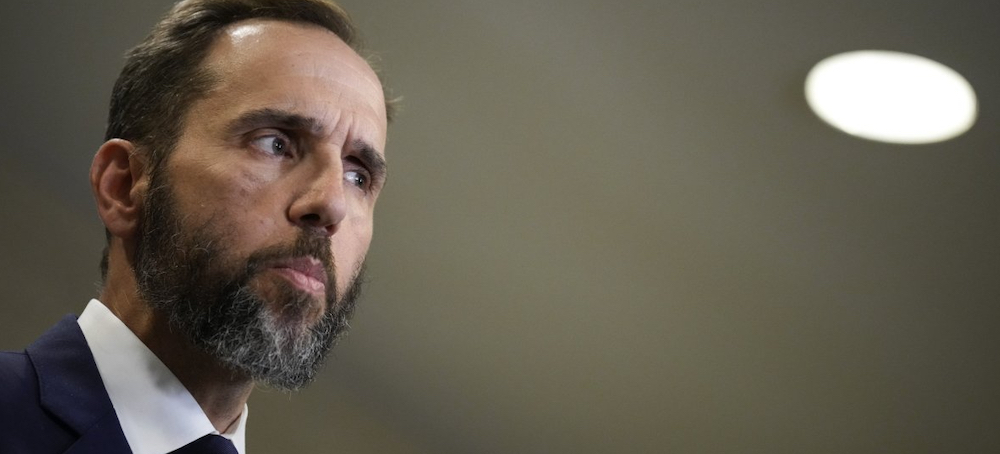 Special Counsel Jack Smith delivers remarks in Washington, DC. (photo: Drew Angerer/Getty Images)
U.S. District Judge Aileen Cannon granted requests from Mr. Trump and two of his former co-defendants in the case, Walt Nauta and Carlos de Oliveira, to issue an order prohibiting the release of the second volume of Smith's report. The order bars Attorney General Pam Bondi or her successors from releasing or sharing that portion of the final report.
Bondi had already determined that the report's second volume shouldn't be released to the public, in part because of questions surrounding the legality of Smith's appointment as special counsel. Cannon, who was overseeing the prosecution of Mr. Trump in the documents case, ruled in July 2024 that Smith was unlawfully appointed special counsel and dismissed the charges against the president.
Smith had appealed that decision, but the case ultimately ended after Mr. Trump won a second term in the White House.
"Special Counsel Smith, acting without lawful authority, obtained an indictment in this action and initiated proceedings that resulted in a final order of dismissal of all charges. As a result, the former defendants in this case, like any other defendant in this situation, still enjoy the presumption of innocence held sacrosanct in our constitutional order," Cannon wrote in her decision. "For obvious reasons, the Court need not take actions in contravention of that protection absent a statutory or other lawful directive to do so."
Cannon, who was appointed to the U.S. district court in South Florida by Mr. Trump during his first term, also wrote that the second volume contains "voluminous discovery" that remains subject to a protective order issued during the early stages of the case.
She said that allowing the release of the report would lead to large amounts of material related to the case becoming public.
"Moreover, while it is true that former special counsels have released final reports at the conclusion of their work, it appears they have done so either after electing not to bring charges at all or after adjudications of guilt by plea or trial," Cannon continued. "The Court strains to find a situation in which a former special counsel has released a report after initiating criminal charges that did not result in a finding of guilt, at least not in a situation like this one, where the defendants contested the charges from the outset and still proclaim their innocence."
Without Cannon's order, Smith's report was set to become public on Tuesday.
Kendra Wharton, one of Mr. Trump's lawyers, said the judge "properly ruled that the broad disclosure of protected grand jury testimony and discovery materials related to a dismissed criminal case, along with the publication of opinions and unproven accusations by an unconstitutional prosecutor, has no place in the American judicial system. Judge Cannon's courage and judicial resolve on these important due process issues should be recognized and taught in law school classrooms across America."
A spokesperson for Smith declined to comment. The Justice Department did not immediately respond to a request for comment.
Mr. Trump and his personal legal team asked Cannon last month to issue an order that would block "current, former and future" Justice Department officials from ever releasing the report.
The Justice Department backed Mr. Trump's request, agreeing that Smith's second report "should not be released outside of the Department of Justice."
"The potential, improper release of Volume II would constitute an irreversible violation of this Court's constitutional rulings in the underlying criminal action and of bedrock principles of the separation of powers," Mr. Trump's attorneys argued.
Justice Department lawyers separately claimed Smith's investigation was "unlawful from its inception."
"Smith not only weaponized the Department of Justice against a leading presidential candidate in pursuit of an antidemocratic end, but he did so without legal authority and while targeting constitutionally protected activity," they wrote.
Prosecutors continued: "Put simply, Smith's tenure was marked by illegality and impropriety, and under no circumstance should his work product be given the full weight and authority of this Department," adding that Bondi has marked the report "an internal deliberative communication that is privileged and confidential and should not be released outside the Department of Justice."
Smith brought two criminal cases against Mr. Trump in 2023. The first stemmed from an alleged effort to subvert the transfer of power after the 2020 presidential election, and the second involved the president's alleged mishandling of sensitive government documents after the end of his first term. Mr. Trump denied wrongdoing and pleaded not guilty to all charges.
Both cases came to an end after Mr. Trump won the presidency again. Smith resigned before Mr. Trump was sworn in for a second term, but before leaving his post, he submitted a two-volume report detailing his investigations to then-Attorney General Merrick Garland.
The report quickly became the focus of legal wrangling. Mr. Trump's two co-defendants in the documents case, Nauta and de Oliveira, attempted to block the release of a portion of Smith's report involving the investigation into the 2020 election.
Their efforts, however, were unsuccessful, and that volume was made public days before Mr. Trump's second inauguration. But the second volume has remained out of the public's view.
Garland had kept that part of the report secret because of ongoing legal proceedings involving Nauta and de Oliveira. But a federal appeals court granted a Justice Department request to drop the case against them last February, bringing it to an end.
Still, Cannon had issued an order last January barring the release of the second volume. The Justice Department, Nauta and de Oliveira said in a court filing last March that "under no circumstances should the court order the release of" the second volume of Smith's report.
Smith testified before Congress last month about his investigations, but primarily discussed his case related to the 2020 presidential election because of the ongoing proceedings in the documents case.
Federal regulations require special counsels to provide the attorney general with a report that explain prosecution or declination decisions once their work is concluded. Final reports from previous special counsels have been made public after their investigations were finished.
Among those disclosed in recent years were Robert Hur's findings from his investigation into former President Joe Biden's handling of classified documents from his vice presidency, which did not lead to charges against Biden. Still, Hur's report was highly critical of the former president, who the former special counsel said could present himself to a jury "as a sympathetic, well-meaning, elderly man with a poor memory."
The Justice Department also released former special counsel John Durham's report from his probe of the origins of the FBI's investigation into Russian meddling in the 2016 presidential election. Three people were prosecuted as a result of Durham's investigation and two of them were acquitted. The third, a former FBI lawyer, pleaded guilty.