Judge Orders Kennedy Center to Remove Trump’s Name From Building
Jonathan Edwards The Washington Post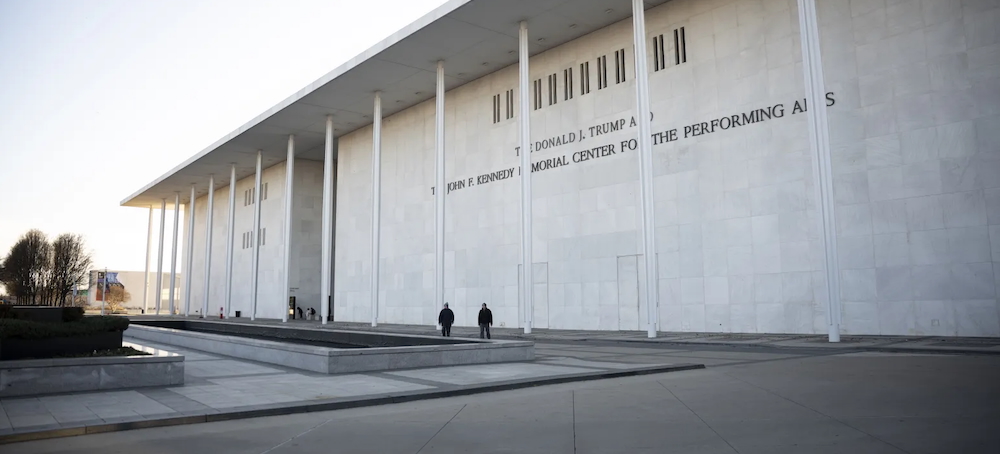 The John F. Kennedy Center for the Performing Arts in Washington, D.C. (photo: Celal Gunes/Anadolu/Getty Images)
ALSO SEE: Judge Says Kennedy Center Board Broke Law Putting
Trump’s Name on Building, Blocks Closure
The ruling also orders the arts institution to halt plans to close for two years starting in July.
In a pair of rulings, U.S. District Judge Christopher Cooper granted in part Rep. Joyce Beatty’s (D-Ohio) request for a preliminary injunction to temporarily block Trump from taking any further steps toward closing the institution. The judge also ordered Kennedy Center officials to remove Trump’s name within two weeks.
The ruling throws the Kennedy Center’s near future into uncertainty, blocking leaders from shutting down the performing arts venue in July after they have canceled most performances in anticipation of the closure.
The decision is the most significant point in two lawsuits filed against Kennedy Center leadership over the Trump administration’s involvement in affairs big and small at the performing arts institution.
In December, Beatty, an ex officio member of the Kennedy Center’s board, sued her fellow trustees days after they voted to rename the institution “The Donald J. Trump and The John F. Kennedy Memorial Center for the Performing Arts.” Beatty said she was muted during the virtual board meeting when she tried to voice opposition to the name change, a claim the center disputed. She later amended the lawsuit to seek a broader halt to the closure, and the court granted her request for key documents related to the renovation plan, including building assessments and budget materials.
Both cases landed before Cooper, who has been pressing both sides on a central question: whether the Kennedy Center renovations must follow the same review process that governs nearly every other major federal construction project in the capital.
A lawsuit filed in March by a group of eight architectural and historical preservation organizations, including the DC Preservation League and the National Trust for Historic Preservation, argues that the center must complete several steps of federal review before work can begin. Those steps include historical preservation consultation under the National Historic Preservation Act, environmental review under the National Environmental Policy Act, and formal approval from the National Capital Planning Commission and the Commission of Fine Arts. No such reviews have begun, the plaintiffs said.
The coalition also alleges that the administration has already caused historic harm to the building without those reviews by repainting its “original and character-defining” 200 gold exterior columns white and affixing Trump’s name to its facade, alterations significant enough to require a federal review process. Because Kennedy Center officials have engaged in “a deliberate pattern” of making harmful changes without going through that process, they said, federal agencies have a legal duty to deny approval to future project applications.
The government countered that the Kennedy Center’s board is not a federal agency subject to those review requirements and that Congress effectively authorized the renovation when it appropriated $257 million for the center’s “capital repair, restoration, maintenance backlog, and security structures” in last year’s One Big Beautiful Bill. Justice Department lawyers also argued that no demolition is planned and that the lawsuit is animated by fears rooted in Trump’s social media posts rather than the actual construction plans.
At an April 29 hearing, the center’s new executive director, Matt Floca, described a building in serious disrepair: failing soffit panels weighing more than a ton each hanging above public walkways, water seeping into electrical vaults and causing corrosion that could spark a fire or explosion, plumbing pipes in systemic failure. He said keeping the center open during construction would be “irresponsible.”
The preservationists pushed back, noting that the center’s own 2022 building plan had contemplated making repairs while remaining open, and that Floca himself had been developing just such a plan until Trump announced the closure on social media in February. Floca testified that he could not speak to the president’s intentions for the building — only his own.
The legal fight is unfolding against a backdrop of broader tumult at the center. Since Trump installed himself as board chair in February 2025, several productions have canceled or withdrawn from the calendar, among them the tour of “Hamilton” and the Washington National Opera, which ended its 55-year residence. Ticket sales and subscriptions have plummeted. Dozens of staff members have been laid off in waves, and a group of remaining employees filed last year to form a union, citing a culture of fear and a lack of transparency from the center’s new leadership.