Judge Halts Construction on Trump’s Ballroom, Says Congress Must Decide
Dan Diamond and Jonathan Edwards Washington Post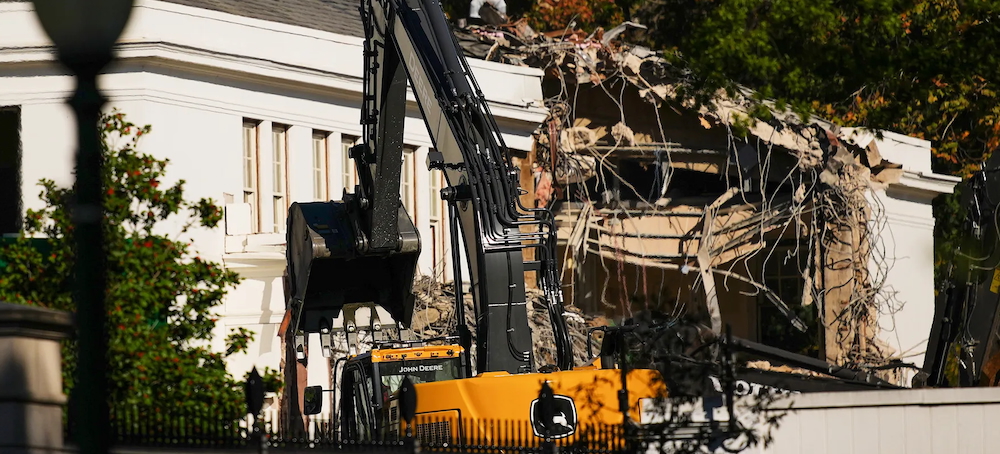 The facade of the East Wing of the White House is demolished by work crews on Oct. 21, 2025. (photo: Andrew Harnik/Getty Images)
ALSO SEE: Judge Orders Trump Administration to Halt White House Ballroom Construction
Judge Richard Leon criticized the Trump administration’s “brazen” arguments for the project. The planned $400 million ballroom has been a presidential priority.
U.S. District Judge Richard Leon disagreed with the Trump administration’s argument that the president has broad authority to make changes to the White House without congressional approval, including projects on the scale of his planned, 90,000-square-foot ballroom.
“The President of the United States is the steward of the White House for future generations of First Families. He is not, however, the owner!” Leon wrote in a 35-page ruling issued Tuesday afternoon.
“No statute comes close to giving the President the authority he claims to have,” he wrote.
Leon, an appointee of President George W. Bush, also wrote that Trump has not identified a law that allowed him to demolish the White House’s East Wing last year without congressional approval.
He stayed his order for two weeks and ruled crews could continue construction necessary to ensure the safety and security of the White House.
Within hours, the Trump administration notified the court it would appeal Leon’s decision, which the White House called “egregious.”
“President Trump clearly has the legal authority to modernize, renovate, and beautify the White House – just like all of his predecessors did,” White House spokesman Davis Ingle said in a statement, adding: “We ... are confident we will prevail.”
Speaking in the Oval Office, Trump told reporters that Leon was “so wrong” for ruling that the ballroom needed congressional approval. He suggested that many parts of the project would move forward, such as the ballroom’s bulletproof glass and anti-drone installations on the roof, citing Leon’s decision that the White House could proceed on efforts to ensure safety and security.
“I’m allowed to continue building as necessary,” Trump said. He also attacked the group that brought the lawsuit, the National Trust for Historic Preservation, on social media.
Carol Quillen, the National Trust’s CEO, said the organization was pleased that the ballroom construction would be halted until the administration “complies with the law” and obtains authorization from Congress.
“This is a win for the American people on a project that forever impacts one of the most beloved and iconic places in our nation,” Quillen said in a statement.
For more than three months, lawyers have battled over whether the president needed congressional approval for his project.
Administration lawyers have argued that Congress implicitly authorized the president to make changes in the White House when it set aside several million dollars for annual maintenance of the president’s residence in a law that allowed for the building’s “alteration” and “improvement.”
Leon sharply rejected that argument in his ruling, noting that the law authorizes the president to spend an annual budget on the building’s “care, maintenance, repair” and specifically cites air conditioning, heating and lighting as examples. He accused administration lawyers of cherry-picking words to support an argument that would allow “tearing down the White House and building a modern skyscraper in its place” so long as the president considered it an “improvement.”
“A brazen interpretation, indeed!” Leon wrote.
Leon had signaled his skepticism of the administration’s claims in several previous hearings. In a March 17 hearing, he expressed frustration after a Justice Department lawyer defended the East Wing’s demolition and the ballroom’s construction by citing past projects at national parks, which Leon said were not comparable.
The White House “is a special place,” he said. “This is an iconic symbol of this nation.”
In February, Leon denied an earlier request for a preliminary injunction sought by the National Trust but invited the organization to revise its challenge. At that time, he said the National Trust had wrongly invoked the Administrative Procedure Act to attempt to block Trump’s project, finding that the law did not apply to the White House executive residence because it is not a federal agency.
Trump subsequently claimed on Truth Social that Leon had “thrown out, and completely erased, the effort to stop” the ballroom’s construction, mischaracterizing the judge’s ruling.
Trump has made the project a top priority, saying that presidents have long needed a permanent space to entertain VIP guests and that he hopes to hold events in the new ballroom before his term ends. The project, which would be nearly twice the size of the 55,000-square-foot executive mansion, represents the most significant change to the White House campus in decades.
Trump on Sunday night showed off new designs for the project, following criticism from architects about some of its features. He also said that the military was building a “massive complex” under the ballroom.
The White House has said the project must go forward, citing matters of national security, but has declined to offer further details. It has long been known, however, that the area underneath the former East Wing contains secure facilities the president and staff members could use in an emergency.
Leon on Tuesday signaled his skepticism of that argument.
“Please! While I take seriously the Government’s concerns regarding the safety and security of the White House grounds and the President himself, the existence of a ‘large hole’ beside the White House is, of course, a problem of the President’s own making,” he wrote.
The way the project is unfolding has raised questions about oversight and transparency. Democrats and watchdog groups have questioned whether ballroom contributors — including major corporations such as Amazon, Google and Palantir that collectively have billions of dollars in contracts before the administration — will receive special access or other perks in exchange for their gifts. (Amazon founder Jeff Bezos owns The Washington Post.) Some Democrats have acknowledged the potential value of renovating the White House grounds but said the ballroom should be far smaller and undergo congressional review.
The National Trust sued the Trump administration in December, arguing that the ballroom project was illegal and calling for a pause until it could undergo public review. The White House subsequently submitted plans to the Commission of Fine Arts, a federal review panel that advises on major design projects. It approved the ballroom on Feb. 19. The National Capital Planning Commission, another review panel, is set to vote on the project on April 2.
Commission spokesman Stephen Staudigl said the judge’s order bars construction, not planning, so commissioners still intend to discuss and vote on the ballroom project at their Thursday meeting.
The deliberation and vote on the East Wing Modernization project is still on NCPC’s agenda for Thursday, April 2, 2026. NCPC is not a direct party to the case, and Judge Leon’s order enjoins construction activities, not the planning process related to NCPC’s meeting. Thus, the commission is expected to deliberate and vote as scheduled on Thursday.
Trump has packed both panels with allies, including his 26-year-old executive assistant.
Lawyers for the National Trust, which is charged by Congress with preserving historic buildings, also focused on Trump’s decision to solicit private donations, saying that the project needed express authorization by Congress.
“Rather than admit that none exists, the Defendants invent a Rube Goldberg machine” to justify proceeding with the project without express congressional approval, the National Trust’s lawyers argued in court filings in January.
Justice Department lawyers have repeatedly defended the project on national security grounds, arguing that any pause could imperil the president. On Feb. 2, they wrote that they planned to immediately appeal any order that would delay the project, asking Leon to pause any injunction until an appeal could take place.
The judge said in January that he expected the case to be appealed, potentially to the Supreme Court, regardless of how he rules.