Judge Blocks Trump’s Federal-Assistance Freeze After Chaos Over Medicaid, Other Funding
Ken Thomas, Kristina Peterson, Liz Essley Whyte and Patience Haggin Wall Street Journal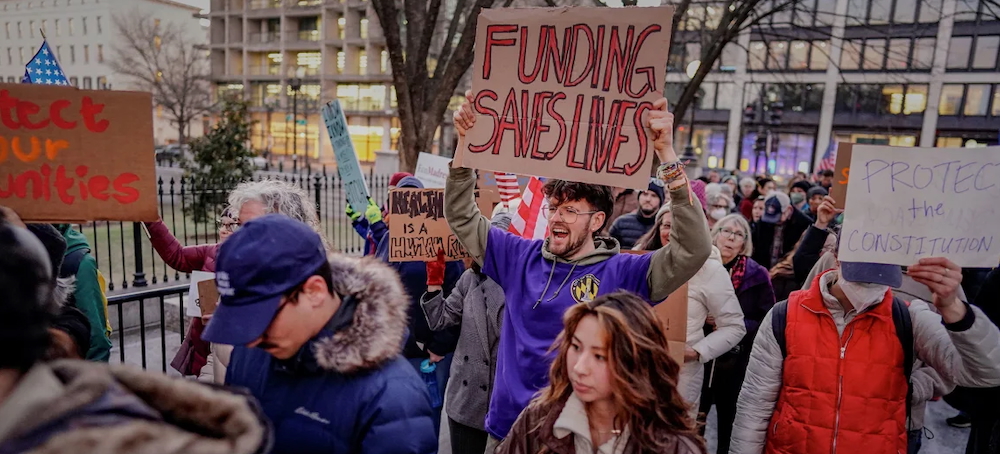 People gather during a rally in support of federal funding and in opposition to President Donald Trump's order to pause all federal grants and loans, near the White House in Washington, DC, Tuesday. (photo: Ken Cedeno/Reuters)
ALSO SEE: Firings, Freezes and Layoffs: A Look at Trump's Moves Against Federal Employees and Programs
White House sought to pause trillions of dollars in federal assistance
The memo, issued to agencies by the White House Office of Management and Budget late Monday, sowed widespread confusion, prompting government officials, lawmakers, nonprofits and others to parse through the two-page document—down to the footnotes—to try to understand which programs would be halted.
The memo’s broad language prompted some federal officials to wonder whether it halted the vast array of federal assistance programs, from Medicaid and nutrition programs for school children to rental assistance and highway funding. Footnotes to the memo exempted Medicare, Social Security benefits and assistance provided directly to individuals—but gave few other clues as to what it covered or didn’t cover.
States including Illinois reported trouble accessing Medicaid funds Tuesday, and Sen. Ron Wyden (D., Ore.) said his staff “has confirmed reports that Medicaid portals are down in all 50 states following last night’s federal funding freeze.”
An Illinois state spokesman said state agencies “have reported to the Governor’s Office issues with accessing federal funding sites and disbursement systems, including Medicaid systems.”
Early Tuesday, the OMB sent a directive, reviewed by The Wall Street Journal, notifying federal agencies that they were required to fill out an attached spreadsheet answering a series of questions about programs that might require funding. The information requested information related to programs with funding or activities planned through March 15.
The move by President Trump to temporarily freeze federal assistance represented his most audacious effort yet to disrupt the nation’s spending priorities, setting up an expected legal clash with Democrats. The memo echoes Project 2025 blueprint, which included a proposal calling for the U.S. Environmental Protection Agency to “institute a pause and review for all grants over a certain threshold.” Russ Vought, a Project 2025 author and Trump’s nominee to lead OMB, recently made similar arguments to confront “government waste.”
Vought hasn’t yet been confirmed by the Senate.
Trump campaign officials discussed the freeze as early as last year, a person familiar with the discussions said. And campaign staff and allied groups helped draft lists of specific grants they considered to be ideological wastes of government money, with the discussions anticipating widespread panic.
Aides on Capitol Hill said Republican lawmakers who write the annual spending bills weren’t given a heads-up about the unexpected OMB move.
Nonetheless, Rep. Dusty Johnson (R., S.D.), said: “This shouldn’t surprise anybody. Donald Trump was talking about doing this throughout the campaign,” adding: “Listen, this guy wants to change how D.C. operates, and I think we need to work through this process to figure out what’s best.”
The federal government spent more than $3 trillion on federal assistance, such as grants and loans, in the fiscal year 2024, according to the memo, which didn’t say where that figure came from.
For the current fiscal year, which ends Sept. 30, the government is expected to spend about $7 trillion, according to the nonpartisan Congressional Budget Office.
“There’s real people that depend on these grants, and real people with real jobs, with missions, and I’ve heard from people in my district this morning asking me about it,” said Rep. Don Bacon (R., Neb.), who represents a competitive Omaha-area district. “All I could say right now, I hope it’s short lived.”
The memo said that agencies “must temporarily pause all activities related to obligation or disbursement of all Federal financial assistance, and other relevant agency activities that may be implicated by the executive orders, including, but not limited to, financial assistance for foreign aid, nongovernmental organizations, DEI, woke gender ideology, and the green new deal,” the memo said. The memo refers to programs promoting diversity, equity and inclusion, as well as Democratic climate-related initiatives.
The memo cited the ability to provide exemptions “on a case-by-case basis,” adding to the confusion. The temporary pause becomes effective on Tuesday at 5 p.m., the memo stated.
The pause jeopardizes “billions upon billions of community grants and financial support that help millions of people across the country,” said Senate Minority Leader Chuck Schumer (D., N.Y.), one of several Democrats who criticized the pause. “It will mean missed payrolls and rent payments and everything in between: chaos for everything from universities to nonprofit charities, state disaster assistance, local law enforcement, aid to the elderly, and food for those in need.”
Democrats said the move by the Trump administration raised constitutional questions, violating Congress’s power of the purse and ability to ensure funding for priorities through the appropriations process.
The exception for programs that pay individuals directly appeared to spare the food stamps program, which helps low-income people afford food.
The OMB order isn’t expected to curtail Pell grants and federal student loans, according to Madison Biedermann, a spokeswoman for the Education Department.
But grant recipients of Head Start are currently not able to draw down any funds, said Yasmina Vinci, executive director of the National Head Start Association. The federal Head Start program, which provides early childhood education to low-income children, serves nearly 800,000 children and their families nationwide, according to the group.
State officials said they were particularly concerned about how the order might affect Medicaid, the health-benefit program for lower-income Americans. Medicaid is funded by a combination of state and federal money and covers about 80 million people, including an affiliated program for children.
“Even a ‘pause’ broadly applied will cause real, measurable and immediate harm to people,” said Kody Kinsley, a former North Carolina health secretary.
Some former officials of the Centers for Medicare and Medicaid Services, the agency that oversees Medicaid, said they believe that Medicaid disbursements would be exempt because the memo said that the pause only applies where permitted by law. Medicaid payments are subject to statutes and contracts with states.
But several former federal health officials said its implications for Medicaid remained unclear.
“The memo is very confusing, and states and Medicaid providers will need to get clarification from the administration about whether Medicaid funds are clearly included in the memo,” said Thomas Barker, a CMS chief legal officer in the George W. Bush administration. “If they are, that would be devastating for the Medicaid program.”
The order requires each federal agency to complete a comprehensive analysis of all of their federal financial-assistance programs “to identify programs, projects and activities that may be implicated by any of the President’s executive orders,” the memo said.
The pause must be applied “to the extent permissible under applicable law,” according to the memo. Agencies must immediately report to the OMB any legally mandated actions or deadlines that arise while the pause remains in effect, it said.
Agencies must submit detailed information on all paused programs, projects and activities to the OMB by Feb. 10.