Jesse Jackson, Civil Rights Leader Who Sought the Presidency, Dies at 84
Peter Applebome The New York Times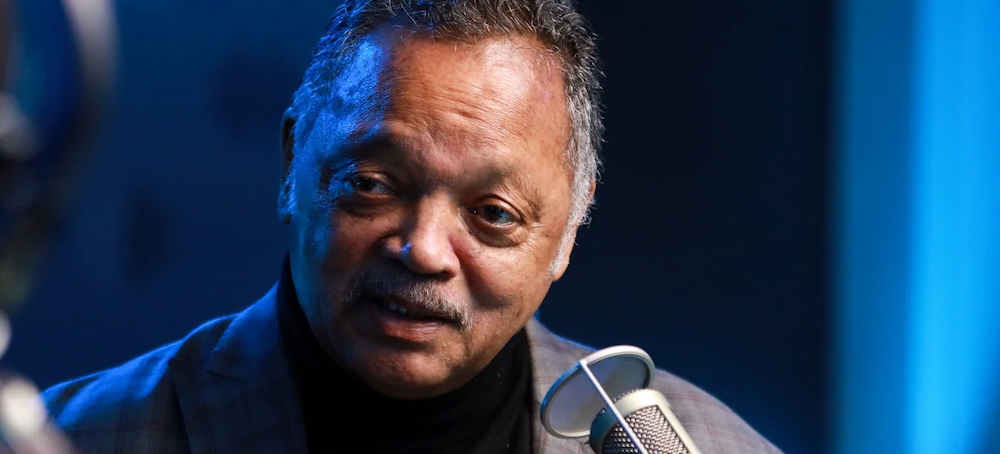 The Rev. Jesse Jackson died Tuesday at the age of 84. (photo: Jason Mendez/Getty Images)
ALSO SEE: Longtime Civil Rights Leader the Rev. Jesse Jackson Dies at 84
An impassioned orator, he was a moral and political force who formed a “rainbow coalition” of poor and working-class people. His mission, he said, was “to transform the mind of America.”
His death was confirmed by his family in a statement, which said that Mr. Jackson “died peacefully” but did not give a cause or say where he died.
Mr. Jackson was hospitalized in November for treatment of a rare and particularly severe neurodegenerative condition, progressive supranuclear palsy (PSP), according to the advocacy organization he founded, the Rainbow PUSH Coalition. In 2017, he announced that he had Parkinson’s disease, which in its early stages can produce similar effects on bodily movements and speech.
Mr. Jackson picked up the mantle of Dr. King after his assassination in 1968 and ran for president twice, long before Mr. Obama’s election in 2008. But he never achieved either the commanding moral stature of Dr. King or the ultimate political triumph attained by Mr. Obama.
Instead, through the power of his language and his preternatural energy and ambition, he became a moral and political force in a racially ambiguous era, when Jim Crow was still a vivid memory and Black political power more an aspiration than a reality.
With his gospel of seeking common ground, his pleas to “keep hope alive” and his demands for respect for those seldom accorded it, Mr. Jackson, particularly in his galvanizing speeches at the Democratic conventions in 1984 and 1988, enunciated a progressive vision that defined the soul of the Democratic Party, if not necessarily its policies, in the last decades of the 20th century.
It was a vision, animated by the civil rights era, in which an inclusive coalition of people of color and others who had been at the periphery of American life would now move to the forefront and transform it.
“My constituency is the desperate, the damned, the disinherited, the disrespected and the despised,” Mr. Jackson said in the rolling cadences of the pulpit at the 1984 Democratic National Convention in San Francisco. “They are restless and seek relief.”
His transcendent rhetoric was inseparable from an imperfect human being whose ego, instinct for self-promotion and personal failings were a source of unending irritation to many friends and admirers and targets for derision by many critics. Mr. Jackson, the writer and social commentator Stanley Crouch once said, “will be forever doomed by his determination to mythologize his life.”
Still, he offered an expansive vision of American opportunity that admirers say helped change the nation’s landscape of possibility. And his idea of a multiracial coalition empowered by an activist government to confront rampant inequality in American life remains central to the progressive wing of the Democratic Party and has inspired groups like Black Lives Matter.
A Son of Greenville
Nothing about Mr. Jackson was simple, starting with his upbringing.
He was born Jesse Louis Burns on Oct. 8, 1941, in Greenville, S.C. His mother, Helen Burns, was 16 at the time, a high school majorette renowned in town for her coloratura soprano singing voice. His father, Noah Louis Robinson, was a handsome, imposing 33-year-old former boxer who lived next door, married to another woman. That he was not involved in his son’s rearing was a source of humiliation for Jesse as he grew up in his small, segregated Black community.
In 1943, his mother married Charles Jackson, whom she had met while he was a shoeshine attendant at a barbershop, before he joined the Army. Mr. Jackson did not adopt Jesse until 14 years later. When the couple had a son of their own, Jesse was sent to live with his maternal grandmother in a shotgun shack around the corner.
Rejected by his father and not fully embraced by his stepfather, he was taunted by other children, all while learning the racial caste system of the segregated South. Years later, he recalled the two water fountains at Claussen’s bakery, where he worked on Saturday mornings, and the first time his mother led him to the back of the bus.
At the same time, he stood out for his energy, intelligence and athleticism. “He was an uncommonly nervy little fellow, never abashed at all,” Vivian Taylor, a high school English teacher in Greenville, told Marshall Frady for his sprawling 1996 biography, “Jesse: The Life and Pilgrimage of Jesse Jackson.” She added, “He thought a whole lot of himself right off the bat.” As another friend, Leroy Greggs, told Mr. Frady, “He could talk a hole through a billy goat.”
After graduating from high school in 1959, Mr. Jackson enrolled at the University of Illinois Urbana-Champaign on a football scholarship, an opportunity that allowed him to escape Jim Crow for the first time.
He soon experienced what he later described wryly as “the legendary liberalism of the North.” He had never been called the most hurtful racial slur in the South, he said, but he was taunted with it by college students in the North. “It was the same thing as South Carolina,” he said, “just way off somewhere else.”
His bravado shaken, he transferred after his freshman year to what is now North Carolina Agricultural and Technical State University, a historically Black institution in Greensboro. There he found the familiar cadences of Southern life; friends recalled the gospel music of Mahalia Jackson pouring out of his room. He became a leader in his fraternity and eventually president of the student body. And he fell in love with a vibrant, high-energy student named Jacqueline Lavinia Brown, known as Jackie.
They married on New Year’s Eve in 1962. Soon, their first child was born, a daughter they named Santita. Four more children followed over the next 12 years.
Mr. Jackson went home to something else as well: the early stirrings of the civil rights movement. The winter before he arrived, in February 1960, four students from the agricultural college had sat down at the segregated lunch counter of the Woolworth’s store in downtown Greensboro.
For a time, Mr. Jackson resisted being drawn into the protests. When he did join, he became a leader. In June 1963, he led a march that drew hundreds of students downtown and was arrested the next day, turning the occasion into something of a political coming out party.
In what seems, in retrospect, both a homage to Dr. King and a gesture of either characteristic ambition or characteristic egotism, while in jail for a day Mr. Jackson sketched out a one-page “Letter From a Greensboro Jail,” modeled after Dr. King’s famous “Letter From Birmingham Jail,” which had been published a month earlier. (It’s not clear if Mr. Jackson ever finished the letter, and it does not appear that it was ever published.)
As an undergraduate, Mr. Jackson considered becoming a lawyer but decided to enter the ministry instead. After graduating from college in 1964, he enrolled at the Chicago Theological Seminary.
It was an impossible time for someone with Mr. Jackson’s passions to be lost in scholarly contemplation. Stunned by the beatings of Black demonstrators in Selma, Ala., in March 1965, he climbed atop a table in the seminary’s cafeteria and challenged other students to join him on a trip there.
About 20 students and a third of the faculty took him up on the call, and they all headed South. There, Mr. Jackson offered his services to members of Dr. King’s inner circle in the Southern Christian Leadership Conference, irking a few of them by acting as if he were in a position of authority. He met Dr. King and went home transformed.
On to Chicago
Six months after Selma, while still pursuing his studies, Mr. Jackson became, at 24, the youngest S.C.L.C. staff member. He was chosen to head the Chicago chapter of the S.C.L.C.’s Operation Breadbasket, a national economic development campaign whose goal was to use boycotts as a way to pressure white businesses to hire Black workers and to purchase goods and services from Black contractors.
By 1967, he was gaining a national reputation as he promoted the program. Six months before graduating, he quit his seminary studies to plunge into the civil rights movement full time. (He was later ordained by the minister of a Chicago church after he went to work for Dr. King.)
Dr. King became an intellectual and a spiritual model for Mr. Jackson, as well as a father figure. “Jesse,” said the Rev. Ralph David Abernathy, perhaps Dr. King’s closest associate, “wanted to be Martin.”
For all his zeal, Mr. Jackson became the most controversial member of Dr. King’s inner circle. Though he was part of the leadership, he was also, with his base in Chicago, almost an independent actor. His ego, charisma and ability to generate press for himself left others in the S.C.L.C. suspicious of his ambitions and led to clashes, even with Dr. King.
It all came to a climax in April 1968, when Dr. King went to Memphis to show support for striking garbage workers. Dr. King was outside his second-floor room at the Lorraine Motel bantering with S.C.L.C. colleagues in the parking lot below before going out to dinner when a single rifle shot shattered the moment.
What happened next shadowed the way Mr. Jackson was viewed for decades. He was one of several aides who rushed toward Dr. King after he was shot. Later that night, Mr. Jackson hurried back to Chicago, parts of which were in flames in the unrest that followed the assassination. The next morning, he appeared on the “Today” show wearing the olive turtleneck sweater, blotted with blood, that he had worn the day before in Memphis. At a memorial convocation of the Chicago City Council that day, he declared, “I come here with a heavy heart because on my chest is the stain of blood from Dr. King’s head.” He added: “He went through, literally, a crucifixion. I was there. And I’ll be there for the resurrection.”
At least once publicly, he indicated that he was the last person to speak with Dr. King and that he had held his bloodied head as Dr. King lay dying. Others who were there said it never happened. Mr. Jackson’s account changed over time, from cradling Dr. King’s head to reaching toward it.
If Mr. Jackson had been a figure of suspicion before, he became an object of outrage after Dr. King’s death. Some in Dr. King’s inner circle — including his eventual successor, Mr. Abernathy, and Hosea Williams, both of whom rushed to Dr. King when he was shot — questioned the accuracy of Mr. Jackson’s account and resented what they saw as his calculated grab to seize the spotlight as the First Mourner.
Their misgivings were not misplaced. Don Rose, a political consultant who worked with Mr. Jackson, said in a recent interview that almost immediately after returning to Chicago, Mr. Jackson was making the case that his youth and energy made him the logical person to inject new life into the movement rather than the somewhat stodgy older members of Dr. King’s inner circle.
Other observers said that some of those who were most critical of Mr. Jackson had made their own plays for attention, and that so many conflicting accounts emerged from the chaos following the shooting that it was hard to be certain precisely what role anyone had played. Even some of those most incensed at the time tried to make their peace with it.
“I hope God has forgiven him,” Mr. Abernathy told The New York Times in 1987 as Mr. Jackson was preparing for a second presidential run. “He has had time to pray. He is a different man now.”
Mr. Jackson largely avoided discussing what he called the “slanders” directed at him, but he indicated that they reflected a misunderstanding of his actions and words as well as the rifts in the S.C.L.C. that preceded Memphis. Still, if Mr. Jackson’s perceived attempt to seize Dr. King’s mantle struck some as unseemly, it presaged in large part what was to come. If no one could replace Dr. King, Mr. Jackson was the one who spent most of his life trying.
After Dr. King’s death, Mr. Jackson repeatedly clashed with Mr. Abernathy, the new head of the S.C.L.C. In late 1971, their relationship fell apart entirely after Mr. Abernathy suspended Mr. Jackson for 60 days for “administrative improprieties and repeated acts of violation of organizational policy.”
Politics Beckoned
Freed from the institutional hierarchy of the S.C.L.C., Mr. Jackson became a ubiquitous presence in American life, promoting social justice causes almost nonstop across the United States and overseas, in South Africa, Haiti, the Middle East and elsewhere. Before long, his focus had shifted almost inevitably to a new area: politics.
As early as 1971, he flirted with the idea of starting a new political party. In 1980, he became a tireless campaigner for President Jimmy Carter in his unsuccessful re-election bid. It set the stage for his becoming invaluable to the Democratic Party for his success in registering Black voters.
In 1984, Mr. Jackson decided it was time to campaign for himself — as the second Black candidate from a major party to run for president, after Shirley Chisholm, the former congresswoman from Brooklyn, in 1972. He established the National Rainbow Coalition as a vehicle for a populist campaign.
That campaign illustrated the potential of an insurgent Black politician and the land mines strewn in front of him. His informal globe-trotting diplomacy, particularly his prominent role in 1984 in securing the release of a Navy lieutenant, Robert O. Goodman Jr., who was imprisoned in Lebanon after his plane was shot down, made him at once a political force and an international figure who transcended politics. So potent was his voice that his ardent promotion of the term African American, to honor the origins of the descendants of an enslaved people, influenced the nation’s very vernacular of the time.
Three weeks after launching his presidential campaign, in informal conversations with Black reporters, he used the offensive terms “Hymie” and “Hymietown” to describe the Jewish population in New York City. The words, reported 37 paragraphs deep in an analytical article in The Washington Post, set off a furor that would hang over him for years. And his initial reluctance to distance himself from Louis Farrakhan, the Nation of Islam leader who had made antisemitic remarks himself, only added to his problems — although he stated in 1984 that criticism Mr. Farrakhan had made of Israel was “reprehensible.”
Still, fueled by Black voters, particularly in the South, whom he had helped register in historic numbers, Mr. Jackson stunned many political observers with the strength he showed in the 1984 race for the Democratic presidential nomination, emerging as the first Black candidate to become a serious contender in a national contest.
Mr. Jackson picked up 3.2 million votes in primaries, third behind Senator Gary Hart of Colorado and former Vice President Walter F. Mondale, the eventual nominee. And his dramatic 50-minute speech to the convention at the Moscone Center in San Francisco was perhaps the emotional high point of the doomed Democratic campaign against the popular incumbent, Ronald Reagan.
He tried again in 1988, and this time he began as a party heavyweight. In the Super Tuesday primary on March 8, he ran first or second in 16 of the 21 primaries and caucuses. Party leaders, fearing they could not win a general election with an assertively left-wing Black presidential candidate, desperately looked for an alternative. In the end, Gov. Michael S. Dukakis of Massachusetts won the nomination, even though Mr. Jackson had earned almost seven million primary votes — 29 percent of the total.
The party’s convention, in Atlanta, was bittersweet. Mr. Jackson campaigned hard for the vice-presidential nomination and was disappointed not to be picked. But again, a televised speech he delivered electrified the convention.
This time, weaving his own story of overcoming poverty and abandonment with the aspirations of those represented by his Rainbow Coalition, coming back again and again to the search for “common ground,” he spoke, as if personally, to all those at the forgotten corners of American life.
“Call you outcast, low down, you can’t make it, you’re nothing, you’re from nobody, subclass, underclass,” he said, “when you see Jesse Jackson, when my name goes in nomination, your name goes in nomination. I was born in the slum, but the slum was not born in me. And it wasn’t born in you, and you can make it.”
The speech, which he concluded by four times shouting out “Keep hope alive!,” was immediately hailed as an American political classic.
A Voice From the Left
Mr. Jackson found himself unsure about where to go from there. At times he considered running for the Senate from South Carolina or for mayor of Washington, but he decided against another political campaign, giving fuel to those who saw his failure to hold public office as a mark against him.
“Jesse don’t want to run nothing but his mouth,” Mayor Marion S. Barry Jr. of Washington was quoted as saying in The Los Angeles Times in 1990.
Mr. Jackson won his first election later that year, when he captured one of two special unpaid “statehood senator” posts created by the Washington City Council to lobby Congress for statehood for the District of Columbia. The position brought no ability to enact legislation or shape policy. To some, he was trying to play by the old rules of moral suasion and extragovernmental activism when power was increasingly shifting to Black politicians like Mayor Harold Washington of Chicago and later a young United States senator, also from Illinois, named Barack Obama.
(Over Mr. Jackson’s last decades, it was Representative John Lewis, wielding power from the more traditional political platform of the Georgia congressional seat that he held for 17 terms, who was widely viewed as the most admired living veteran of the civil rights era.)
Mr. Jackson decided against a third presidential run in 1992, when Democrats took back the White House behind Bill Clinton. Mr. Clinton made him a special envoy to Africa and, in 2000, awarded him the Presidential Medal of Freedom, the nation’s highest civilian honor.
As the Democratic Party struggled to adjust to a nation moving to the right, Mr. Jackson became a voice of the marginalized American left, pushing back at the prevailing political winds in speaking out for antiwar and social justice causes.
He also faced personal controversies and crises. In 2001, it was revealed that he had fathered a child, Ashley Jackson, in 1999 with a woman who had worked for his advocacy group, now called, after a merger, the Rainbow PUSH Coalition. During Mr. Obama’s presidential run in 2008, Mr. Jackson had to apologize and was rebuked by his own son, Representative Jesse Jackson Jr., for derisive remarks he had made about Mr. Obama that were picked up by an open microphone.
If Jesse Jackson Jr. had become part of his father’s legacy, he was also a source of dismay when the son resigned from Congress in 2012 and was sentenced to 30 months in prison for spending $750,000 from his campaign on personal items.
Mr. Jackson requested that President Joseph R. Biden Jr. pardon Jesse Jr. in 2024 in an appeal that mentioned Mr. Biden’s pardon of his own son, Hunter. The request was denied. In October, Jesse Jackson Jr. announced that he would seek to regain his seat representing Illinois’s Second Congressional District in this year’s midterm election.
In addition to his son Jesse Jr., Mr. Jackson’s survivors include his wife; his other children, Santita, Jonathan, Yusef, Jacqueline and Ashley; and a number of grandchildren.
The elder Mr. Jackson continued his political work, including efforts to promote Black economic inclusion in Silicon Valley and on Wall Street, though some companies objected to what they viewed as pressure tactics by his organizations in raising money. The companies complained that the groups would first publicly criticize them over their records on minority contracting or serving low-income consumers and then turn around and accept grants from those same companies, some of which contracted with minority concerns run by Mr. Jackson’s friends.
Mr. Jackson said his organizations had done nothing improper. “The same people that you challenge one day, once they come around and honor the law, then we build relationships with them,” he told The New York Times in 2001. “Of course that’s what we do. It is legal, appropriate and effective.’”
In later years, groups like Black Lives Matter brought new faces and energy to causes that Mr. Jackson had once championed, and the presidency of Donald J. Trump presented an unwelcome counterweight to his life’s work.
Mr. Jackson was 76 when he announced in November 2017 that he had been diagnosed with Parkinson’s disease and that he would be taking time to focus on his health. His diagnosis of progressive supranuclear palsy, which shares some symptoms with Parkinson’s, was announced in April last year.
But he remained active, and as recently as August 2021, at 79, he was among the activists arrested in Washington while protesting voting restrictions that were being pushed by Republicans nationwide.
He officially retired from his role leading the Rainbow PUSH Coalition in 2023. But he continued to participate in rallies and public events. In 2025, he joined a boycott of Target after the company rolled back its D.E.I. program. The year before, he went to Racine, Wis., to encourage young people to vote in the presidential election.
A Vision Unrealized
To some, Mr. Jackson’s unrealized aspirations reflected his own limitations as a charismatic public figure whose instinct for improvisational, media-focused politics left him with no appealing final act. And for all his rhetorical thunder, the Democrats never fully embraced his vision of an unashamedly liberal party based not on the white middle class but rather on his coalition of poor and working-class people of all colors.
Clayborne Carson, a history professor at Stanford University and director of the Martin Luther King Jr. Research and Education Institute, said Mr. Jackson had suffered in large part from being caught between two eras — too late to be an unambiguously heroic figure like Dr. King, too early to succeed at the highest levels in politics like Mr. Obama.
But Mr. Jackson had played a critical role, Professor Carson said, in translating the voting rights gains of the 1960s into a political reality that made possible a Black president far sooner than many would have expected.
“Jesse Jackson played as central a role in his era as King did in his era,” he said in an interview for this obituary in 2012. “But it was not the kind of heroic struggle as in the 1960s. You’re not going to get a Nobel Prize for what Jesse Jackson did, but it took a lot of talent, initiative, energy, imagination and charisma, and he had those in full supply.’’
Similarly, Mr. Rose, the Chicago political consultant, who also worked with Jesse Jackson Jr., said that the successes of the father, more than his failings, were what undid him: In helping to kick down racial barriers to electoral success without winning office himself, he was left with limited political options.
“He was kind of a victim of his own success,” Mr. Rose said in an interview. “He was really a moral leader rather than an elected leader, but we now look to elected leaders to address our problems. A picket line is not going to change the voter laws in Florida.”
Mr. Jackson, too, described himself as more a moral leader than a political one. “My mission has been to transform the mind of America,” he told a convention of Black lawyers in Washington in 1988. “It’s not just politics — small p — as in delegates and votes. But politics — big P — as in transforming our minds and changing our self-concept.”
If Mr. Jackson never realized his grandest dreams, Professor Carson said, he was not alone in falling short.
“In his best imagination,” he said, “he saw himself as someone who could bring the country together, appeal to working-class whites as well as poor Blacks, unite them around economic change. But that’s been a dream in American politics for as long as there has been American politics. When that dream has to confront reality, it’s a hard bridge to cross.”
Still, if Mr. Jackson’s political journey remained painfully unfinished, his aspirations and frustrations are as relevant to American politics now as they were during his “Keep hope alive” speech to the Democratic National Convention in 1988.
At one point in that speech he told a story about his grandmother in Greenville. She could not afford a blanket, he said, but she did not complain, and the family did not freeze. Instead, she took pieces of old cloth — patches of wool, silk, gabardine, croker sack — “only patches, barely good enough to wipe off your shoes with,” and she sewed them together into a quilt, “a thing of beauty and power and culture.” He implored Democrats to build such a quilt.
“Be as wise as my grandmama,” he said. “Pull the patches and the pieces together, bound by a common thread. When we form a great quilt of unity and common ground, we’ll have the power to bring about health care and housing and jobs and education and hope to our nation. We, the people, can win.”