JD Vance’s Appalachian Graveyard
Elizabeth Catte In These Times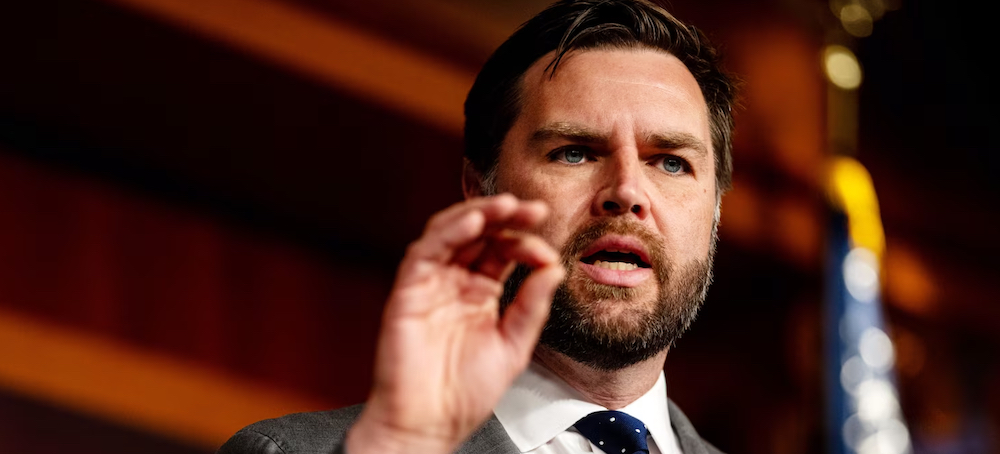 Sen. JD Vance gestures while speaking during a news conference on Capitol Hill on May 22, 2024 in Washington, DC. (photo: Kent Nishimura/Getty Images)
The Republican VP nominee’s politics of blame were never meant to help the working class.
Hillbilly Elegy told the story of a young man from a marginalized region who overcame the odds to become a Yale graduate and Silicon Valley venture capitalist. It also pantomimed analysis enough that readers could nod along as Vance described his neighbors in Ohio and Kentucky as social detritus doomed by their own personal failings and struggles with addiction and poverty.
Vance’s rise to fame came courtesy of the bipartisan myth that a self-directed person unshy of hard work could overcome the structural and traumatizing realities of poverty. His autobiography is the bootstrap narrative at its most classic, painting Vance as a survivor of not only a broke childhood but also a community devoid of “a single person aware of his own laziness.” Hillbilly Elegy allowed readers to feel culturally connected to Trump voters without having to think deeply about issues such as addiction, poverty and abuse that are nominally at the heart of the book. After all, J.D. turned out alright. Didn’t he? Sales of his book now total at least 1.6 million copies.
At the time, Vance’s celebrity appeal rested on his unthreatening persona as a messenger who could explain Trump’s popularity among the white working class while in the same soundbite condemning it. In 2016, he told NPR’s Terry Gross, “My dad is a Trump supporter, and I love my dad, and I always say, ‘Dad, you know, Trump is not going to actually make any of these problems better.’ And he says, ‘Well, that’s probably true, but at least he’s talking about them and nobody else is, and at least he’s not Mitt Romney.’” The apparent duality of his willingness to both sympathize with and challenge Trump supporters was intoxicating to liberals, who contrived to make Vance their token conservative both on stage and behind the scenes.
As a close observer of the Vance phenomenon, I would be hard-pressed to find anything out of place with Vance’s story about his first years of fame. The Vance I saw then was an ego-driven young man who stood out more for his unaddressed childhood trauma — his mother’s struggles with addiction and what he later came to recognize as various Adverse Childhood Experiences — than his political smarts, eagerly taking every opportunity offered to prove how far he’d come by calling the rest of us hillbillies losers forever.
In other words, it didn’t seem like Vance was having a bad time during those years. He had an enviable education, powerful friends, a talented wife, a bestselling book, a standing invitation to both Fox & Friends and Rachel Maddow’s MSNBC, plus access to enough capital to make the Appalachian Regional Commission’s annual grants budget look like a tip jar. Meanwhile, a lot of people in Appalachia ran out of creative ways to call him an asshole and a creep.
According to his New York Times interview, however, there was a hidden price to his celebrity: having to share intimate spaces with liberals who tested the limits of his conservative sympathies. His moment of clarity, he said, came at a 2018 gathering hosted by the Business Roundtable, a CEO lobbying group, as Vance sat next to an executive who opposed Trump’s immigration policies, but only to the extent that they interrupted his access to cheap labor. That the executive assumed he would be more sympathetic to his plight than that of the U.S. workers undercut by such practices made Vance realize, he told Douthat, that he was “on a train that has its own momentum and I have to get off this train, or I’m going to wake up in 10 years and really hate everything that I’ve become.”
Instead, Vance returned to venture capitalism that year, joining forces with AOL’s Steve Case to promote businesses in the Rust Belt and Appalachia. Three years later, he entered politics, with the ambitious goal of winning the seat of retiring Republican Sen. Rob Portman. His Silicon Valley connections proved fruitful during the race, as tech ultra-donors like Peter Thiel and David Sacks heavily funded his campaign. He also worked to forge a new alliance with the Trump movement he’d formerly disdained.
Trump was “well aware that I criticized him in 2016,” Vance explained at the time in an interview with NBC. But, he continued, Trump was “also well aware that I’ve been on TV the last few years defending critical parts of his agenda when other people were not.” Trump appeared to appreciate the transformation, declaring at a 2022 rally, “J.D. is kissing my ass. Of course, he wants my support,” before delivering his endorsement: that “The entire MAGA movement is for J.D. Vance.”
But even after winning, his ambition didn’t seem to wane. In 2023, labor historian Gabriel Winant predicted that Vance “will torture the rest of us until we agree to make him President to prove that there is nothing wrong with him.” Now in second place on the Republican ticket, today’s Vance the senator and vice presidential nominee appears to have a different set of politics from those of Vance the memoirist — at least superficially.
Politico writer Ian Ward has described Vance’s ascendancy as a victory for the New Right: a “rag-tag band of conservative intellectuals” who reject “the GOP’s traditional fusion of free-market fundamentalism, small government libertarianism and foreign policy interventionism in favor of a program that combines some elements of economic populism with ultra-traditionalist social conservatism and a more restrained foreign policy.”
Put more plainly, Vance is the face of a new conservative clique of the bookish super-elite, many with ties to Yale, who promote nationalism and a regressive social agenda on issues like abortion rights and immigration, all wrapped in claims of a more working class-friendly GOP.
No matter his professed empathy, Vance, like Trump, has no real warmth for the people he claims to represent. Hillbilly Elegy, as Vance’s first claim to a political ideology, blamed poor people for their poverty. The new iteration of his politics blames a phantom class of pro-globalist elites for poverty.
In both versions, however, the only real Americans are the ones who reproduce the next ruling class. This preoccupation — which appears in Elegy through eugenics-tinged suggestions about genetically inherited failure — has translated to a set of politics that is anti-abortion, anti-LGBTQ+, anti-immigration and anti-bodily autonomy. (Vance opposes abortion rights even in cases of rape and incest as well as amnesty for immigrants.) The collective harm such politics imply is immaterial to Vance, who sees his own lingering traumas as having been resolved by starting a family of his own. (“Usha has learned how to manage me,” he writes of his wife in Elegy.)