It Sure Does Look Like Someone Blew Up a Major Gas Pipeline Connecting Europe and Russia
Kevin T. Dugan New York Magazine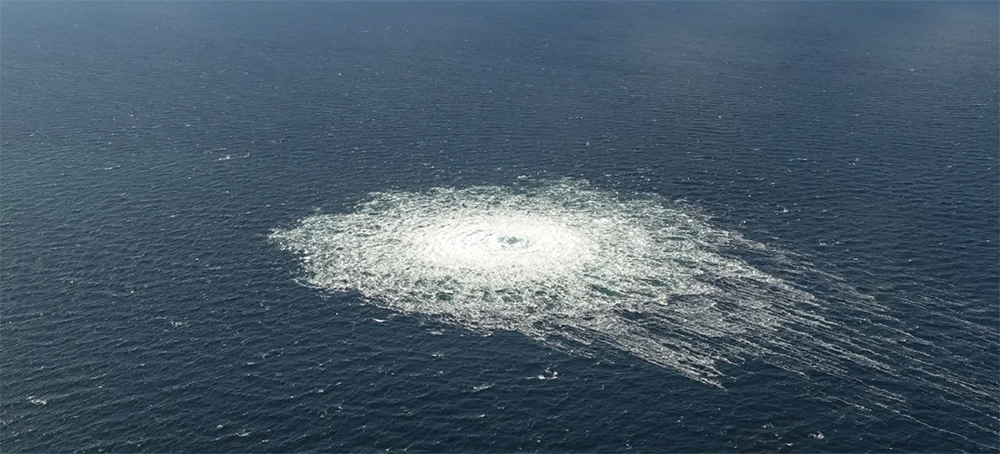 Nord Stream pipeline. (photo: Danish Defence)
Billeder fra F-16 af gaslækage i Østersøen. https://t.co/OgCDfcvTjG pic.twitter.com/D5wsoXvuda
— Forsvaret (@forsvaretdk) September 27, 2022
This was sabotage, according to German and Polish officials. “We can’t imagine a scenario that isn’t a targeted attack. Everything speaks against a coincidence,” a German official told the newspaper Tagesspiegel. Even the Kremlin’s spokesman said yes, this sure does look like that. Underground oil pipelines like these — which hug the floor of the sea — don’t typically leak, as each segment of pipe is coated in concrete and weighs about 24 tons. The operator of the pipelines hasn’t said anything definitive yet, except that there was “a pressure drop on both strings of the gas pipeline” and that it was investigating. [Update: Nord Stream later said that the leaks lead them to “a strong assumption” that the pipeline was physically damaged, and that a perimeter of five nautical miles has been established around the leaks.] As Bloomberg columnist and energy expert Javier Blas points out, natural or more prosaic explanations for the leaks are unlikely.
The two areas of the leaks is so far apart (~75 km) that natural events (like subsea mudslides or earthquakes) can be almost certainly ruled out. The same goes about ships dragging anchor or fishing nets from trawlers, or a submarine colliding by chance. This is deliberate.
— Javier Blas (@JavierBlas) September 27, 2022
The evidence so far is pointing toward some kind of deliberate explosion. The Swedish National Seismic Network said that it detected blasts in the Baltic Sea. “There is no doubt that these are blasts or explosions,” Björn Lund, a seismologist with the Network, told SVT, a Swedish news site. European officials are still investigating the blast, however, and it could take as long as a week to stop the gas leak.
#BREAKING: Swedish National Seismology Centre measurement stations in Sweden and Denmark registered subsea blasts in areas of Nord Stream gas leaks on Monday - SVThttps://t.co/4yAXglCq1w
— I.E.N. (@BreakingIEN) September 27, 2022
So why is this happening now? That is still unclear. Late on Tuesday, Der Spiegel reported, and the New York Times confirmed, that the C.I.A. had given some non-specific warnings to a few countries, including Germany, that the pipeline could be a target. The Nord Stream 1 had the capacity to deliver 550 billion cubic meters of gas a year to Europe, but it had essentially been turned off for months as part of Europe’s sanctions against Russia — one of the main reasons for soaring gas prices in Europe. The Nord Stream 2 was never operational, with Germany opting out of activating it to punish Russia.
Despite the accusations from European officials, it’s still unclear who might have blown it up. The Russians denied responsibility, and have tried to pin this as a false-flag operation by the U.S. or Ukraine. But European analysts suggest Russians might have had a reason to do it themselves — even though they are the owners of the pipelines. An adviser to Ukrainian President Volodomir Zelenskyy called it a “terrorist attack” by Russia that was meant to destabilize the European Union. Recently, Polish and Danish heads of state had participated in a ceremonial opening of another gas pipeline, and the nearby explosions may be intended as “a signal that something could happen to the Norwegian gas,” Anders Puck Nielsen, a researcher with the Center for Maritime Operations at the Royal Danish Defence College, told Reuters.