Israel's Mossad Admits for the First Time: We Were Surprised on October 7
Yossi Melman Haaretz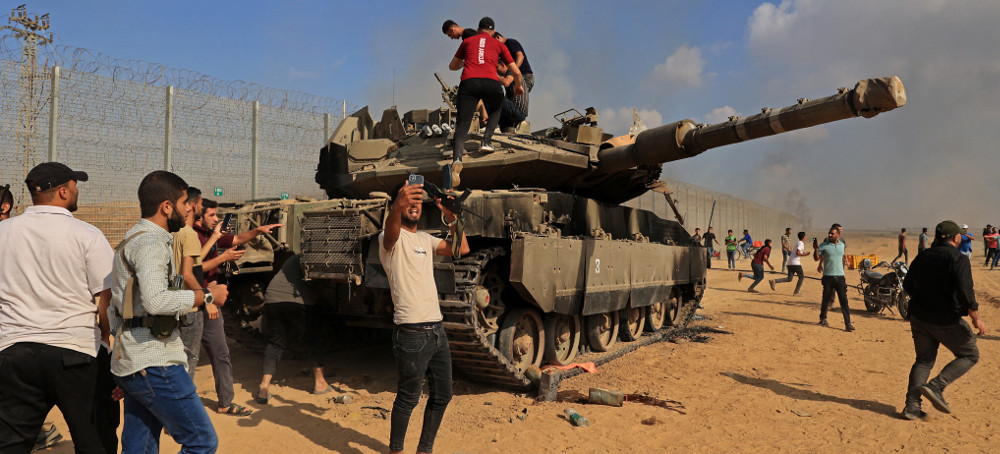 Palestinian terrorists take control of an Israeli tank after crossing the border fence with Israel from Khan Younis in the southern Gaza Strip on October 7, 2023. (photo: Said Khatib/AFP)
Even though the intelligence agency's responsibility for the catastrophic failure of October 7 is marginal compared to that of other organizations, it was involved in various ways in Israel's activity in Gaza, primarily in the flow of Qatari funds to Hamas
This acknowledgment may seem self-evident, but it does actually carry significance when it appears in an official agency publication. Although the document is not signed, it's clear to anyone familiar with the organization's work procedures that every word in it has been approved by the director of the Mossad, David Barnea.
The document goes on to state that "it's true that the Mossad, in the scope of its role, is not focused on the Palestinian arena." But in practice, it certainly has contact and interface with several aspects related to this arena.
First of all, the head of the Mossad not only participates in the discussions of the Committee of the Heads of Intelligence Services (known by the Hebrew acronym Varash), but even chairs it. In its deliberations, the committee deals, among other things, with issues concerning Gaza and the West Bank, and especially the activities of Hamas and Islamic Jihad outside Israel's borders.
The Mossad also has a research division, part of its intelligence wing, which has many resources and means, and which provides information, assessments and analyses on many arenas around the world.
Following the Yom Kippur War of October 1973, and based on the recommendation of the state inquiry commission headed by Supreme Court President Shimon Agranat which investigated the failures of that war, it was decided to establish a large research unit within the Mossad in order to diversify opinions and stimulate brainstorming in the intelligence community, instead of relying solely on the evaluations of the research division of the Military Intelligence Directorate (MI). Since then, the Mossad has been obligated to contribute its analyses and inputs to the formation of national intelligence assessments, for which MI and its head are responsible.
It's true that the highest priority of the Mossad in general, and of its research apparatus in particular, is Iran and Hezbollah in Lebanon and Syria. But as a result of this broad scope – and mainly through the Mossad's working relationships and cooperation with Arab intelligence organizations, including those of Egypt, Qatar, Saudi Arabia and the United Arab Emirates, as well as Turkey – the organization has also been exposed to materials related to Hamas, Islamic Jihad and events in the Gaza Strip.
This occurred on numerous occasions: in meetings between Mossad chiefs or other senior officials in the organization with their Arab counterparts, in their discussions in Varash, in their meetings with Israel's Prime Ministers and in reviews and discussions in the Knesset's Foreign Affairs and Defense Committee. Not infrequently, the head of the Mossad has heard proposals from his counterparts in the Arab world and beyond for furthering the peace process with the Palestinians, and even direct or indirect messages from Palestinian leaders, including from terrorist organizations.
As I first published about two years ago, in 2014, against the background of the 2014 Gaza War, then-Mossad chief Tamir Pardo, the IDF Chief of General Staff, Aviv Kochavi, and other top generals and officials, flew to Jeddah. There, they met with the head of Saudi intelligence, Prince Bandar bin Sultan, who proposed a years-long cease-fire in Gaza, reconstruction of the Strip, and initiation of diplomatic moves vis-à-vis the Palestinian Authority.
These were supposed to lead to a regional arrangement, with the support of the entire Arab and Muslim world, which would culminate with Saudi Arabia establishing diplomatic relations with Israel. The heads of the intelligence community conveyed the proposal to Prime Minister Benjamin Netanyahu, who initially supported it, but then retreated out of fear of the reaction of the right-wing and the settlers.
Operations against Hamas alongside cultivation of 'the conception'
The Mossad also initiated special operations against Hamas command centers in Lebanon and diplomatic moves against command centers in Turkey, as well as against Iran's efforts to smuggle weapons into Gaza and to train Palestinian professionals and experts to improve armament efforts of Hamas and Islamic Jihad.
Among the special operations attributed to the Mossad was an the assassination in Tunisia, in December 2016, of Mohamed Zouari – a Tunisian engineer who helped Hamas in improving its aerial capabilities (building drones) and building mini-submarines.
About two and a half years later, Fadi al-Batsh, an electrical engineer from Gaza who worked for Hamas and Islamic Jihad on projects to improve the accuracy of their rockets and build drones, was assassinated in Kuala Lumpur, the capital of Malaysia. In addition, the Mossad supplied technological "gadgets" it acquired through its foreign contacts to the IDF for its intelligence activities in Gaza.
But the Mossad's greatest involvement in relation to Gaza was in the transfer of funds from Qatar to Hamas. During the tenure of former director Yossi Cohen, the Mossad was not only the party coordinating the transfers of funds, but also a partner in devising "the conception" – a term used to describe the national blind spot that developed in the wake of 1967's Six-Day War, denoting a belief that Israel's neighbors would never dare to attack it militarily – by which Hamas was deterred.
Cohen – who, until the war on October 7 was considered to be a confidant of Netanyahu, who even said that he saw him as his successor – believed that the flow of funds intended to improve the standard of living in Gaza was a welcome move, which would keep the danger of war at bay. Since October 7, Cohen has been expressing remorse and admitting that he was wrong.
Cohen stepped down from the role almost three years ago, but the infusion of funds – as part of the policy for which Netanyahu is primarily responsible (although prime ministers Naftali Bennett and Yair Lapid during the period of the "government of change" also adhered to it) – continued also during the tenure of his successor, Barnea. The last installment of about 30 million dollars was transferred from Qatar to Gaza in September 2023, shortly before the war.
Barnea is now approaching the midpoint of his term, and soon, as is customary in the organization, he will have to appoint a new deputy. The current deputy will probably go for further studies or be loaned to another government organization. The responsibility of Barnea and his organization for the omissions and failures that led to October 7 is marginal.
The head of Military Intelligence, Aharon Haliva, who announced his resignation, along with his senior subordinates, bears this responsibility. He shares it with IDF Chief of Staff Herzi Halevi and the head of the Shin Bet, Ronen Bar. Close associates believe that the two will announce their resignation after the war – which is currently expanding to Rafah and will last at least a few weeks – without waiting for a state commission of inquiry, if one will even be established at all.
Like the IDF and Shin Bet, the Mossad has also recovered from the shock of the failure. In the document it published in its internal bulletin (alongside similar documents from the Shin Bet and MI), it proudly mentions the mobilization of its employees for the war effort.
Among other things, the Mossad boasts that it has provided the IDF with its technological capabilities. This is an interesting point: in the not-too-distant past, it was Military Intelligence's Unit 81 that provided the intelligence community, including the Shin Bet and the Mossad, with the scientific and technological developments and solutions necessary for producing means for special operations.
Now, the Mossad is reporting in a bulletin that it provided robots used for underground warfare to detect tunnels, in order to reduce risk to soldiers, delivered means to protect combat vehicles, and made facial recognition and artificial intelligence technologies available to the army to arrest suspects in Gaza. This is in addition to the Mossad's proactive involvement in thwarting attempts by Hezbollah and Hamas to carry out terror attacks abroad.
Barnea, with the help of Mossad's "Tevel" wing (known in English as Cosmos), which is in charge of liaison with its counterparts, is also very active in efforts to secure a deal for the release of the hostages. Barnea, like most senior officials in the security establishment, sees this as a top priority.
It is good that the Mossad acknowledges being surprised, but even if its responsibility for the failure is minor and insignificant compared to that of the other organizations, it would have been desirable for Barnea to address it personally and publicly, rather than just through the organization's bulletin.