Is Trump’s Attack on the Media Following Putin’s Playbook?
Joshua Yaffa The New Yorker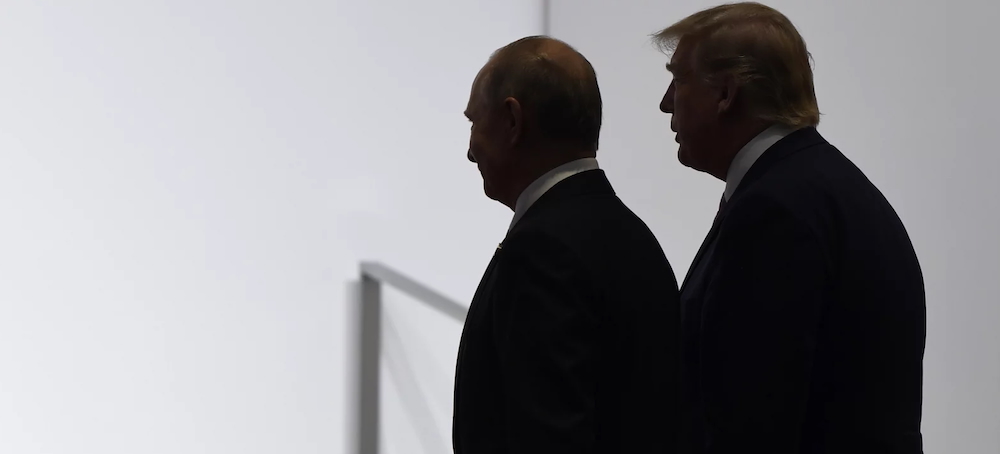 President Donald Trump and Russian President Vladimir Putin walk together. (photo: Susan Walsh/AP)
What it was like to live through the takeover of one of Russia’s most influential television stations—and what the experience suggests about the state of free expression in the U.S. today.
That May, days after Vladimir Putin was inaugurated to his first term as Russia’s President, a high-ranking Kremlin official conveyed a list of demands to NTV. If the channel hoped to survive, the official said, it must end its investigations into corruption in Putin’s entourage, abandon its unflinching coverage of the war in Chechnya, and more readily coördinate its editorial policy with the Kremlin.
A final demand pertained to one of the more popular shows on NTV: “Kukly,” or “Puppets,” which featured caricatured puppet versions of various members of the country’s political and business élite. In one episode, which had aired a few months earlier, Putin’s puppet appeared in the role of Little Zaches, a character from an E. T. A. Hoffmann fairy tale, an allegorical satire of how readily people can be fooled by superficial charmers. Putin was portrayed as an unsightly troll, who, by an act of magic—a spell cast by the puppet version of Boris Berezovsky, the magnate who helped engineer his rise to the Presidency—comes to appear beautiful and virtuous, the subject of great adulation and deference.
Putin, NTV journalists and editors learned, was incensed not just by the mocking tone and the implication that his popularity was based on P.R. hocus-pocus but also by the fact that his puppet was, like the character in the original Hoffmann story, short and rather ugly. “He took this as a personal attack, an anthropomorphic insult,” Viktor Shenderovich, one of “Kukly” ’s chief screenwriters, told me. The puppet’s short stature was a metaphor, Shenderovich said. “But where Putin got his education”—the late-Soviet-era K.G.B.—“they don’t believe in metaphors.” The official told the channel that the “first person,” meaning Putin, should disappear from “Kukly.”
Shenderovich nominally complied. The next episode of “Kukly” featured Putin as God—only not in puppet form but as a burning bush and a storm cloud. (An updated version of the Ten Commandments made an appearance: “Thou shalt not steal, unless He permits it.”) In any case, NTV’s fate was set. Before long, a media holding company of the Russian state energy giant Gazprom took a majority stake in the channel, ending its independence and giving the Kremlin decisive influence over its editorial policy.
Many at the channel, including Shenderovich, left; those who stayed quickly learned the new rules. “My greatest sorrow was that so many of my colleagues effectively helped Putin become who he did,” Shenderovich told me. “At first, Putin wasn’t strong enough to defeat everyone. He was far from omnipotent. But, by bending to him, they participated in creating what, over time, became his aura of unchecked power.” (Shenderovich left Russia in 2022, after a libel probe was opened against him at the request of a close Putin associate.)
The takeover of NTV also set an important precedent. Many more individuals and institutions would be suborned and co-opted. With one of the country’s most influential media outlets brought to heel, Shenderovich told me, “everything else became possible.”
I spent a decade living in Moscow, during which time independent journalists went from being intimidated and marginalized to being essentially outlawed. I wanted to ask the central players in the drama at NTV—who, at the time of their channel’s crisis, looked to the United States as a model of free expression and democratic values—what they made of the ongoing standoff between Donald Trump and the American media. Shenderovich noted that, for the health of a polity, its norms—what’s considered morally permissible—can often matter more than the laws that formally govern it. And those norms can change quickly, with much of society managing to adapt to a prolonged state of unfreedom. “People tend to accept new rules imposed from above quite readily,” Shenderovich said. “Unfortunately, it turns out the U.S. is no exception.”
In July, CBS announced that it was cancelling Stephen Colbert’s late-night program, which the network said was “purely a financial decision against a challenging backdrop in late night.” On September 17th, ABC suspended the late-night show hosted by Jimmy Kimmel, because of comments Kimmel had made in the wake of Charlie Kirk’s murder. Both Colbert and Kimmel have been frequent critics of Trump. And both of their networks had previously paid millions of dollars to settle lawsuits brought by the President. ABC paid fifteen million dollars to settle a Trump defamation suit stemming from comments made on air by George Stephanopoulos; Paramount Global, which owned CBS, paid sixteen million to settle a suit over a “60 Minutes” interview with then Vice-President Kamala Harris which Trump had claimed was unfair to him. In April, the executive producer of “60 Minutes” resigned, writing in a memo to staff that CBS’s corporate owners had undermined the program’s editorial independence: “It has become clear that I would not be allowed to run the show as I have always run it.”
Five days after suspending Kimmel’s program, ABC announced that it would return the following night. “This show is not important,” Kimmel said in his first opening monologue back on air. “What’s important is that we get to live in a country that allows us to have a show like this.” But the matter remained unresolved. Nexstar Media Group and Sinclair Broadcast Group, which together control more than twenty per cent of ABC’s affiliated stations across the country, have vowed to keep blocking Kimmel’s program.
In the case of NTV, the Kremlin went to great lengths to present the affair as a “dispute between business entities,” as the terminology went. Trump, for his part, has been open about settling political scores. In the wake of Kimmel’s suspension, he said of television networks that air negative coverage of him, “They’ll take a great story and they’ll make it bad,” adding, “I think that’s really illegal.” There was little subtlety in his threats. “I would think maybe their license should be taken away,” he said. That’s the shift in norms that seems most worrying to Shenderovich. “This used to be the kind of thing in the U.S. that was indecent, even taboo,” he said. “Now this is permissible. Decent. And there’s no small number of people calling for more.”
In Putin-era Russia, the takeover of NTV, and similar cases of state encroachment in the media, eventually led to a culture of self-censorship, in which outright bans or other repressive measures were relatively rare. Instead, individuals were enlisted as agents of their own oppression. Better to avoid certain topics or stories, lest your show, article, or media outlet become the next NTV. “I’m afraid this tendency is inevitable in autocracies,” Sergey Parkhomenko, the former editor-in-chief of Itogi, a popular newsweekly that was part of Gusinsky’s media holdings, said. “But it seems as if it’s happening terribly fast in the U.S. Russia needed twenty-five years for this culture to embed itself. In the U.S., it feels like it’s becoming the norm in a matter of weeks.”
Parkhomenko brought up the case of the Wilson Center, a nonpartisan foreign-policy think tank funded by Congress, where he was previously a senior adviser, working on projects related to press freedom in Russia. In March, Trump issued an executive order effectively dismantling the organization; officials working for the Department of Government Efficiency showed up to enforce it. The director resigned. “It looked like they gave up in the span of a single day,” Parkhomenko said. “They didn’t even try to defend their right to exist. They stood up, cried, and left. It was terrible to see.”
Evgeny Kiselev, NTV’s executive director at the peak of its influence, told me that at the time of the “Kukly” affair, he and his colleagues made a number of assumptions about Russian society’s newly-acquired taste for free speech, and the efficiency with which the state could carry out an attack on it. “It’s rather simple,” he said. “We miscalculated.”
Kiselev recalled a trip to New York in the early two-thousands. After the Kremlin seized control of NTV, he had moved to a smaller channel with a more modest reach, which the authorities had nonetheless moved to shut down. He met with producers from “60 Minutes” to pitch them on a piece about the pressures facing independent media outlets in Putin-era Russia. “They thought for a long time and then said, ’No, it’s not for us,’ ” Kiselev told me. The American producers explained, “This won’t interest our audience. It won’t make sense to them.” He laughed at the irony.
In the case of Kimmel, it appeared as if public outcry—from Republican and Democratic politicians, actors, directors, other late-night hosts, and even regular viewers—had forced corporate managers to reconsider. “Thank God,” Kiselev said. “This is the difference between Russia and America: Public opinion remains a force to be reckoned with.”