Iranians Voice Shock and Defiance in Face of Trump’s Looming Deadline
Erika Solomon and Sanam Mahoozi The New York Times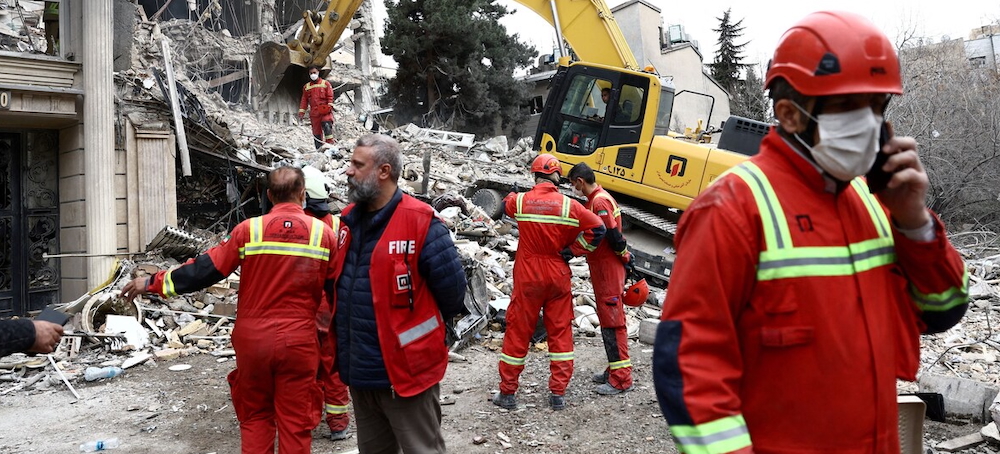 Emergency personnel work at the site of a strike on a residential building in Tehran. (photo: Majid Asgaripou/West Asia News Agency/Reuters)
President Trump has threatened devastating attacks if Iran does not reopen the Strait of Hormuz. Some Iranians questioned what had happened to American values.
Mr. Trump has vowed to level power and desalination plants, oil installations and bridges if Iran does not reopen the Strait of Hormuz, a key oil shipping route, by 8 p.m. Eastern time. On Tuesday morning, he warned that “a whole civilization will die tonight” if a deal is not reached.
“The first thing that came to my mind is that I think Trump is under a lot of pressure, and that he has lost his mind,” said Lili, who works in the arts scene in the Iranian capital, Tehran. She asked not to use her full name out of fear of repercussions for speaking to foreign media.
Mr. Trump has escalated his threats against Iran for the past three days. In a social media post on Tuesday, he said he did not want his threat of annihilation to be realized “but it probably will."
“We will find out tonight, “ he added, “one of the most important moments in the long and complex history of the World.”
Lili said she and her family had made no contingency plans at all, and they were not planning to flee Tehran. They were not stocking up on goods, or bracing to hole up at home.
“We need to continue with our lives,” she said, adding there was no clear haven to flee to: Attacking infrastructure meant almost anywhere could become a target.
Legal experts have argued that striking civilian infrastructure could constitute a war crime under international law.
Iran, apparently as emboldened by its shooting down of U.S. aircraft as Mr. Trump appears to be by the daring rescue of the airmen, put forward its own proposals and demands on Monday to end the war.
Mr. Trump called this a “significant step,” but one that was “not good enough” to change his announced deadline.
Mohsen Borhani, a law professor at Tehran University, said that as he read through Mr. Trump’s threats toward those the American president had called the “crazy bastards” running Iran, his first thought was of the founding fathers. In particular, he thought of the writings of Thomas Jefferson, “and the values that America was supposed to lead by,” he said.
“I also thought about the global order established after World War II, centered around the United Nations and shaped under Roosevelt’s leadership,” he said, referring to former President Franklin D. Roosevelt. “And I wondered, how it is possible for a U.S. president to undermine and discredit all American values and 250 years of human legacy?”
Mr. Borhani, a well-known political commentator in Iran, said the Trump administration was still operating under a “false assumption” that enough military pressure could force Iran’s authoritarian clerical rulers to surrender.
“Based on my understanding of Iranian society and governance,” he said, “I can state clearly that even several nuclear bombs would not achieve such an outcome.”
Ahead of Mr. Trump’s deadline, the Israeli military said it had launched airstrikes on eight bridges across Iran on Tuesday, and warned Iranians not to use railroads until 9 p.m. local time.
In response, Iranians have formed human chains along bridges and around power plants across the country, videos and photographs posted by state and other local media showed. Many waved the flag of the Islamic Republic of Iran, or held posters of Ayatollah Ali Khamenei, the supreme leader who was killed in the opening salvos of the U.S.-Israeli assault on Iran.
In the western city of Kermanshah, photographs from the semiofficial Mehr news agency showed protesters in front of a power plant carrying a banner that read, “Attacks to electricity infrastructure is considered a war crime.
A video posted by the reformist newspaper Shargh purported to show protesters in northern Iran in front of the Semnan power plant chanting “Death to America. Death to Israel.”
Iran’s government has organized rallies by supporters throughout the war. It is unclear whether Tuesday’s demonstrations were spontaneous or planned.
Lili, the Tehran resident, said that as someone who long opposed her government and sympathized with the nationwide demonstrations that sought to topple it just months ago, Mr. Trump’s threats have shifted her feelings toward the United States and Israel.
Both countries’ leaders have repeatedly voiced support for Iran’s opposition and encouraged Iranians to use the war to rise against their leaders. But their warplanes are now bombing not just military sites, she said, but critical industrial facilities, universities and schools.
“So now, we are supporting Iran and whatever government is running it,” she said.
Mr. Trump, in a news conference on Monday, maintained that Iranian civilians want the United States to conduct such bombings.
“They would be willing to suffer that in order to have freedom,” he said.
But Pari, another Tehran resident who asked to withhold her full name, said that some people she knew who once supported the U.S.-Israeli attacks, in the hope they could topple Iran’s government, found those positions harder to sustain.
“There is a growing fear that, rather than helping, these measures could end up harming ordinary citizens,” she said.
Other Iranians made direct appeals to Americans to stop their president, arguing that whatever Mr. Trump unleashed on Iran would ripple across the globe and potentially lead to blowback against U.S. citizens.
Pedram Soltani, a prominent Iranian businessman, used his social media page to make such an appeal.
“Your president has now placed not only Iran, but also America and the entire world at a tremendous risk,” he wrote on X.
The bombardment Mr. Trump has vowed would cause a “humanitarian catastrophe,” he said. Should Iran retaliate against infrastructure in Gulf countries, as is widely expected, he said the damage to oil and other essential industries would send prices skyrocketing.
“The United States will become one of the most hated countries in the world, seen as responsible for these disasters,” he wrote. “That resentment will inevitably affect your own security and daily lives.”