Iran War Spreading Economic Damage Far Beyond Oil and Gas Markets
David J. Lynch Washington Post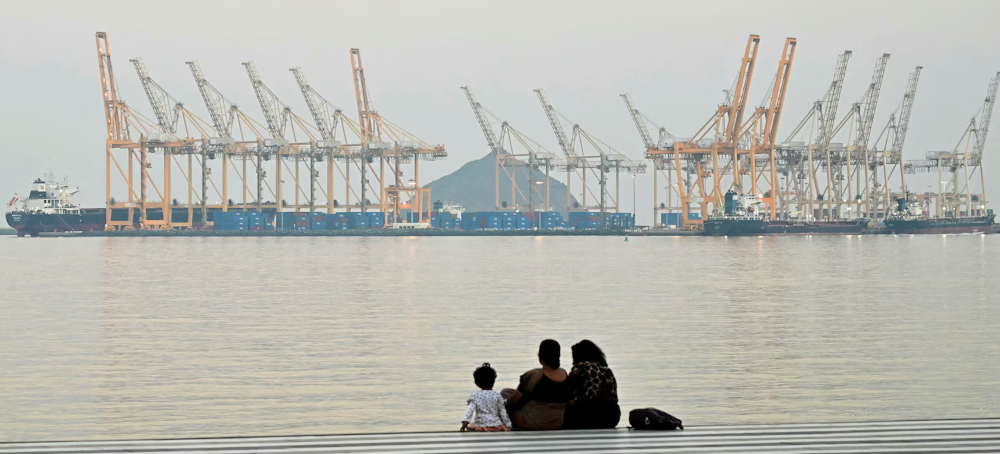 A dockyard in the Strait of Hormuz, seen Feb. 25. (photo: Giuseppe Cacace/Getty)
The conflict has hit Europe and Asia harder than the United States, with rising shipping costs and energy prices.
As the U.S.-Israeli assault on Iran enters a second week, the war’s economic casualties extend well beyond the oil and natural gas shipments that normally transit the Strait of Hormuz. The closure of several international airports in the conflict zone, including the world’s busiest in Dubai, idled nearly one-fifth of global airfreight capacity, interrupting shipments of consumer electronics, pharmaceuticals and precious metals.
But the pain is not being felt equally. The cost of shipping goods by air from Asia to Europe is up 45 percent since the war began, more than twice the increase for sending items from Asia to the United States, said Ryan Petersen, chief executive of Flexport, a freight forwarder and logistics company in San Francisco.
The shipping impact illustrates a broader economic truth: The war is hitting the economies of Europe and Asia harder and faster than it is striking the United States.
“Europe and Asia are heavily dependent on energy imports, so that alone makes them more vulnerable to negative macroeconomic spillovers from the Iran war,” said Maurice Obstfeld, former chief economist for the International Monetary Fund. “Being closer geographically to the hostilities also makes Europe and Asia more vulnerable to shock waves from the war.”
That does not mean Americans will escape unscathed. Gasoline prices now average $3.41 a gallon, up from $2.98 one week ago, according to AAA. Farmers face higher bills for critical crop nutrients, and additional supply chain headaches are certain if the Iran conflict continues longer than the Trump administration anticipates.
But for now, economies such as Italy, Belgium, China, India and South Korea, which are the most dependent on oil and gas shipments through the Strait of Hormuz, are feeling some of the worst effects. In February, inflation in the euro zone came in hotter than expected, and war-related energy bills are likely to make it worse. With QatarEnergy’s liquefied natural gas production shut down following Iranian attacks, European and Asian customers could be forced into a “bidding war” for available gas supplies, said TS Lombard in London.
Wall Street’s losses last week — the S…P 500 index dropped about 2 percent — were dwarfed by setbacks elsewhere. The South Korean stock market fell 20 percent before staging a mild rebound. India’s currency, the rupee, hit a more-than-half-century low against the dollar. India, which spends more than $32 billion annually subsidizing retail energy prices, is one of several Asian nations that are likely to see government finances come under strain in a lengthy war.
“Do not ignore the economic impact on Asia. If this is a protracted conflict, Asia is going to feel a very difficult sting out of this,” said Eric Robertsen, global head of research for Standard Chartered PLC in Dubai.
Tanker traffic through the strait is down 90 percent from prewar levels, according to MarineTraffic, a tracking service. On Thursday, the captain of an oil tanker anchored off Kuwait reported witnessing “a large explosion” off the vessel’s port side, which caused ballast water and a small amount of oil to spill into the northern Persian Gulf, said the U.K. Maritime Trade Operations Center.
A total of 57 container ships bearing goods for Middle Eastern customers or bound for global markets also are trapped inside the strait, according to Flexport. The immediate impact of that backlog is modest. The thousands of shipping containers they carry represent less than 1 percent of global capacity.
But dozens of other vessels are effectively quarantined in the northern gulf, loitering outside it or diverted to other ports in the region. The maritime traffic jam is starting to ripple through global supply lines. On Thursday, Maersk, one of the world’s largest ocean carriers, said it was suspending new bookings on almost all cargo in or out of the United Arab Emirates, Oman, Iraq, Kuwait, Qatar, Bahrain and Saudi Arabia.
“Those containers will then just sit at origin ports around the world and not get loaded,” said Petersen of Flexport.
Fresh disruptions loomed Thursday after reports of an Iranian drone attack on Oman’s largest port, Salalah, on the Arabian Sea, and a civilian airport in Azerbaijan.
MSC, another major carrier, last week said that containers in transit to the gulf would be diverted to the “next safe port.” The decision means businesses may suddenly find their goods dumped at ports far from their intended destination — with unexpected storage charges mounting by the day.
Certain products generally travel by air, which is faster but more expensive than the weeks-long sea voyages of container ships. Computer chips and other electronics, aerospace components, fast fashion, flowers and medical goods typically ride in the belly of passenger jets or on board dedicated freighters.
Air cargo thus far has been more heavily affected than seaborne shipments. Amid intense missile, drone and aircraft bombardments, several countries such as the UAE, Qatar, Bahrain, Kuwait, Iraq and Iran closed their airspace. A limited number of flights from the region have resumed, meaning a sharp reduction in cargo capacity.
For each week that air shipments are suspended, cargo carriers will need at least a week and a half to catch up, said Oscar de Bok, CEO of DHL Global Forwarding, which moves more than 2 million tons of airfreight annually.
“It all depends on the stability and how many drones are getting in,” he said. “This changes continuously. We need to constantly replan.”
The gap between available airfreight capacity and demand is leading to cargo backlogs in Southeast Asia and China, Stefan Paul, CEO of Kuehne + Nagel Management, a Swiss logistics giant, told investors on Tuesday. The emerging situation is “similar to the covid times,” he added.
Cargo aircraft are still flying between Asia and Europe. But planes that normally would stop in Dubai or Qatar are forced to take roundabout routes that require carrying more fuel, which further erodes freight capacity.
Aircraft originating in China and other parts of north Asia must fly a “meticulous route” over nations such as Turkmenistan, threading the needle between the Iranian battlefield to the south and prohibited Russian airspace to the north, said Brian Bourke, chief commercial officer for SEKO Logistics in Chicago.
“You can’t fly too north; you can’t fly too south,” he said.
The near-blockage of Persian Gulf oil shipments is sending jet fuel prices soaring, which will only add to air cargo bills. One European gauge of jet fuel prices is up 72 percent since the war began, rapidly approaching its 2022 peak following Russia’s invasion of Ukraine.
Spiking airfreight costs on the Asia-to-Europe route will act like “surge pricing on Uber,” drawing aircraft from other routes, such as Asia-to-U.S., and causing those prices to rise as well, Bourke said.
Supply chain managers have adjusted to serial crises in recent years, including the pandemic and the war in Ukraine. So they are accustomed to scrapping standard modes of operation. But airlines face constraints in airport runway and warehouse capacity when they reshuffle their airfreight operations, said Chris Rogers, head of supply chain research for S…P Global.
“The good news is planes can fly to different airports. However, it’s not like these airports have infinite capacity to take cargo from other areas,” he said.
The freight market upheaval could be exacerbated by companies responding to changes in U.S. tariffs, which are temporarily lower following the Supreme Court ruling invalidating Trump’s emergency levies. Indian goods, for example, are now subject to a 10 percent tariff, down from as high as 50 percent before the court ruling.
Administration officials have said they intend to re-create the original tariff lineup as much as possible before the 10 percent global tariff expires in late July. In the meantime, U.S. importers have an incentive to rush Indian goods such as telecommunications gear and generic drugs into American ports. Any increase in demand for airfreight from New Delhi could run straight into airlines’ limited capacity, driving shipping costs higher, analysts said.
Farmers, meanwhile, will probably be among the first Americans to feel a financial jolt from the war. Three of the world’s top 10 producers of urea and anhydrous ammonia fertilizer are in the conflict zone: Saudi Arabia, Qatar and Iran.
Urea prices jumped by roughly one-quarter last week and are expected to head higher if the strait remains closed, said Josh Linville, vice president of StoneX, a financial services firm. The price hikes come just as farmers are preparing to place their heaviest fertilizer orders of the year.
With China, another top producer, restricting its exports until at least August, a long war could leave farmers hurting.
“I don’t even know how to place numbers on it,” Linville said. “This is an event we’ve never seen before.”