Internal White House Document Details Layoff Plans Across US Agencies
Emily Davies and Jeff Stein The Washington Post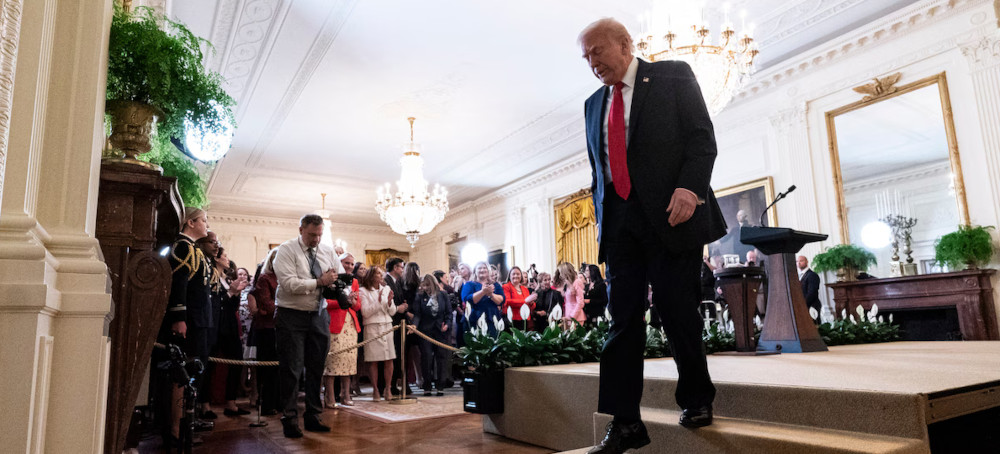 President Donald Trump departs after a Women's History Month event at the White House on Wednesday. The administration is working on plans to shrink the federal government. (photo: Jabin Botsford/The Washington Post)
ALSO SEE: RFK Jr. Announces Big Cuts to Department of Health and Human Services
In all, the agency that oversees Medicare and Medicaid will cut 20,000 positions, half of them through layoffs. The total is almost a quarter of its workforce.
The moves will save the department about $1.8 billion annually, the agency said in a news release, by reducing staff from 82,000 to 62,000. Half of those 20,000 employees took buyouts and early retirement, while 10,000 will lose their jobs.
Kennedy’s downsizing of HHS is remarkable in its scale. Virtually every corner of the HHS research and regulatory enterprise — which also includes substance abuse, maternal health, disease surveillance and grants to research universities — is likely to be affected.
With its nearly $2 trillion budget, much of which goes to Medicare and Medicaid recipients, HHS oversees other large agencies, including the National Institutes of Health, the Centers for Disease Control and Prevention, and the Food and Drug Administration.
Kennedy announced he will reduce HHS’s 28 divisions to 15 and create a new Administration for a Healthy America that includes several core functions. The number of regional offices will drop from 10 to five, and the focus will be on “safe, wholesome food, clean water, and the elimination of environmental toxins” in an effort to “Make America Healthy Again,” according to the news release.
In an address posted to the social media platform X, Kennedy said that while HHS’s budget had increased, so had rates of cancer and chronic disease, and American lifespans have declined. Calling his agency a “sprawling bureaucracy,” Kennedy said that as part of President Donald Trump’s U.S. DOGE Service efforts, he would “streamline HHS” in what would be a “painful period” for the department.
“We’re going to do more with less. No American is going to be left behind,” Kennedy said. “We’re going to consolidate all of these departments and make them accountable to you, the American taxpayer and the American patient.”
Kennedy’s announcement drew condemnation from alarmed public health advocates, who fear that the long-term effects of the downsizing would not be what Kennedy is seeking.
“Losing people, losing money, making relationships dysfunctional is not going to improve the health of the American people,” said physician Georges C. Benjamin, longtime head of the American Public Health Association. “Wrong diagnosis, wrong therapy.”
“MAHA” advocates praised the move. Food adviser Calley Means posted on X, “The insane spending and staffing in healthcare is actually the cause of our bad health outcomes.”
This is an amazing video and worth watching.
— Calley Means (@calleymeans) March 27, 2025
The democrats are arguing that the only thing standing in the way of better health is MORE spending.
The insane spending and staffing in healthcare is actually the cause of our bad health outcomes. @elonmusk @DOGE https://t.co/MHI8Nx0O1H
Vani Hari, an author and activist known as the Food Babe, wrote in a text message to a reporter that “we need major restructuring of our health agencies to eliminate the bureaucracy and streamline departments to start delivering on the reversal of chronic disease.”
An official notification from HHS to the American Federation of Government Employees union said layoffs are “primarily aimed at administrative positions, including human resources, information technology, procurement, and finance” and are likely to take effect by May 27. The reductions also will focus on redundancies between HHS and other parts of the federal government, the notice said.
The HHS moves, first reported by the Wall Street Journal, were hashed out among a tight circle of staff and advisers in recent weeks, said two people with knowledge of those conversations. Acting leaders, such as Sara Brenner, the interim FDA commissioner, helped devise and approve changes.
Lawmakers, former Trump health officials and even some current HHS leaders said they were not consulted on the planned changes and only learned of them as they were announced Thursday morning.
Even some critics of Kennedy’s approach acknowledged that his powers as secretary allow him to broadly remake the agency. They also noted that some operations that he seeks to reorganize — such as many of the responsibilities that historically fell to an emergency-response division that Kennedy would move to the CDC — have not been reauthorized by Congress, giving him a freer hand.
But current and former HHS staff questioned whether Kennedy would be able to implement the furthest-reaching aspects of his plan, such as cutting FDA staff without removing personnel who are funded by fees from the pharmaceutical industry.
They also questioned whether he had statutory authority to include parts of divisions in his new Administration for a Healthy America.
The questions were echoed by congressional staff, who said Thursday that they were waiting for further details on how the reorganization would work.
The cuts will hit the FDA hard. It will lose 3,500 employees, according to a fact sheet released by HHS, which said the cuts would not “affect drug, medical device, or food reviewers, nor will it impact inspectors.”
But some staffers fear there could still be an impact on those functions. “If people that support us are also fired, like scientists and policy people that help us … then it will be trouble,” said one FDA medical device reviewer who spoke on the condition of anonymity for fear of retribution.
The roughly $7 billion FDA is charged with overseeing the safety of vaccines and medicines, the majority of the U.S. food supply, tobacco products and more.
It has previously been a top target for Kennedy, who last fall posted on X that some FDA officials should “preserve your records” and “pack your bags.” On Tuesday, the Senate confirmed Marty Makary — a surgeon and researcher at Johns Hopkins University and former Fox News contributor known for criticizing the medical establishment — to lead the agency.
“It looks like a vindictive hatchet job,” said Dorit Reiss, a professor at the University of California College of the Law at San Francisco, who focuses on public health. “He’s cutting agencies that are already understaffed for what they need to do.”
HHS also includes the Centers for Medicare and Medicaid Services, which will lose about 300 staffers. HHS said those cuts “will not impact Medicare and Medicaid services.” Approximately 66 million people are enrolled in Medicare, the health insurance program for people 65 and older and younger people who are disabled, and 72 million are on Medicaid, which primarily serves low-income people and the disabled.
The $9 billion CDC, based in Atlanta, will lose 2,400 employees and be refocused on fighting epidemics, according to the fact sheet.
Public health officials and agency staff have been bracing for cuts there. The CDC has come under intense scrutiny from conservatives in Congress regarding its scope and mission in recent years.
The CDC is leading the response to a rapidly expanding measles outbreak in Texas and New Mexico, in which two people have died, an ongoing bird flu outbreak and growing vaccine hesitancy.
But often-discussed targets are HIV/AIDS prevention programs and centers that study the causes of birth defects and autism; investigate the effects of the environment on health; and work to prevent overdoses, suicides and vehicle accidents.
State and local health departments may be affected, because as much as 80 percent of their budgets are funded by the CDC.
Sen. Bill Cassidy (R-Louisiana), chairman of the Senate Health Committee, said in a statement that he is “interested in HHS working better, such as lifesaving drug approval more rapidly and Medicare service improved. I look forward to hearing how this reorganization furthers these goals.”
Cassidy, a physician, openly wrestled with Kennedy’s confirmation, asking the longtime anti-vaccine activist to stop invoking the debunked link between vaccines and autism. Ultimately, Cassidy voted to support Kennedy.
In contrast, Sen. Dick Durbin (D-Illinois) told The Washington Post that the cuts are inappropriate. “They’re going too far, too fast,” he said. “They’re just chopping heads.”
The HHS announcement said the NIH workforce will be reduced by about 1,200 employees by “centralizing” some operations across its 27 institutes and centers. Republicans in Congress have pushed for consolidation of those independent entities, reducing the number to 15, but the HHS announcement did not mention that.
While HHS said no additional cuts are currently planned, it promised to continue to look for ways to streamline its operations. At HHS headquarters, the video of Kennedy’s speech is playing on a loop on monitors around the building, an employee told The Post.
“People are avoiding the monitors or turning them off,” the employee said.