Inside the Republican National Committee’s Poll-Watching Army
Antonia Hitchens The New Yorker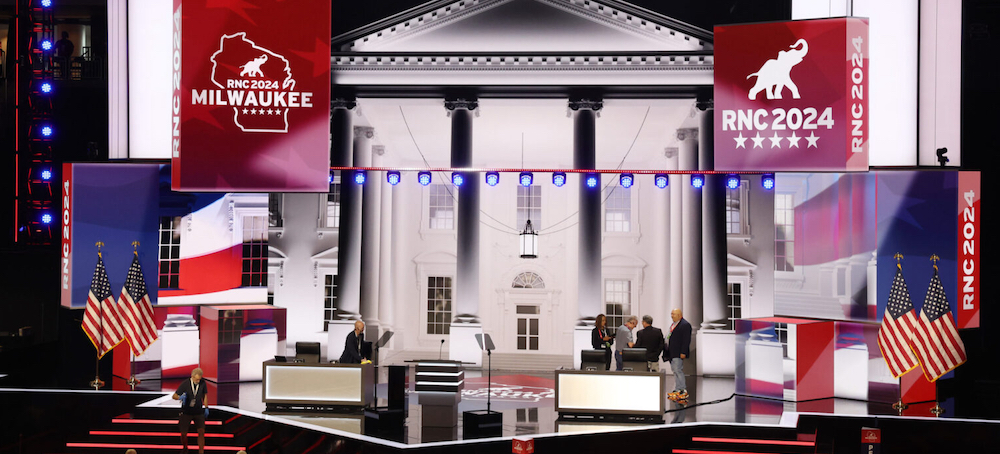 Workers prepare the stage for the Republican National Convention at the Fiserv Forum on July 13, 2024, in Milwaukee, Wisconsin. (photo: Scott Olson/Getty Images)
The R.N.C. says it has recruited tens of thousands of volunteers to observe the voting process at precincts across the country. Their accounts of alleged fraud could, as one Trump campaign official put it, “establish the battlefield” for after November 5th.
He had come to the conference room of a grim corporate hotel on a rainy afternoon to “do something to help.” The event was just one stop on the R.N.C.’s nationwide “protect the vote” tour, billed as a way to “learn how YOU can join our Election Integrity Team.” Mike was thinking about becoming a poll watcher at a voting site, meaning that he would observe election workers as they performed their duties and report any discrepancies to Party lawyers. A man named Ed, who was sitting next to Mike, told us that all the talk he was hearing from Republicans about election integrity gave him a bit more confidence in the process—“just a little bit,” though. “I still worry about those drop boxes,” he said. “We still can’t figure out what the hell happened in the middle of the night. You know what I mean? You kind of worry. Worry about the immigrants. Can they vote? Can all the states purge the dead people, the people that aren’t supposed to vote? Did they do that?” He went on, “It seems like there’s still a lot that we don’t know.” A Trump campaign staffer told us to wind down the conversation so that Mike and Ed could start the training.
Trump has told his rallygoers that “eighty-two per cent of the country understands 2020 was a rigged election.” Even by the Associated Press’s recent estimates, nearly sixty per cent of Republicans don’t think Biden was legitimately elected. This spring, when Lara Trump, the former President’s daughter-in-law, took over the R.N.C, alongside Michael Whatley, she promised to be “laser-focussed on election integrity,” hoping to restore confidence in the system so that people like Mike and Ed would bother to vote in the first place. Throughout the election season, the R.N.C. has heavily prioritized bringing in Party members to “guard the vote,” as Trump puts it. Whatley was in Pennsylvania to address the prospective poll watchers before their training started. “Look, you’ve got to be in the room,” he said. “We need Republican attorneys and observers in the room.” When Whatley took the R.N.C. job, he vowed to recruit a hundred thousand poll watchers, poll workers, and volunteer lawyers; by his own count, he’s since enlisted almost twice that.
Mike and Ed respected Whatley’s efforts, but they weren’t convinced that poll watching would make a difference. “It’s higher than that,” Ed told me. “I think it goes beyond us being there and being able to watch what’s going on. It’s behind the scenes, like the dropped ballots.” He gestured at Mike. “Like he was saying with ‘2000 Mules.’ We can’t see that when we’re standing there.” He went on, “You worry about things that you can’t control. But if you don’t vote, it’s a vote for their side. Oh, my gosh, I believe in voting, for sure.” A woman who had stopped by the training on a whim because it was near her Pilates class told me, “I want to see what the process is and for people to know the process works.”
In rooms of committed Trump voters, I often sensed this nagging tension—an amorphous feeling of dread about possible intrusion in the election, coupled with a renewed desire to engage with the electoral process. In theory, poll watching could allow grassroots Republicans to regain faith in voting by observing it—though that same activity could contribute to worry and distrust on all sides. Carla Sands, Trump’s former Ambassador to Denmark, who had come to the training with Whatley, said, “They don’t want Trump to succeed. We’ve got election interference coming from every side. Remember what they did? There’s going to be problems at the polls.” She continued, “It’s not enough to vote. Because I don’t trust them, and you don’t have to trust them. You don’t have to trust—you can verify.”
Poll watching has been a regular component of American elections for about two hundred years. In a recent documentary on the history of poll watching, Gideon Cohn-Postar, the senior adviser for election infrastructure at the Institute for Responsive Government, pointed out that, in the nineteenth century, voting “in the United States took place openly. Everyone could see who you were voting for, what ballot you cast. And in that environment, the polls became a really raucous place. Violence and intimidation at the polls ranged from verbal threats to outright gunplay, stabbings.” Poll watchers were appointed to prevent fraud and intimidation. Now they are tasked with observing and monitoring elections; political parties recruit partisan volunteers to support fairness and make sure that everyone is following the rules.
After the Voting Rights Act of 1965 was passed, reports published by the U.S. Commission on Civil Rights showed that having Black poll watchers was instrumental in reducing discrimination. But things could also go the other way. In 1981, the R.N.C. sent a so-called ballot-security task force to minority communities in New Jersey; some of these poll watchers were armed, off-duty police officers. The R.N.C. was sued for intimidation and discrimination, and, as part of the settlement, it was placed under a federal consent decree that effectively banned it from future poll-watching activity. The decree expired in 2017, and, in 2020, the first general election in which R.N.C. poll watching was allowed again, Trump encouraged his supporters to go “watch all the thieving and stealing and robbing they do.” That year, poll workers in Detroit partially covered windows with cardboard while they counted ballots. They did so to make sure that private voter data wasn’t visible to bystanders pressing their faces against the glass; Trump’s supporters came away with the impression that something was being hidden. Similar scenes unfolded across the country and contributed to doubt sown about the result. During the 2022 midterms, a poll watcher in North Carolina stood between a voter and a voting machine; in Texas, an armed poll watcher trailed election officials to their ballot-counting location.
Republican poll watching during the 2020 Presidential election was something of a slipshod endeavor, more of a last-minute suggestion than a concerted effort; this year, the R.N.C. and the Trump campaign celebrated National Poll Watcher Week. On Election Day, the R.N.C. plans to have “war rooms” staffed with attorneys operating an “election-integrity hotline,” ready to field calls from poll watchers. In 2020, when Whatley was the head of the Republican Party in North Carolina, he put in place a statewide election-protection program that included poll observers and volunteer lawyers. Trump selected Whatley to run the R.N.C. in part because he hoped Whatley could create a similar infrastructure at the national level; Trump’s impression, according to reporting in the Times, was that Whatley’s efforts had stopped Democrats from cheating in the state. When I asked Whatley whether he thought the program actually prevented malfeasance, he responded, “I think it was a sense of reassurance.” Of poll watching, he said, “If everything goes the way it’s supposed to go, it’s kind of a boring job. That’s what we want. But if something is amiss, if something is out of order, if something’s wrong . . . How do you raise it as an issue and make sure that we get it taken care of?”
Many of the speakers at these trainings take a less evenhanded approach. Cleta Mitchell, the leader of the far-right Election Integrity Network—in 2021, she was on the phone call with Trump when he asked Georgia’s secretary of state, Brad Raffensperger, to “find 11,780 votes”—has rallied poll watchers with stories of lawfare and cheating. When Jack Posobiec, a heavily online alt-right conspiracy peddler, of Pizzagate fame, addressed volunteers at one of the R.N.C.’s recent sessions, he said, “You need to think of yourself as the ground forces, as the army that’s going to be out there, the eyes and the ears of the Trump campaign, of the Republican Party, that are there on the front line to say, ‘We are going to catch you, and when we catch you we’re going to make a stink about it.’ ” Kari Lake, the Republican candidate for Senate in Arizona, who still disputes her 2022 election loss, has also trained poll watchers.
Though poll watching could theoretically reassure skeptical Republicans about election integrity, a Trump campaign official told me that, more importantly, accounts of alleged fraud by poll watchers will provide evidence for lawsuits and court battles after the election. “It’s part of an establishment of a fact pattern,” he said. “Poll watchers are trained to do something that is very specific: take notes, call the lawyer. The lawyer will come, swear an affidavit, you’ll have a certified testimony under oath to file immediately. So, literally within twenty-four hours of the result that needs to be looked at, there will be legitimate fact-based filings.” He went on, “My desire would be it’s not political—that the result is clear and agreed to. It would be great if, like 2016, at some point before the sun rises the next morning, everybody agrees. But if by 10 A.M. on the sixth of November there isn’t a clear victor, you will see a flurry of activity.”
This year, Trump’s campaign and the R.N.C. are much better prepared, and coördinated, for that legal deluge. (In 2020, the R.N.C. only attached its name to a small fraction of Trump’s post-election lawsuits, and it was often difficult to find lawyers willing to take his cases, nearly all of which were dismissed or dropped.) The R.N.C. has already filed more than a hundred lawsuits alleging, among other things, various forms of impropriety related to voter rolls, disputing which forms of identification should be permitted, and challenging the legitimacy of some ballots cast by U.S. citizens living abroad. “When we get the rules of the road in place right away, before the voting starts, it’s going to make a tremendous difference,” Whatley has said. Christina Bobb, the R.N.C.’s lead election-integrity lawyer, remarked, “I’m kind of holding my breath” for post-election lawsuits. (Bobb is currently under indictment in Arizona for trying to overturn the 2020 election. She denies wrongdoing.) The Trump campaign official, referring to the failed 2020 cases, explained, “That’s because they didn’t have evidence. We didn’t have what we needed to get to the next level of court. That won’t be the case this time. Should there be a legal battle, part of what we’ve done is establish the battlefield.”
In late September, I went to a poll-watcher training held at the Brickery, a pizzeria in Jackson, Georgia, southeast of Atlanta. “We’ve got to have poll watchers. We’re not going to go into why—we’re all on the same page, but we need poll watchers,” Harrileen Conner, the head of the Butts County G.O.P., said, before asking an attendee to come forward and lead the room in prayer. Everyone put down their slices of pizza. “I pray everybody understand what the purpose of this is, and that we might come together and be able to perform a deed for the community and this county in this upcoming election,” the attendee said. In the corner, a year-round Christmas tree was covered in U.S.A. memorabilia. I was there with about a dozen other people, one of whom, a man in a Trump hat, had never voted before. (I found a flyer posted for the event online.)
Conner introduced the evening’s teacher, a man named Robert, who she said was a representative from the Trump campaign. I learned that I didn’t have to be a resident of the county, or even the state, to poll-watch there; I could live in a Republican county but still choose to observe in a Democratic one. Robert told us to bring a notepad and pencil on Election Day—no phones—and “God forbid, don’t be taking recordings or pictures or anything of that sort.” He told us not to talk to voters, touch the election materials, or interfere in the conduct of the election; if we saw something questionable, we should just tell the poll manager or call the hotline. “Don’t be an Election Day cowboy,” he said. He advised the group not to make “unsubstantiated claims” but to write down anything that seemed out of place. “When it comes to reporting to the G.O.P. hotline, a short pencil is better than a long memory,” he said. “I’m sure Elon Musk and Donald Trump can be forgetful.”
When voting was over, Robert explained, the poll manager, accompanied by at least one poll worker and possibly by a law-enforcement officer, would deliver the results to the superintendent. “If you want to follow them in your car to make sure they’re not making additional stops on the way to the superintendent, you’re allowed to do that,” he said. “But just make sure you’re respecting the traffic laws and that you’re not violating laws or driving recklessly or tailgating or anything like that. Be respectful to them.”
After the training, which lasted about forty minutes, Robert took questions. People were worried about drop boxes. A few years ago, Georgia had passed a voting law that required drop boxes to be inside precincts and under surveillance at all times. “But are they locked?” someone asked. There were also concerns about voters with disabilities who needed assistance at the polls. “I saw an individual bring in a woman who couldn’t speak, couldn’t write, yet he brought her through to vote,” another person said. “I mean, if she can’t even write her name, sign her name, is that a red flag for us to call in?”
I got the sense that even if the observers saw their location as above board, it would be difficult for any of them to conclude with certainty that the entire election was safe. As one attendee put it, “This county is clean as a hound’s tooth as far as I’m concerned, but, I will tell you, you think about those larger metro areas . . .”
Two weeks later, in Cartersville, Georgia, about eighty miles away, I attended a training course for poll managers, who are paid by the county government to run the voting sites and supervise the voting machines. Many have worked the community’s elections for years. Joseph Kirk, the county election supervisor, told the group, “People are going to be going over our work with a fine-tooth comb. Don’t give them that opening.” This year, owing to new rules, poll watchers across the state will have expanded access to see and hear what poll managers and workers are doing, at a closer range. Kirk reminded everyone to be especially careful and to insure that any incidents—a scanner goes down; a voter comes in with a firearm and doesn’t want to remove it; the paper used to print the ballots runs out—are recorded properly in a report in case the worker or manager needs documentation to defend themselves against allegations of impropriety.
Though Kirk acknowledged that poll watching had lately been co-opted by partisan interests, he spoke of the ritual as an important safeguard. “I know it’s uncomfortable, but it’s very valuable for us,” he said. “Poll watchers saved us in 2020. The reason we didn’t have as many angry phone calls and voters as other counties did is because I was able to say, ‘There were poll watchers there from both parties. See what they have to say about what was going on, and, if you don’t like their answer, call me back.’ I didn’t get a single call back. It made a difference.”
“Poll watchers are and have been integral in providing public oversight in our elections,” Donald Sherman, the executive director of the nonpartisan Citizens for Responsibility and Ethics, in Washington, told me. “Usually these are thoughtful people who care about the election and do this without any partisan bent or dog in the fight.” This has become less reliably the case. If the lasting narrative of unproven interference in 2020 is that illegitimate ballots were ferried in and dumped in drop boxes, the analogous plot in 2024 appears to be that vast numbers of noncitizens will try to vote. In some states, observers can directly challenge a voter’s eligibility. “What seems clear now,” Sherman said, “is that there is a coördinated strategy to have more election deniers who are questioning the results of an election that hasn’t happened yet to serve as poll watchers and to make it easier for those kinds of conspiracy-theory-charged partisan poll watchers to create confusion and disruption in the process.”
Sherman, who studies legal threats to election certification, identified Georgia’s election board as particularly vulnerable. “There are several members of the board who have implemented a number of changes, all designed to make it easier for someone to make an unscrupulous and uninformed challenge to the election-certification process,” he said. (A judge recently blocked these changes, which included calling on local officials to conduct a “reasonable inquiry” before certifying the vote. Republicans are challenging the ruling.) In 2020, Sherman added, some county officials refused to certify just because they had heard about or divined problems in other counties. “They’re disenfranchising their own citizens based on rumors they’ve heard. So it’s like my vote can be threatened even though there’s nothing wrong.”
Brad Raffensberger, Georgia’s secretary of state, has encouraged volunteers interested in poll watching to make the more intense commitment to train as poll workers. This fall, according to a recent report in ProPublica, they, too, may be called upon to help further Trump-ally agendas. Cleta Mitchell’s Election Integrity Network started to recruit poll workers for the midterms in 2022, directing them to become a “part of the election apparatus.” The United Sovereign Americans group, which already plans to request injunctions to stop election results from being certified in some places, will turn to poll workers’ accounts to bolster their efforts. “What we need is your reports to fill in as those are going to constitute the exhibits,” the group’s founder said on Steve Bannon’s “War Room” podcast.
Some are fearful about the possibility of vigilantism. When I attended a recent meeting of battleground-state election officials, they described threats and harassment as “part of the landscape.” Poll workers go through extensive training in de-escalation, and on wellness and resiliency; a doctor from the Department of Defense has seen workers experiencing P.T.S.D. triggers in the run-up to this election. In some Georgia counties, sheriff’s deputies will be stationed outside precincts. When I visited Cartersville, Kirk’s assistant election supervisor told me that there’s “more anxiety than ever” among citizens visiting the election office to check their registration status.
It used to be that no training was required to become a poll watcher in Georgia, but that changed after 2020. “A guy came to a polling place with an AR,” Kirk told me. “He thought he was being helpful.” (Civilians are not permitted to carry firearms in polling stations, a fact noted during the training.) Kirk said that he’s noticed a dramatic increase in people volunteering to become poll watchers ahead of November. “Some do it because they want to see fraud,” he said. “The ones who aren’t combative are real heroes. People think they see illegal things, but they don’t know what’s allowed.” At the training for poll managers in Cartersville, he told the group, “Watching our work is like watching paint dry. It’s not very exciting. They can’t bring their phone. It’s very boring. They want to go find the fraud somewhere else.”
In late September, Trump was in Savannah for a campaign rally, and I went to a nearby country club to attend another poll-watcher training hosted by the R.N.C. Outside, people were playing golf; in a ballroom above the club shop, about two dozen people, mostly seniors, sat beneath a chandelier, watching a PowerPoint slide show. An elderly couple at the front had a lot of questions, even before the presentation started.
Q.: “What are examples of infractions?”
A.: “We’ll get to that.”
Q.: “Are all these rules new? We’ve always had problems. We’ve called our county chair.”
A.: “I can get you in touch with the election-integrity director for your area.”
Q.: “We talk to them all the time!”
A.: “Ma’am, I need to move on.”
Topics ranged from whether you could put snacks or lunch in the fridge at the polling location (no) to how much “reasonable access” you should expect in order to observe poll workers at a close distance (it depends). What if seniors waiting in line to vote wanted water? Could they give out water? A hand went up. Liberals, apparently, got up close to voters under the pretense of handing out food and water. Everyone agreed that it was probably worth a call to the election-integrity hotline if someone was giving out water with what seemed to be ulterior motives. (The instructor said that she wasn’t sure about that.)
One of a poll watcher’s tasks is to verify that ballot scanners show zeros in the morning, indicating that no votes have yet been cast. “The scanners will have goose eggs in them,” one man said. “Every machine should have goose eggs in its counter. Then integrity is achieved.”
A man raised his hand. “The whole integrity of the system is flawed, because, trust me, they know that we’re all going to be looking for the zeros on Election Day,” he said. “But if we have no way to audit prior to that, that’s an opportunity to cheat.” He also didn’t feel good about early voting. The instructor smiled through her exasperation: “We can only do what we can, and leave the rest to God.”
A woman in the front raised her hand. “What do you do with the mentally handicapped? We have one place that’s like a day care for them—how do you prove this person isn’t mentally fit?”
“I wish I had some more clear-cut answers,” the instructor said.
A man imitated the sound you should hear when the scanner takes in a ballot.
Another man had a question. “Now, what difference does it make whether we certify or not if they don’t pay attention to us?” he said. “We’ve got people under prosecution right now for rejecting the outcome of the 2020 election. What do they do?”
“I hear ya,” the instructor said.
After the training, the names of the attendees would be submitted to the board of elections; their next engagement would be in the field, on Election Day, stripped of their Trump garb, bearing letters deeming them official poll watchers. As I walked out, a man turned to me and said, of the session we’d sat through, “That’s messy. That is so messy.” He went on, “And if there’s confusion, there’s gonna be voter fraud.”