In Trump’s War on Global Justice, Court Staff and U.N. Face Terrorist-Grade Sanctions
Andrew R.C. Marshall, Humeyra Pamuk, John Shiffman and Stephanie van den Berg Reuters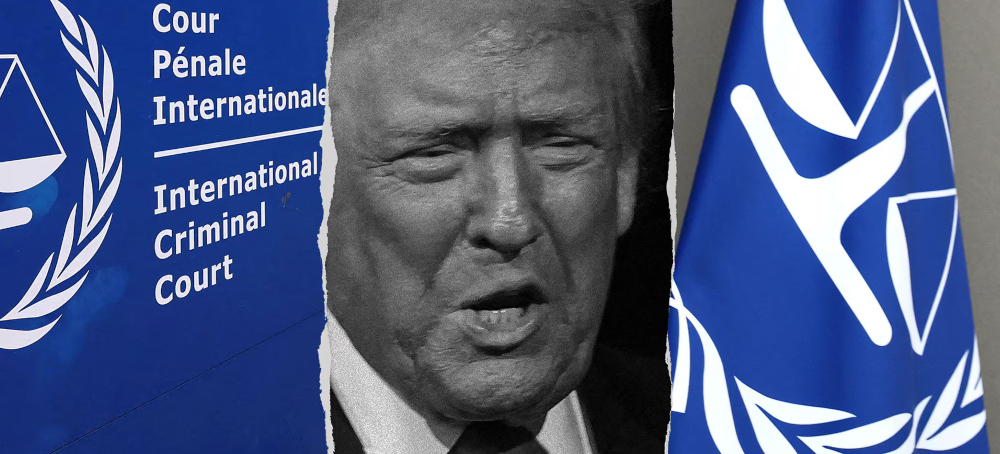 President Donald Trump. (photo: Reuters)
Trump’s sanctions on U.N. expert Francesca Albanese and the International Criminal Court froze assets and disrupted war crimes investigations. The clash is part of the broader campaign by his administration to strongarm allies, enemies and world bodies into toeing the U.S. line.
Written by Francesca Albanese, the United Nations special rapporteur for Palestine, the letters warned more than a dozen U.S. firms and two charities that she might soon name them in a U.N. report for “contributing to gross violations of human rights” by Israel in Gaza and the West Bank. Among her targets: Alphabet, Amazon, Caterpillar, Chevron, Hewlett Packard, IBM, Lockheed Martin, Microsoft and Palantir.
Her letters so alarmed the U.S. companies that at least two sought help from the White House, according to a Reuters investigation into the U.S. campaign against Albanese and the International Criminal Court in The Hague. Despite U.N. insistence that she had diplomatic immunity, the Trump administration imposed sanctions on Albanese for “writing threatening letters” to the companies and urging the ICC to investigate. The Reuters’ findings are based on interviews with more than two dozen U.S. and U.N. officials, ICC staff and sanctioned individuals.
Trump’s strike at Albanese was part of a broader executive order he used to sanction ICC judges and prosecutors – a campaign intended in part to head off any future attempts to hold him or his officials accountable for U.S. military action overseas, Reuters found.
Albanese and the sanctioned ICC staff now sit on the U.S. Treasury Department’s Specially Designated Nationals list, alongside suspected al Qaeda terrorists, Mexican drug traffickers and North Korean arms dealers. “This is unjust, unfair, and persecutorial,” Albanese said in an interview in Modena in her native Italy. “I’m being punished because of my human rights work.”
The Trump administration said it imposed sanctions on ICC staff for their “illegitimate and baseless” attempts to investigate alleged crimes by Israel’s leaders in Gaza and by U.S. military personnel in Afghanistan. The U.S. State Department said Albanese had encouraged the ICC to investigate American companies and executives after making “extreme and unfounded accusations” in her letters to them. “We will not tolerate these campaigns of political and economic warfare,” it said in a statement announcing the sanctions.
But Reuters found deep divisions within the U.S. government over the scope and timing of the sanctions against Albanese and the ICC. The plan to punish them was hatched in November 2024, when Trump was re-elected and the ICC indicted his ally, Prime Minister Benjamin Netanyahu of Israel. While some career U.S. diplomats urged restraint, senior Trump appointees pressed for tougher measures to cripple the ICC and punish Albanese. In addition to Albanese, the Trump administration sanctioned eight ICC judges and three prosecutors last year, in a blow to international judicial and human rights bodies.
The targeting of the ICC and Albanese is part of Trump’s hardball tactics in foreign policy. In recent months, he has arrested Venezuela’s president and jailed him in New York, threatened to attack Iran for its bloody suppression of mass protests, and triggered a crisis within NATO by trying to muscle fellow member Denmark into handing over Greenland.
Trump’s clash with Albanese and the ICC provides a vivid portrait of the institutional and personal fallout of his widening assault on international bodies. Washington has long used sanctions to punish rogue states and deter human rights abusers. Targeting a U.N.-mandated expert and so many ICC staff – including eight of its 18 judges – marks a major break, eight experts on U.S. sanctions said. Individuals and global institutions that once drew mere rebukes from the U.S. now face efforts to hobble or dismantle them when deemed threats to Trump or U.S. business interests.
Trump’s opposition to international organizations dates to his first term in office, when he withdrew from the Paris Agreement, an international climate treaty, and slashed discretionary funding to some U.N. agencies. Today, the U.S. owes more than $2.1 billion in mandatory dues to the U.N, and Secretary General Antonio Guterres warned in a January 28 letter to member nations seen by Reuters that the global body is at risk of “imminent financial collapse.”
Trump is now going further: He recently launched a so-called Board of Peace that – with himself as leader – aims to solve global conflicts, challenging the U.N.’s traditional role as the world’s diplomatic epicenter. At least 20 countries have joined, none of them – apart from the U.S. – major Western powers.
The consequences for Albanese and senior ICC figures were swift. Their bank accounts were closed and credit cards cancelled. Albanese told Reuters she has had to borrow cards from friends to travel. After she received threats, the U.N. tightened security for her and her family. Her children, 12 and 9, no longer roam their neighborhood in Tunisia, where the family lives. “They cannot just run out of the house as they used to and go play,” Albanese said.
Margaret Satterthwaite, the U.N. special rapporteur on the independence of judges and lawyers, said the sanctions set a dangerous precedent. “It’s shocking that someone’s human rights work could be seen as so dangerous that they would be thought of as akin to a terrorist,” said Satterthwaite, a New York University law professor.
The White House declined to comment. But a senior U.S. official said Trump is concerned that the ICC could one day seek to prosecute him or senior members of his administration, Reuters reported in December. The official said the administration would impose additional sanctions if the court didn’t amend its founding statute to explicitly bar investigations targeting Trump or his top aides.
State Department spokesperson Tommy Pigott said the U.S. rejects “an outdated model of multilateralism” and will no longer participate in or fund international organizations that it deemed contrary to U.S. national interests. He said the sanctions against the ICC showed that the U.S. “will not tolerate efforts to violate our sovereignty or to wrongfully subject U.S. or Israeli persons to the ICC’s unjust jurisdiction.”
Trump’s push against the court could weaken one of the few bodies that can hold powerful leaders – including Americans – to account. Some lawyers and diplomats say the U.S. raid in Venezuela and lethal strikes on purported drug traffickers in the Caribbean may violate international law. State Department spokesperson Pigott called those actions a legal and “targeted law‑enforcement operation.”
“U.S. sanctions against the ICC are clearly an effort to really kneecap an institution that the Trump administration has always been opposed to,” said Nancy Combs, international law professor at William … Mary Law School in Williamsburg, Virginia. “It’s a component of the Trump administration’s much larger worldview that Americans benefit when not constrained by a bunch of namby-pamby international norms.”
The ICC has condemned the U.S. sanctions and vowed “to continue providing justice and hope to millions of innocent victims of atrocities across the world.” In its November 2024 arrest warrants, the ICC accused Netanyahu and his former defense minister, Yoav Gallant, of war crimes and crimes against humanity, including using what it called “starvation as a method of warfare.” Israel’s offensive in Gaza has killed more than 70,000 Palestinians since Hamas terrorists killed 1,200 Israelis on October 7, 2023. Netanyahu denounced the ICC warrants as “antisemitic” and a “dark day” for humanity, while Gallant said the attempt to deny Israel’s right to wage a “just war” would fail.
At the same time, the ICC issued a warrant for Hamas military commander Mohammed Deif for murder, torture, rape, hostage-taking and other crimes. The ICC later dropped the warrant after Hamas confirmed that Deif was dead, killed in a July 2024 airstrike by Israel.
In December, the U.S. imposed sanctions on two more ICC judges. The court has other problems, too. It was shaken by a scandal involving its chief prosecutor, Karim Khan, the first ICC official to be sanctioned last year. He went on leave in May amid a U.N. investigation into sexual misconduct allegations, which he denies.
Speaking to Reuters from his home in The Hague, Khan said judges, prosecutors and other officials were “soft targets for a big state with all that power.”
U.S. TUG OF WAR
The Trump administration’s hostility towards the ICC and the U.N. is part of a broader retreat from international human rights diplomacy and institutions. U.S. foreign aid has been slashed, including grants for rights defenders. Washington has also withdrawn from or sharply cut funding for dozens of U.N. programs, including the Human Rights Council, the World Health Organization and the World Food Program.
The ICC was set up in 2002 through an international treaty and is backed by 125 countries – but not the U.S., China, Israel and others. Both Republican and Democratic administrations have rejected its authority to scrutinize the U.S. or its allies.
The first moves by Trump against the ICC came in February 2025, when he issued his executive order authorizing sanctions against the court, starting with its chief prosecutor, Khan. According to interviews with eight officials involved in the process, senior State Department officials deliberated over how far to expand penalties on the ICC and whether a U.N. mandate holder such as Albanese could be sanctioned.
Trump political appointees and career diplomats often disagreed over strategies. At a meeting in March, State Department officials weighed further ICC sanctions, with some advocating diplomatic pressure and limited penalties on lower‑level staff to nudge the court to drop the Gaza and Afghanistan probes, according to an attendee and another person familiar with the meeting.
David Milstein, senior advisor to Mike Huckabee, the U.S. ambassador to Israel, accused the officials of slow-walking Trump’s order, said the attendee. Milstein is a long-time opponent of the ICC. In 2021, he called it “a broken, corrupt political institution,” in part for “going after Israel unjustly.” In the meeting, Milstein urged the administration to sanction the entire court, regardless of any blowback the U.S. might get from European allies, the attendee said. Contacted via the State Department, Milstein and Huckabee declined to comment.
As a U.N. special rapporteur, Albanese had no formal connection to the ICC. But her high-profile work on Gaza and support for the court made her another prominent target for Trump officials.
Instantly recognizable by her thick, horn-rimmed glasses, Albanese is a global icon for many Palestinians and their supporters. An interview with Reuters at a cafe in Modena was repeatedly interrupted by passersby, who hugged her or shook her hand and thanked her for highlighting Gaza’s plight.
“U.S. sanctions have prompted a solidarity toward me wherever I go,” said Albanese, 48. Later, a line of people stretched around the block from the Modena venue where she was due to speak.
Albanese is admired by many human rights advocates and loathed by Israel’s supporters. She was criticized by Biden administration officials in 2024 for what they called antisemitic remarks after she commented on an X post that compared a 1933 photo of Adolf Hitler with his admirers to an image of Netanyahu welcomed by U.S. lawmakers. Beneath the post, Albanese wrote: “This is precisely what I was thinking today.”
She later defended her comment, writing on X that “the Memory of the Holocaust remains intact and sacred” and “selective moral outrage” wouldn’t stop the course of justice. "My comment has been misrepresented," she told Reuters.
Appointed in 2022, Albanese is one of more than 80 independent human rights experts mandated by the U.N. to investigate issues such as torture or freedom of expression, or to monitor particular countries. They are appointed by the U.N. Human Rights Council for a minimum of six years. They are unpaid – Albanese earns money from the books she has written – and don’t represent their governments.
While there is no formal relationship between these experts and the ICC, they can submit their fact-finding reports to the court, meet its officials and use their influence at other global institutions and forums. Their U.N. status gives them diplomatic immunity – vital for doing a job that often makes them the target of powerful people, said three past and present U.N.-mandated experts.
“If you get rid of diplomatic immunity, you get rid of a fundamental principle of how the international system works,” said Agnes Callamard, a former U.N. special rapporteur on extrajudicial executions who now leads human rights group Amnesty International.
Diplomatic immunity was a key issue that U.S. officials debated internally as they considered sanctions against Albanese, according to two people familiar with the matter.
On April 2, Dorothy Shea, acting U.S. representative to the U.N., wrote to Secretary-General Antonio Guterres to ask about Albanese’s official job status within the U.N., according to Shea’s account in a subsequent letter to the U.N. chief. A spokesperson for Guterres, Stéphane Dujarric, declined to comment on Guterres’ reply. But in an email, Dujarric said the secretary-general has made clear to the U.S. government that “Albanese, in relation to her functions as Special Rapporteur, has legal status and immunity.”
Reuters hasn’t seen the written exchange between the U.S. and U.N., and Albanese said she was unaware of it. Shea declined to comment.
It was around this time that Albanese sent the letters marked “confidential” to U.S. companies and charities. She warned they could be named in a report she planned to present to the U.N.’s Human Rights Council for “contributing to gross violations of human rights” by indirectly supporting Israel’s military operation in Gaza, according to a copy of letters reviewed by Reuters.
Among them were major U.S. companies including Lockheed Martin, Caterpillar, Alphabet, Amazon, Chevron, Microsoft, IBM, Hewlett Packard and Palantir. A Palantir spokesperson said the company gave Albanese evidence to show her claims were “categorically false,” which she “chose to entirely disregard.” Albanese told Reuters that, in its reply to her, Palantir had challenged none of the facts that ended up in her report.
Microsoft and Hewlett Packard declined to comment; the other companies didn’t reply to requests for comment.
In some letters, Albanese accused the firms of aiding Israeli military operations in Gaza, urged them to cut ties with Israel, and warned executives they could be violating international law.
At least two U.S. firms that received Albanese’s letters sought help from the Trump administration, three of the U.S. officials said. The companies complained about Albanese’s letters to the National Energy Dominance Council, a new White House office Trump created to promote and implement his energy policy, one of the officials said. Reuters was unable to identify the two companies. The energy council did not respond to a request for comment made through the White House.
On June 20, Shea wrote again to Guterres, saying the U.S. had seen Albanese’s draft report and it was “riddled with inflammatory rhetoric and false accusations.” Albanese made “fundamental legal errors,” the U.S. ambassador wrote, and called into question “any alleged privileges and immunities” she had as a U.N. expert.
The U.N. disagreed. “The U.N.’s position, communicated directly to the State Department and often stated publicly, was that Ms. Albanese, in relation to her functions as Special Rapporteur, has legal status and immunity as an expert on mission for the United Nations,” Dujarric, Guterres’s spokesperson, told Reuters.
“It is clear that my diplomatic immunity has not been respected,” Albanese told Reuters. “Responsibility for this does not lie with the United Nations, but with Member States’ failure to act decisively – particularly my own country, Italy, which has remained completely silent on this matter.”
State Department spokesperson Pigott said U.S. correspondence with the U.N. “concerned calls for Ms. Albanese to be removed from her position” and didn’t discuss whether she had diplomatic immunity.
The Italian government didn’t respond to a request for comment.
On July 1, the U.N. released Albanese’s report accusing major U.S. companies of complicity in what she called Israel’s “ongoing genocidal campaign in Gaza.” Among the crimes and violations the companies had enabled in the occupied Palestinian territories, she alleged, were genocide, forced displacement and starvation. Companies and their executives could be held criminally liable, including before the ICC, she wrote.
In response, the U.S. publicly urged Guterres to remove Albanese and warned that failure to do so would necessitate “significant actions” by Washington. Eight days later, on July 9, the U.S. sanctioned her, citing Trump’s executive order against the ICC.
‘OUTRAGED’
The impact on Albanese was immediate. Just days after the sanctions were imposed, a Reuters reporter spotted her in the Bosnian capital Sarajevo, where she was orbited by two bodyguards. While no guards were apparent in Modena, Albanese said she had received “some physical threats” since sanctions had been imposed, leading to a tightening of her security. She declined to detail the threats.
She and her Italian husband, Massimiliano Cali, an economist for the World Bank, have lived in Tunisia for more than four years. They spent three years in Washington, D.C., where Cali worked for the bank. Cali and the World Bank declined to comment.
U.S. sanctions have deprived Albanese of basic financial services that most people take for granted. The U.S. bank account she had is now closed, and sanctions have prevented her from opening one in another country, including Italy, she said. Her U.S. assets are frozen. That includes a condo in Washington, D.C., valued at about $700,000, that Albanese and Cali own. Under U.S. law, the property cannot be sold or rented while frozen.
U.S. sanctions are powerful: They not only freeze assets in the U.S. but also effectively cut off individuals from the U.S. financial system – a global network that can block access to banking in most countries. U.S. citizens, corporations and foreigners legally residing in the U.S. face steep fines or prison sentences for funding or aiding sanctioned individuals. European banks can be barred from operating in U.S. dollars or excluded from international payment systems, devastating their business.
Albanese told Reuters she had “received offers to open bank accounts in so-called fiscal or tax havens,” but declined, saying that would conflict with her ethical principles and wouldn’t resolve “the illegality of the U.S. sanctions against me.”
During a Hanukkah celebration hosted by the Israeli mission to the U.N. in December, U.S. Ambassador Mike Waltz expressed little sympathy for Albanese, according to a video of the event reviewed by Reuters.
“I’m glad she can’t get a credit card and I’m glad she can’t get a visa to come to the United States,” he said. “We’re taking real action to impose consequences on those who are perpetuating their antisemitic actions.” Waltz’s spokesman declined to comment further.
The U.S. Treasury Department, which enforces sanctions, makes exceptions for medical and other emergencies. In December, it approved a request by the Arizona-based Middle East Studies Association for Albanese to appear virtually at a conference. George Wang, a lawyer for MESA, said it sought U.S. government clearance because it feared the talk might violate the sanctions. A Treasury spokesman said it doesn’t comment on individual cases.
‘RESOLVED TO CARRY ON’
On August 20, six weeks after Albanese was sanctioned, the U.S. targeted more ICC staff – two judges and two prosecutors.
One of them was Canadian judge Kimberly Prost. The State Department said she was sanctioned “for ruling to authorize the ICC’s investigation into U.S. personnel in Afghanistan,” a decision she made in 2020. But the next year, the ICC announced that it would focus on crimes allegedly committed by the Taliban and an Islamic State group, and would “deprioritise other aspects” of the probe – including allegations of torture by U.S. forces. Prost says there is currently “no active investigation to my knowledge” of U.S. conduct in Afghanistan.
“I was somewhat surprised that I would be sanctioned for something I had done five years ago,” she told Reuters, “particularly because sanctions are not about punishment, they’re about changing your conduct, deterring you. And of course, none of that applies to me,” since the investigation of U.S. forces is dormant.
After a lifetime spent in criminal justice, Prost said, being included on a list of people implicated in terrorism and other grave crimes was “really psychologically difficult to accept.”
The court’s work is suffering. Sanctions pose a “huge problem” for the ICC’s investigations into the Russia-Ukraine war, said Oleksandra Matviichuk, head of Ukraine’s Center for Civil Liberties, a nonprofit that won a Nobel Peace Prize for documenting rights abuses. The ICC is looking at Russia’s deportations of Ukrainian children and attacks on civilian infrastructure, said Matviichuk, but its “limited court capacity” due to U.S. sanctions has delayed what she expected to be a new line of inquiry into allegations of abuse of Ukrainians in Russian-run prisons.
In September, Trump’s ICC order was used again, this time to sanction three Palestinian human rights groups that were providing the court with evidence of alleged Israeli abuses. Shawan Jabarin, director of Al-Haq, one of the groups, said the measures halted payments to 45 staff. The ICC order also forced Al-Haq’s American lawyer, former war crimes prosecutor Katherine Gallagher, to drop out.
Albanese remains outspoken. “Palestine will be free,” she told a cheering crowd in an appearance at Together For Palestine, a star-studded fundraising concert in London in September. “Giving up is not a choice. We don’t have that luxury.”
She is still on the job. In October, barred from entering the U.S., she addressed the U.N. General Assembly in New York remotely from South Africa. “I will not stop doing what I’m doing,” she told Reuters. “No way.”