In Suriname, a Shadowy Hunt for Traffickers Selling Jaguar Parts to China
Nick Miroff and Carolyn Van Houten The Washington Post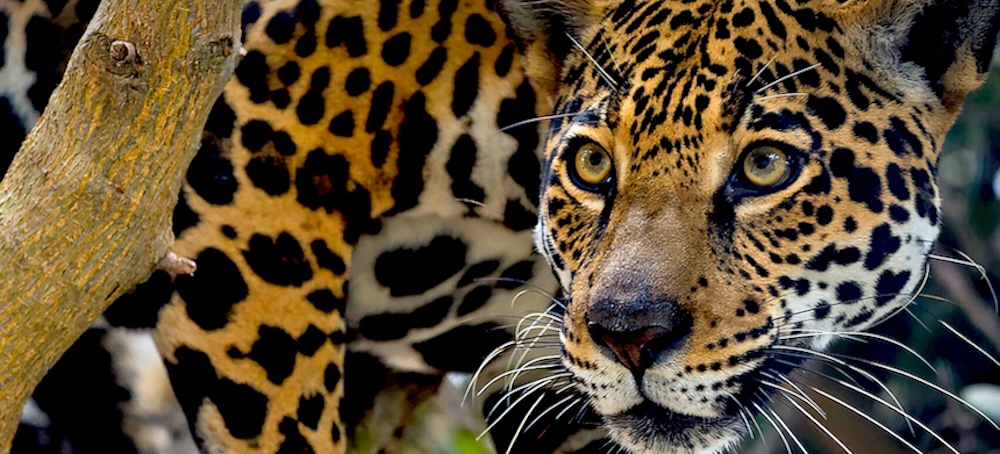 A jaguar. (photo: San Diego Zoo Wildlife Alliance)
Wildlife trafficking is the fourth-largest source of illicit revenue globally after drugs, human smuggling and counterfeit goods, according to Homeland Security Investigations.
Sitting nearby was their best undercover operative, Alpha. He was dining with that day’s target, a Chinese currency trader with ties to a wildlife-trafficking network. Alpha’s phone was face down on the table, but its microphone was on and its fish-eye lens was recording.
Alpha wanted to know about jaguars. How much for fangs? What about a large male carcass?
Crosta, a few tables away, spoke in a hushed voice, though he was safely out of earshot. He is the founder of Earth League International (ELI), a small nonprofit based in Los Angeles that is one of the world’s most unusual animal welfare organizations. He, Alpha and Davis, the group’s intelligence chief and a former FBI agent, were in Suriname to investigate jaguar smuggling and pass the information along to the U.S. Department of Homeland Security.
“Our work isn’t in the jungle,” Crosta said. “It’s here, in the city.”
Last year, DHS established a Homeland Security Investigations unit to target wildlife trafficking and environmental crimes. The effort initially faced skepticism, said Keith McKinney, head of the unit, given the pressing need to boost border security and counter the Latin American and Chinese syndicates driving the drug trade.
“If we have 50,000 people dying a year from fentanyl overdoses, how can we divert resources to address something like wildlife trafficking?” McKinney said. “But the truth is, the same groups that are involved in moving wildlife are moving contraband, moving people, moving weapons and moving money.”
Since taking office, President Donald Trump has prioritized deportations and immigration enforcement and begun slashing government spending elsewhere. His appointees at DHS did not respond to questions about plans for this small investigative team, whose criminal cases can take years to build. But Trump is also moving to counter Chinese influence in the Western Hemisphere and intensify pressure on trafficking groups in Latin America he seeks to label “terrorists.”
The wildlife trade generates $23 billion a year for transnational criminal organizations, according to HSI, whose estimate includes parallel sales in illegal timber. The agency ranks wildlife trafficking as the fourth-largest source of illicit revenue globally after drugs, human smuggling and counterfeit goods. It is an example of what the U.S. government describes as “crime convergence” — multiple sources of illegal revenue that can create more paths to take down the same structure.
Congress authorized DHS to establish the HSI wildlife-trafficking unit in 2023. Its agents and analysts are based out of an office in Northern Virginia. For now the unit has little ability to operate in places like Suriname, but the information provided by partner groups like ELI helps map criminal networks in nations where the U.S. government has more law enforcement personnel. Crosta said ELI chooses its targets based on its own intelligence gathering. It passes the information to HSI, but doesn’t know when or even if the government will act.
He calls the exotic-animal trade “the soft underbelly” of organized crime, because smugglers don’t expect as much scrutiny from law enforcement when they’re moving shark fins or feline parts.
At the barbecue restaurant, the currency trader boasted of his ties to a network connecting gangsters in southern China with South American groups that supply jaguar parts. He told Alpha he was running gold mines in the forest and working for Surinamese traffickers who ship cocaine — “flour” he called it — to Europe. He was looking to trade cash and cryptocurrency. He thought Alpha — who spoke on the condition that only his code name be used — was a broker based in Panama who could help.
Halfway through the meal of skewered pork and lamb, a courier arrived to deliver a bag stuffed with euros and dollars. Alpha’s hidden camera recorded this, too.
The pipeline of animal parts feeds the demand for obscure ingredients in traditional Chinese medicine formulas and food recipes. China’s expanding presence in the Western Hemisphere — driven by Beijing’s underwriting of infrastructure projects as well as private businesses — has brought an influx of criminals and profiteers into the forests and fisheries of Central and South America, according to researchers, environmental groups and U.S. officials.
The region’s drug cartels work with Chinese syndicates to build supply chains for the precursor chemicals used to make fentanyl, meth and other synthetic drugs, analysts and U.S. officials say. Their expanding ties have also been a driving force behind the record number of Chinese migrants — more than 60,000 — who have illegally entered the United States along the Mexico border since 2023.
“This is a watershed moment,” said Vanda Felbab-Brown, who researches organized crime and wildlife trafficking at the Brookings Institution. “It’s symptomatic of the voracious capitalism of the cartels over legal and illegal economies.”
Governments in Central and South America, including Suriname’s, have banned poaching and wildlife trafficking. But enforcement is spotty and poachers face little risk of prosecution, according to a new report by the D.C.-based International Fund for Animal Welfare.
The group documented 1,945 cases of illegal poaching or wildlife trafficking in 18 Spanish-speaking countries between 2017 and 2022. The cases included 188 jaguars.
Crosta studied zoology and business management in his native Italy, worked as a Carabinieri officer protecting judges and prosecutors from the mafia, and then became a tech entrepreneur and security consultant before launching his nonprofit group 13 years ago. His team previously investigated drug cartel ties to illegal fishing operations in Mexico’s Sea of Cortés that harvest the totoaba fish for its swim bladder — an organ that modulates buoyancy and is a delicacy in China. The sweeping gillnets of the illegal fishing boats have driven the world’s smallest porpoise, the vaquita, to extinction.
In Suriname — a country that boasts 93 percent forest cover — jaguar hunters and traffickers are supplying “American tigers” to markets in Asia, where native tiger populations have been nearly wiped out.
Poachers can earn up to $3,000 per jaguar. The traffickers who process the animals for shipment to Asia can earn many times more.
The cats are the largest in the Americas, weighing up to 350 pounds, with a habitat ranging from Patagonia to the U.S.-Mexico borderlands. Their enormous fangs are prized by poachers and worn as medallions. “Chinese mafia like to show them off,” Crosta said. “The bigger the fang, the more money you have.”
Jaguar pelts are used for adornments. Sex organs and bones are added to a “wine” said to boost male virility. Their carcasses are boiled in crude kitchens and made into a paste that has supposedly curative properties and is easy to smuggle in personal luggage.
One of Suriname’s most prolific wildlife-trafficking groups is a network of currency traders that has branched out into smuggling migrants from southern China into the United States. They charge roughly $55,000 per person, according to ELI reports provided to the U.S. government. Once the migrants reach Suriname, the smugglers give them false passports that they use to reach Mexico. From there, they head into California.
“The problem is U.S. law enforcement agencies and governments in Latin America lack the resources, language skills and cultural knowledge to dismantle these networks or even figure out the magnitude of their reach,” said Leland Lazarus, an expert on China-Latin America relations at Florida International University.
Clearing the forest
Suriname, a former Dutch colony that won independence in 1975, is linguistically and physically isolated from the rest of South America — like a Caribbean island surrounded by trees instead of water.
Most of the country’s 650,000 people live in and around Paramaribo, the 400-year-old capital that operates today like a frontier camp, with dollars, euros and gold circulating in a freewheeling economy. The streets are a mashup of historic wooden churches, Hindu temples, casinos, mosques, Javanese restaurants, gold traders and Chinese megastores selling everything from power tools to whiskey to knockoff Nike sneakers.
The U.S. State Department identifies Suriname as a cocaine-trafficking hub. Some of the country’s current and former leaders have been convicted of drug smuggling.
“Our institutions are totally corrupt,” said Erlan Sleur, an activist who returned home to Suriname nearly 20 years ago after studying biology in the Netherlands. Sleur uses drone cameras to document the catastrophic destruction caused by gold mining — some of it in protected forest areas — and waterway spills of chemicals used to process the ore, including mercury and cyanide. The miners, both Surinamese and foreigners, are increasingly controlled by criminal groups. They also target jaguars.
Romeo Lala is head of the Suriname Forest Service, which oversees compliance with international treaties regulating the wildlife trade. He said his country has worked successfully with nongovernmental organizations to promote jaguar conservation and discourage killings by ranchers and casual hunters. Most of the Chinese-run jewelry shops in downtown Paramaribo no longer openly display jaguar fangs on gold chains, and Surinamese prosecutors are getting tougher on poachers, too, Lala said.
But Lala acknowledged that he has just 50 rangers to police a jungle territory larger than the state of Georgia. “Some people are going to do illegal things, and patrols are lacking because we do not have enough resources,” said Lala, speaking at his office in the back corner of a ramshackle building with peeling green paint.
Lala said his agency has only two four-wheel-drive vehicles for the entire country. An aide reminded him that one of the vehicles was under repair.
One area with a high concentration of jaguars, the Bakhuis Mountains in western Suriname, is a 10-hour drive from Paramaribo over cratered logging roads with rickety wooden bridges. Fresh tapir tracks and jaguar prints were visible on the road during a recent visit, along with spent shotgun cartridges.
“If miners come across a jaguar, they will kill it,” said Vanessa Kadosoe, a biologist at the University of Suriname who studies jaguars. “They feel threatened by its presence.” Poachers sometimes use dogs to bait them — “jaguars love to eat dogs,” she said — or play audio recordings of a female jaguar in heat to lure them into the open.
A lucrative trade
After Alpha’s meeting with the animal trader, Crosta and Davis debriefed him back at their hotel. He provided another lead: A Chinese trafficker based in Peru had been traveling regularly to Suriname to obtain monkeys, jaguar parts and birds.
The information and other tips would go into a report for HSI.
“Environmental crimes are heavily co-mingled with legitimate trade and business,” said Chris Egner, an HSI special agent who worked with ELI to bust traffickers moving totoaba fish bladders from Mexico into California. “That can make it more challenging to disrupt and dismantle.”
Poachers and wildlife traffickers have followed not far behind the bulldozers and cranes of China’s Belt and Road infrastructure investments across the Global South, according to scholars and advocacy groups.
The end of China’s covid lockdowns and its decelerating economy triggered a wave of out-migration whose ripple effects in Latin America are only starting to come into focus.
Many Chinese newcomers use accounts in China to purchase commercial goods and ship them to Suriname, selling them for hard currency, according to researchers and analysts. Those funds can be used to invest in mining, logging and other quick-money schemes including the exotic animal trade.
In the port areas along the Suriname River, ships load up with logs bound for China. The vessels can also carry wildlife parts and other illegal cargo, investigators say. Smugglers use the international airport, too, where there are daily flights to Europe, most through the Netherlands. Dutch customs agents rarely screen the baggage of passengers headed to locations outside the European Union, officials in the Netherlands said. That includes flights to China.
China’s Foreign Ministry did not respond to a request for comment.
Angelic del Castilho, a former Surinamese ambassador to Indonesia who now runs an anti-corruption opposition party, said her country’s debt to Beijing and dependency on Chinese trade have made authorities even more hesitant to act against well-connected exporters and merchants, especially over wildlife trafficking, which is seen as a lesser offense.
Suriname’s new Foreign Ministry building was paid for by the Chinese government, she noted. “They even provided the computers,” she said.
Environmental and anti-corruption activists fear even greater corrosive effects due to a looming oil boom. In September, French multinational TotalEnergies announced a deal with Suriname’s government to invest more than $10 billion in the country’s first offshore drilling project. That same month, Chinese authorities announced a new direct shipping link from China to Suriname. It has slashed transit time from 100 to 45 days, opening new opportunities for smuggling.