In Sudan and Afghanistan, Disaster Upon Disaster
Ishaan Tharoor The Washington Post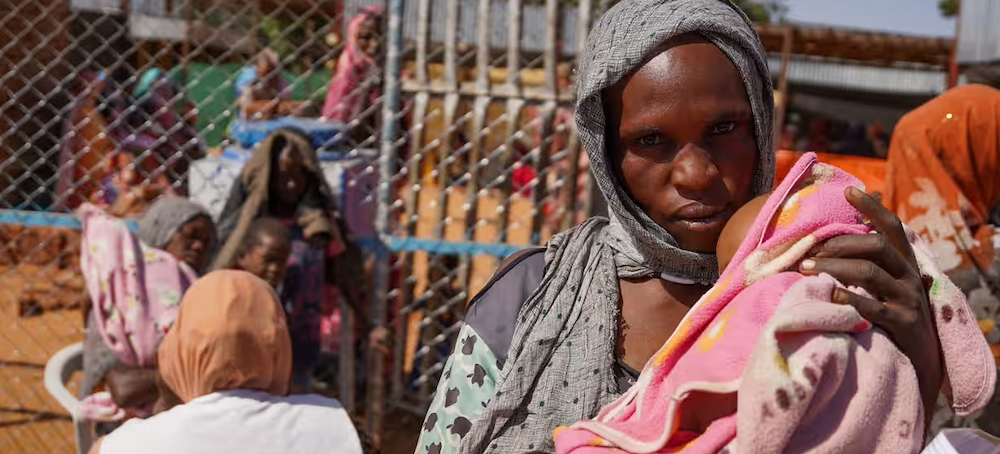 A woman and baby at the Zamzam camp south of El Fasher. (photo: Mohamed Zakaria/Reuters)
The interlocking crises facing Sudan and Afghanistan come at a moment when societies in the West are turning their backs on welcoming refugees and offering international humanitarian aid.
The tragedy marked one of the worst natural disasters in modern Sudanese history, but it seems already a small detail in a broader canvas of suffering. Thanks to the country’s ruinous civil war, which began in April 2023 and has likely killed more than 150,000 people, Sudan is home to an ongoing famine, a cholera epidemic, the world’s largest displacement crisis, and a grim catalogue of other humanitarian calamities. The Marrah Mountains had seen an influx of civilians displaced by fighting elsewhere in Darfur, especially the besieged city of El Fasher, where U.N. officials warn of an entire population under threat of starvation.
On the same day of Sudan’s deadly landslide, a powerful earthquake struck Afghanistan’s eastern Konar province. The quake and subsequent aftershocks and tremors in the past week have killed more than 2,200 people, according to government officials Thursday. Rescue efforts have also been hobbled, with resources limited and roads and bridges damaged. An Islamic relief charity estimated that just 2 percent of homes in the province remain standing, such is the scale of devastation. U.N. officials claim about more than half a million people, including many children, have been impacted by the quake, with many left stranded in the mountains without adequate shelter.
Afghanistan’s pariah Taliban government has requested international assistance, and numerous countries, including neighboring China and Uzbekistan, have dispatched aid. Humanitarian organizations have mobilized some emergency funds, but it’s a fraction of what’s needed for communities that were already poor and vulnerable and now utterly bereft.
“My family lost about 300 cows, sheep and goats in this earthquake. All the people in the village were farmers and livestock keepers,” a farmer in the shattered town of Wadeer lamented to the Associated Press. “We have no other source of income. I don’t know what to do or where to go because our homes collapsed. Not even a wall is left. What are we going to do with this life?”
In Afghanistan, the misery and deprivation extends well beyond the parts of the country hit by natural disaster. Roughly half of the Afghan population requires some form of humanitarian assistance. U.S. aid cuts and other humanitarian funding shortfalls have hit deep in a country long dependent on international support.
The draconian, ultraconservative policies of the Taliban have cruelly targeted women, keeping girls out of school and pushing women largely out of public life. To add insult (and likely more injury) to injury, in Konar after the earthquake, reports suggested some male rescue workers refused to tend to stricken women over cultural prohibitions about touching them.
Despite their isolation on the world stage since seizing power four years ago, the ruling Taliban have tried to stabilize the economy. But Afghanistan has been struggling to absorb the recent return of more than 2 million Afghan refugees deported back to the country from neighbors including Pakistan and Iran. The gutting of USAID by President Donald Trump has led to the closure of hundreds of medical facilities in Afghanistan, and stripped hundreds of thousands of people of access to vital food staples, as my colleague Rick Noack reported earlier this year.
“Local resources are stretched to the breaking point, and lack of funding is limiting the scale and speed of the humanitarian response,” Jacopo Caridi, Afghanistan country director for the Norwegian Refugee Council, said in a statement Wednesday. He urged donors to “step up and remain engaged for the long haul — not only to fund life-saving relief, but also to ensure Afghans have a chance at a future beyond perpetual emergency.”
For now, though, perpetual emergency remains the status quo in both Afghanistan and Sudan. Even as other governments reconsider their approach to the Taliban in Kabul, Washington maintains stifling sanctions and looks unlikely to normalize ties with the Islamist militants anytime soon. The Trump administration has also terminated protected status for thousands of Afghan refugees hoping to build a life in the United States, including many Afghans who worked closely for years with U.S. forces in the country.
The traumas of generations of bloodshed and atrocities loom large; in Sudan, the International Criminal Court believes there’s sufficient evidence of war crimes in the recent conflict, especially carried out by the paramilitary Rapid Support Forces in Darfur. For all his fitful efforts of global peacemaking, Trump has not devoted much lip service, let alone any real time, to forcing a ceasefire in Africa’s third-largest country.
The USAID cuts can be measured in lives lost in Sudan, especially in a surge of children dying of malnutrition. As roving militias wield rape as a weapon of war, the United Nations estimates that some 7 million women and girls in Sudan no longer can access vital reproductive health services, leading to a spike in stillbirths, newborn mortality and preventable maternal deaths.
The interlocking crises facing Sudan and Afghanistan come at a moment where societies in the West are turning against welcoming new refugees, while major governments are turning their backs on funding huge pillars of a faltering international humanitarian system.
“Global needs are alarmingly high, driven overwhelmingly by the consequences of conflict and instability, yet the resources required to meet them are shrinking as some governments cut their funding for international humanitarian work,” Cindy McCain, executive director of the U.N.’s World Food Program, wrote in an op-ed last month. “As a result, WFP is facing a deep budget shortfall which has forced drastic cuts to critical food assistance. Millions of people have lost, or will soon lose, the lifeline we provide.”