In Chicago, ICE Creates a Regime of Terror
Emma Janssen Prospect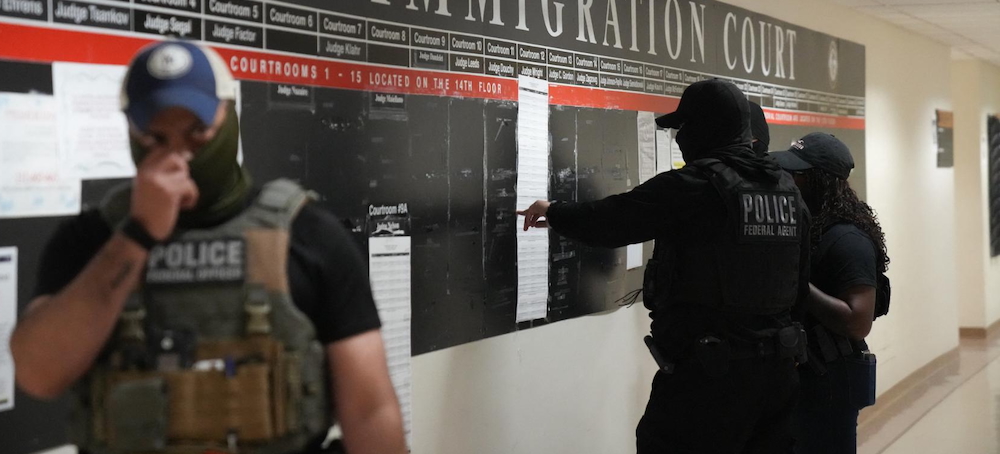 US Immigration and Customs Enforcement agents look over lists of names and their hearing times and locations inside a courthouse. (photo: Bryan R. Smith/AFP/Getty Images)
On Friday, ICE agents killed a man in a suburb and fired pepper balls at peaceful protesters.
The situation reached a new level of intensity on Friday. I reported from a protest outside of an ICE processing facility in Broadview, a town just outside of Chicago. When someone is detained by ICE in the Chicago area, they are likely to be brought to the Broadview facility before being transferred out of state—in 2021, Illinois lawmakers made it illegal to use Illinois jails to hold ICE detainees.
By mid-morning, a crowd of around 100 protesters had gathered. Some had been there since the early hours of the morning. The facility’s doors and windows are boarded up, and chain link fences topped with coils of barbed wire kept agents in and protesters out.
A small contingent of around seven protesters sat in front of one of the facility’s driveways with the goal of blocking vehicles from moving in and out. Most of those vehicles were nondescript, unmarked white vans.
Just before 11:30 a.m., agents attempted to drive a gray sedan out of the facility. In tactical gear with their faces characteristically covered, they pushed forward toward the chanting protesters, who refused to move. Agents responded by surrounding them and dragging them forcibly across the road before retreating into the facility. Throughout, Broadview police officers formed lines to separate the protesters from the ICE agents.
Meanwhile, the protesters remained peaceful. A handful of them were members of the same church group. One, who asked to stay anonymous out of fear of retaliation, told me that their faith motivated their decision to come protest.
“We are called to love and care for one another,” they said. “It’s so maddening to me that they’re doing this, and that we have local police, state police, and federal police cooperating on stuff that is just so abhorrently cruel.”
Around noon, the same van returned to the facility. A prerecorded message played from a speaker, telling protesters to disperse or risk arrest. Nobody moved. Agents once again pushed toward the protesters, this time firing what the crowd assumes were pepper balls at the seated protesters. The van drove quickly around the crowd and back through the gate. An agent stood on the roof, weapon in hand, looking down at the crowd.
When agents weren’t dragging protesters across the concrete, the mood was calm and bordering on joyful. Spanish music boomed from speakers (Bad Bunny featured prominently), and protesters hunted for any sliver of shade they could find to protect themselves from the late-summer sun. Two candidates for Illinois’s Ninth Congressional District open seat, Evanston Mayor Daniel Biss and online media personality Kat Abughazaleh, made appearances and chatted with those gathered. When the sun was at its highest, someone brought bags of crushed ice (pun very much intended) and passed out improvised snow cones.
“It’s clear to me that any escalation is coming from the state,” another protester, who lives in Chicago, told me. They had been sitting in the driveway when ICE agents picked them up by the underarms to clear the way. “I think some people were able to stay limp more successfully than I was. And once we were up, they [ICE] shoved us out of the way.”
A few hours later, I watched a different protester get shoved by ICE agents and spoke to her after they had gone back into the building. “They just wanted to push us around,” she said. “They’re just a bunch of wannabe fascists.”
By 2 p.m., there were some 25 protesters left. Attorney Kevin Herrera of Raise the Floor Alliance arrived at the scene and attempted to enter the facility by knocking on the boarded-up front door. Nobody answered. Herrera explained that one of his clients had been detained by ICE just hours earlier while driving his car in Little Village, one of Chicago’s predominantly Latino neighborhoods.
Herrera said that he didn’t know where his client was taken after his arrest but figured that the Broadview facility was a likely place to look. His client is a day laborer in his late thirties whose wife lives in Chicago with him. The man is a plaintiff in a civil rights lawsuit against the Chicago Police Department and Home Depot for the detention and beating of day laborers. Herrera noted that the timing of his client’s detention and his participation in a lawsuit seems suspicious.
Herrera's first stop after the arrest was to make sure his client’s wife was OK, and his second stop was the processing facility. But he was unable to get in or even communicate with the officials inside.
In the past, he said, “I’ve been able to show that I represent the individual and then have a conversation with them. I know that Los Angeles has had similar problems with access to counsel at processing facilities.”
ON FRIDAY, THE NEWS ALSO BROKE THAT, just four miles from the Broadview facility, an ICE agent shot and killed a man named Silverio Villegas-Gonzalez. A representative for ICE said that Villegas-Gonzalez was resisting arrest during a vehicle stop and drove his car toward ICE officers. One officer was dragged by the car and injured but is now in stable condition.
Department of Homeland Security Assistant Secretary Tricia McLaughlin tried to use the incident to discourage anti-ICE activism and awareness campaigns, saying in a statement: “Viral social media videos and activists encouraging illegal aliens to resist law enforcement not only spread misinformation, but also undermine public safety, as well as the safety of our officers and those being apprehended.”
Chicagoans haven’t taken the bait. “Know your rights” trainings are continuing across the city, and some activists I spoke to are planning to demonstrate outside of the Broadview facility at least once a week.
Earlier in the year, Tom Homan, President Trump’s border czar, tried to scorn but instead actually complimented Chicago: “Sanctuary cities are making it very difficult,” he said on CNN in January. “For instance, Chicago … they’ve been educated on how to defy ICE, how to hide from ICE.”
Over the weekend, Chicagoans celebrated Mexican Independence Day. Even before then, cars have been driving around with massive Mexican flags sticking up out of their sunroofs. Some celebrations, like the relatively new El Grito, were canceled or postponed due to fear of ICE. In Little Village, parade organizers advised vulnerable people to stay home. Advocates and activists have been handing out cards with legal resources, as well as whistles that community members can use to alert the area if immigration officials are present.