‘If You’re Not Here, You Think L.A.’s Burning’: Trump’s Alarm Meets City Calm
Reis Thebault The Washington Post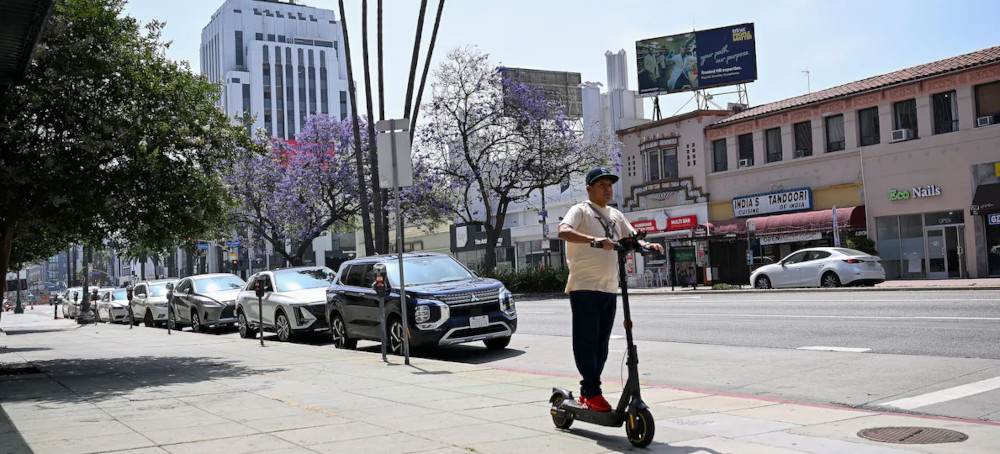 A pedestrian rides an electric scooter along Wilshire Boulevard in Los Angeles on Wednesday. (photo: Joshua Lott/The Washignton Post)
The demonstrations over immigration raids occupy only a tiny parcel of real estate in this huge metropolis — despite the president’s claims of vast mayhem.
For days — as social media feeds and cable news replayed images of burning cars and smashed windows, as President Donald Trump claimed a violent insurrection was underway — the couple fretted about whether they should cancel their anniversary trip out West.
Yet the Los Angeles they saw after arriving Tuesday morning was serene: sunny skies, peaceful streets, no hint of civil unrest or the federal government’s aggressive, militarized response.
“If you’re not here, you think L.A.’s burning to the ground,” Joe McGuire said. “But you come out here, you look around and you just say, ‘My God, this is where I want to be.’”
Despite Trump’s assertions that Los Angeles was beset by widespread lawlessness, a chaos he insisted could be quelled only by thousands of National Guard troops and Marines, the protests that have unfolded here since Friday in response to immigration raids have been mostly confined to a few downtown blocks.
They have featured sporadic violent clashes, which intensified as the sun set and organized rallies dispersed, prompting the mayor to impose a curfew for downtown Tuesday night. Overall, though, the crowds have not been especially large, and life in much of this sprawling metropolis has continued uninterrupted.
On the tree-lined streets of the city’s westside, joggers passed beneath blooming purple jacarandas. In northeast neighborhoods, street vendors sold fresh fruit and tacos. Kids, celebrating the start of summer break, played in parks. Retirees read newspapers outside a cafe.
Riding in open-top tour buses, visitors craned their necks to get a good look at the homes of celebrities. Revelers packed the city’s Pride parade and the Hollywood Bowl’s opening weekend.
An around-the-clock, everywhere-all-at-once emergency this is not.
“This is a manufactured crisis with a manufactured narrative that completely misunderstands Los Angeles,” said Fernando Guerra, director of Loyola Marymount University’s Center for the Study of Los Angeles. “It is as though there’s a fire in one house and someone is claiming that the entire town is burning down.”
That doesn’t mean Angelenos aren’t aware of what’s happening. On the contrary, many stridently oppose the Immigration and Customs Enforcement crackdown, fearing for themselves, their families or their neighbors.
But Los Angeles is huge, and even as a feeling of foreboding lingers, the protests triggered by the ICE raids have hardly impeded daily routines. The city is roughly 500 square miles and could hold more than 20 Manhattans within its bounds. L.A. County is even larger and, with nearly 10 million residents, would be the country’s 11th most populous state.
In portraying the pandemonium as total, Trump and his allies are furthering several political goals, Guerra said. The president is showcasing his anti-immigration policies, communicating his willingness to upend long-standing norms and bolstering his persistent argument that Democratic-led cities are out of control.
“If you ever wanted a playbook on how to dominate the national narrative, this is it,” Guerra said. “He’s met all his objectives.”
For a reality check, he added, compare the events of recent days with past moments of upheaval. The 2020 protests following the murder of George Floyd by Minneapolis police drew far larger crowds here, and the 1992 riots after the beating of Rodney King left an extensive trail of damage across the L.A. area.
And the latest demonstrations weren’t even the biggest of the year locally, nor were they the first to shut down parts of the 101 freeway. Officials maintain that a typical police response — which might include mutual aid from the state, county or neighboring cities — would have been sufficient.
“We’ve all been, in Los Angeles, a part of a grand experiment to see what happens when the federal government decides they want to roll up on a state, roll up on a city and take over,” Los Angeles Mayor Karen Bass (D) told reporters recently.
In the same news conference, she took pains to underscore that the most significant confrontations between protesters and police were isolated to a relatively small area. “Unfortunately the visuals make it seem as though our entire city is in flames, and that is not the case at all,” Bass said. “And I think it’s important to say that.”
At the Griffith Observatory, those visuals didn’t fool Lynn Counts, who had just arrived from Illinois a couple hours before. She and her family saw the headlines but decided to make the trip anyway. Her impression after driving the distance from Los Angeles International Airport? An overreaction.
“We’re from Chicago,” she said. “So we’ve seen plenty of stuff like that.”
Peter Pastore of Toronto has been in Los Angeles for nearly a week, sightseeing while his son competed in a Tetris tournament. Best he can tell, Trump is just back to picking a fight with California, a favorite punching bag. His family hasn’t noticed anything amiss.
“It’s really no big deal,” Pastore said.
The only thing that has made him nervous during the trip: his lifelong earthquake phobia.
In the neighborhood of Silver Lake, Tera Uhlinger and her 12-year-old schnauzer, Mason, were lounging in the grass next to the area’s reservoir. Like other residents, she has been fielding concerned messages from out-of-town friends and family.
“I think people who don’t live in L.A. think that it’s kind of like any other city,” she said.
Instead, it’s diffuse, spread out, a multiplicity of diverse places and people. Uhlinger — a writer, actor and Reiki practitioner — has been feeling the dissonance lately. She has been dismayed by the immigration raids, but the protests have felt a world apart.
Her focus has been on Mason, who is recuperating from a back injury.
“We’re a few miles from the protest right now,” Uhlinger said. “But I’m a million miles away, sitting in the park, giving my dog attention.”