ICE Agents Hate Being Filmed
Guy Chazan and Sam Learner Financial Times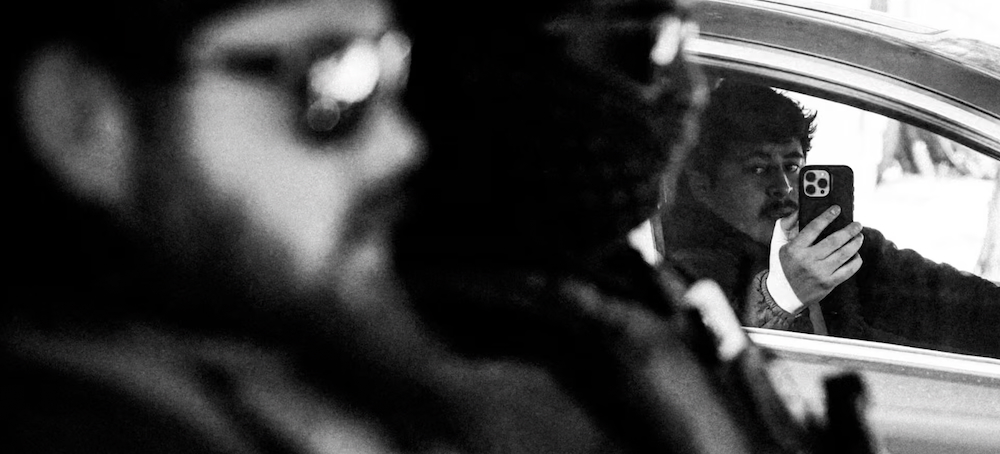 A community member films federal agents conducting an immigration enforcement action in Saint Paul, Minnesota, on 27 January 2026. (photo: Seth Herald/Reuters)
Trump administration accused of trampling First Amendment by targeting Americans recording immigration raids
Ecklund is one of hundreds of Americans who have been apprehended by Immigration and Customs Enforcement for recording the largest crackdown on undocumented migrants in recent American history.
It is an activity that civil rights experts insist is fully protected under the First Amendment — and one that Trump administration officials have equated to domestic terrorism.
In an interview, Ecklund said he felt morally obliged to capture what the agents were doing in his community.
“In that moment, I felt the responsibility to hold those who have been given immense power . . . to a commensurate level of accountability,” he said. “Because no one else seems to be doing that.”
Over the past few months, video footage circulating on social media has repeatedly shown US citizens who have tried to film ICE agents on their phones being pushed, pepper sprayed, threatened with arrest and occasionally detained.
DHS officials have argued that filming amounts to an obstruction of justice or interference in the duties of federal agents. However, federal and appellate courts say it is allowed as long as it does not physically obstruct the officers being videotaped or interfere with their work.
Critics of ICE say its interactions with people trying to monitor and record its operations are proof of a lack of professionalism in an agency whose public profile has dramatically increased since President Donald Trump launched his campaign against illegal immigrants.
“In the US people have fundamental speech rights and we have the freedom to film and follow cars under our constitution,” said Janet Napolitano, who was secretary of Homeland Security from 2009 to 2013.
“Law enforcement agents should be trained in how to handle that and not respond with tear gas and pepper spray,” she added.
Much of the focus on ICE’s hostile interactions with the public has been in Minneapolis, where two US citizens — Renée Nicole Good, a poet and mother of three, and Alex Pretti, an intensive care nurse, were shot dead by immigration agents last month, sending shockwaves across the country.
But confrontations with immigration enforcement agents have also taken place in other cities.
In a residential area of Santa Barbara, north-west of Los Angeles, local police were called out on Wednesday to deal with a confrontation between ICE agents and a large group of local residents protesting their presence.
Videos of the encounter, shared on social media, show one person being sprayed with some kind of chemical and another pushed by ICE agents, apparently in retaliation for filming the encounter.
Ashley Farrell, a landscape designer, witnessed the incident, which involved a friend of hers, a local estate agent she identified as Beth.
“They tried to push a woman whose car was stuck in the street, and Beth went to her aid and ended up getting sprayed in the face,” she said. “It was unnecessary aggression.
“They are unvetted, untrained and aggressive,” she said of the ICE agents operating in Santa Barbara. “They’re wearing military gear and carrying weaponry as if they’re in Fallujah, and they’re on the streets of America.”
Another video that went viral on social media shows a row between a local resident and an ICE agent in Portland, Maine. A woman asks why her information is being taken down: the agent responds: “Because we have a nice little database. And now you’re considered a domestic terrorist”.
The woman responds, “Ha, ha, ha, for videotaping you? Are you crazy?”
Meanwhile, the administration is finding other ways to curtail attempts to monitor ICE’s activities. On January 16, the Federal Aviation Administration announced a ban on drone flights in the proximity of DHS “facilities and mobile assets, including vessels and ground vehicle convoys”.
The “Notice to Airmen” (NOTAM) makes it illegal to operate a drone within 3,000 horizontal feet or 1,000 vertical feet of any DHS vehicle, without providing any specific co-ordinates for the vehicles or restricted airspace. The action has drawn condemnation from groups such as the American Civil Liberties Union, which warned that the order would be impossible to comply with owing to the lack of advance notice of DHS movements and would “create a sweeping power for DHS officials to take down nearly any drone they like”.
A coalition of media groups — including Getty Images, the New York Times and National Press Photographers Association — expressed legal concerns in a letter to the FAA, noting that the nature of the restrictions “put journalists at significant risk of criminal and civil penalties for conducting what, before now, had been routine First Amendment protected activity”.
Addressing complaints about agents’ interactions with protesters, Trump administration officials say they are simply responding to a heightened atmosphere of violence at anti-ICE protests and threats to their own personal safety.
Filming, they say, is often a prelude to “doxxing”, the practice of publishing personal data about an individual or group without their consent.
“Violence is anything that threatens them and their safety, so it is doxxing them, it’s videotaping them where they’re at when they’re out on operations, encouraging other people to come and to throw things, rocks, bottles,” Kristi Noem, secretary of Homeland Security, said last July.
Officials are increasingly describing such activity as domestic terrorism. A leaked memorandum from attorney-general Pam Bondi from December last year, sent to all federal prosecutors, said domestic terrorism included the “organised doxxing of law enforcement” and “violent efforts to shut down immigration enforcement”.
Agents are also using another tool — invoking a federal criminal statute known as 18 U.S.C. § 111 that makes it a crime to assault, resist, oppose, impede, intimidate or interfere with certain federal officers or employees while they are performing their official duties.
Videos circulated on social media often show ICE agents citing 18 U.S.C. § 111 when they tell people to stop following them. Ecklund said that a handwritten piece of cardboard was hanging above the table where he was booked by DHS agents with the words “U.S.C. 111”.
But civil rights experts insist the statute is being misapplied, since yelling, whistling at or recording agents does not necessarily constrain their ability to carry out their operations.
David Bier, director of immigration studies at the Cato Institute, a think-tank, said the use of the statute against people trying to film ICE officers was “totally spurious”, noting that, as far as he knew, everyone detained under 111 for filming had been released without charge.
But he said the toughened policy would have a “chilling effect” by discouraging people from getting out their phones and recording law enforcement — even when it is engaged in legally questionable tactics.
“The implications here are that these agents get to effectively be as unaccountable as any group in the history of our country,” he said. “Not only do they get to wear masks and not identify themselves and arrest and detain people with impunity, but then they can also block people from filming them. So there’s no record of what they’re doing.”
Ecklund said he did not regret his decision that day in January to grab his phone, videotape and follow the ICE agents patrolling his neighbourhood.
“What’s happening here is far larger than the protests and the police actions in our city,” he said. “It’s the systematic undoing of everything our country was supposed to be built on.”