I Miss My Old Life
Mahmoud Khalil New York Magazine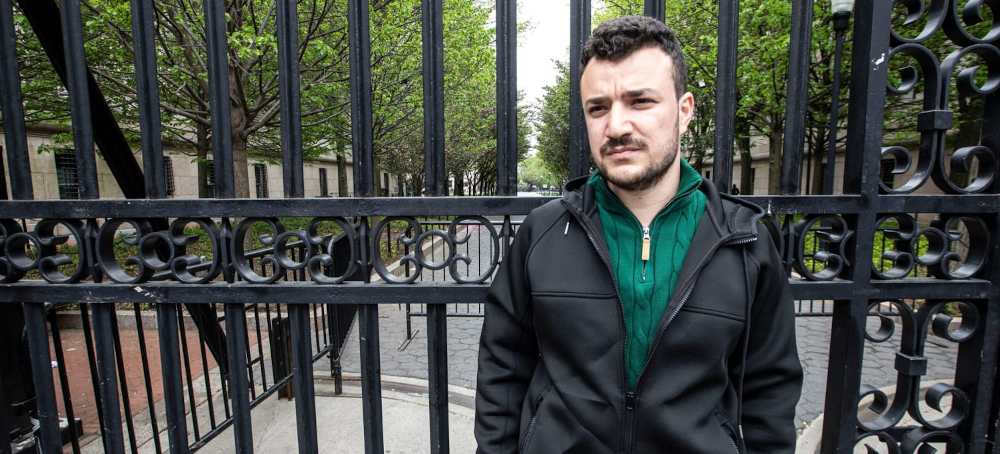 Mahmoud Khalil, a graduate student at Columbia University, outside the campus gates last year. (photo: Seth Harrison/USA Today network)
A year ago, the Trump administration unlawfully arrested me at my home and detained me for 104 days. I walk free now, only after an army of lawyers sued the administration for targeting me because of my pro-Palestine speech. But the government is relentless in targeting me, still using every road and alleyway it can find to punish me with the legal system and bureaucracy. So when I walk, I watch my back. When someone falls in step behind me, I stop, tie my shoe, check my phone, and wait until they pass.
Before I leave home, I put on sunglasses and a baseball cap, a different color each day. I can’t afford cabs every day, so I ride in the last subway car — less crowded, fewer eyes. I keep my head down, reading a book so I don’t have to look up. My face may not be widely recognizable, but it takes only one person to ruin my day. Or my life.
At home, I catch myself mid-sentence, mid-bite, mid-laugh, gone somewhere else. My wife, Noor, will say something and I’ll nod. I am on the sofa but not in the room: always thinking, planning, reading, writing, scrolling, while time ticks away. Am I being a good father? A good husband? How can I be when I cannot take walks alone with my son? How can I explain to Noor that I take her out less now because when we are together, people recognize us more?
This past December, Noor and I were having dinner at a restaurant. I had not Googled it beforehand to get a sense of the political temperature of the space. We were almost finished with our meal when a group of customers who had been watching us stood to leave. On their way out, they stopped across from our table and began singing “Am Yisrael Chai” over our heads for two minutes — an Israeli nationalist anthem often chanted by racist mobs while harassing Palestinians. It went on long enough to make clear that this was not a celebration. We did not react. Now, I check. I look up every place before we go somewhere new. I scan for signs, flags, and cues.
I miss my life before the fog. I miss wandering with Noor through Times Square at night, letting it swallow us, that particular New York surrender to noise and light and strangers, necks tilted toward glowing screens. I miss Washington Square Park on a weekday evening, the city’s chaos gathered in one place. I miss Sunday brunch at Community, in Morningside Heights, followed by coffee at Qahwah House, and the long walk home along Claremont Avenue — that narrow, tree-lined stretch that always felt like a pause. Back then, we didn’t think of those walks as anything. That’s the thing I can’t get back: the not-thinking.
I miss attending events at Columbia or meeting friends on Low Steps. Since my release, the university has refused me entry three times: twice to speak and once simply to see a friend and return a library book. (White House Ghosts: Presidents and Their Speechwriters sits on my bookshelf with a $100 late fee.) For every refusal, its stated reason was “safety” and “security” concerns. I have heard those words before. Every Palestinian has. They are the words that justify the checkpoint, the wall, the permit denied, the road closed, the house demolished, the neighborhood sealed. They are words that mean: Your presence is the threat. Columbia has made me into a security problem to be managed. It was not enough that Columbia failed its Palestinian students. Now it seeks to erase our voices entirely.
When strangers approach me and ask, “Are you Mahmoud Khalil?” — the same words in the same expectant tone the DHS agent used before the handcuffs — I do not know if they want to shake my hand or spit in my face. I do not know whether they will say, “Thank you for what you’re doing,” or follow me through midtown aggressively shouting, “Am Yisrael Chai.” Both have happened. At first glance, I can never tell them apart.
I see the pity in people’s eyes when they meet me. To them, I am the man who missed his son’s birth. This is the version of me that is legible and sympathetic. A victim. Someone to whom something bad has happened. I understand why this story travels. It is a clean wound. It asks nothing of the listener except sympathy. It’s the same with friends and acquaintances. When I behave normally, they say, “Oh, you are taking it with such grace!” I nod and smile. How am I supposed to act? Should I be deranged? What would they prefer? A spectacle?
I am now described everywhere as an “activist.” Nothing angers me more. The word flattens me. Worse still, it implies a version of me who was not already shattered by a life of exile, refuge, and resistance. As if this began with something I did. I did not advocate for Palestine because I wanted to be active. I advocate because I have no choice. From the moment I was born Palestinian, my existence was political. What choice does a Palestinian refugee, deprived of basic rights, have but to resist the forces that seek to erase him?
When I’m online, I hesitate before looking up certain terms or topics that any person would normally search. I pause before liking posts that I would have otherwise engaged with. There are replies I have swallowed, opinions I have kept to myself, jokes I have not made, not because they were wrong or embarrassing but because I have learned that anything I do now can be taken out of context and made into evidence. Of what exactly, I do not know. That is part of the punishment. The charge is never specified, so the vigilance must be total.
I cannot travel internationally. That is a condition of my bail. But my son, Deen, has grandparents who have never held him. He is their first grandchild. I cannot introduce them. I cannot bring him to them.
Sometimes people ask me, “Why don’t you just leave?” The question comes from friends and family. From my parents, still struggling to understand how their youngest son, who left Beirut for New York only to study, ended up a target of the highest levels of the U.S. government. Sometimes the question carries a note closer to accusation, as though staying were stubborn self-indulgence, a refusal to accept reality, as if leaving was the only rational choice. Maybe it is.
I remain in New York to fight this unjust system that treats Palestinian speech as a threat. But I also want my son to live surrounded by the community that brought meals for his mom when I was absent, that built his first library with books spilling off the shelves, that sewed the quilts hanging on the side of his bed, and that will embrace him as a son of this city, not of his father’s legacy.
The fog has not lifted. I do not think it will lift for a long time. I sometimes wonder whether it first settled long ago, when I realized that the world watched as Palestinians were slaughtered live on television. Perhaps the fog is what stands between me and the full weight of what has happened, not only to me but to all of us. If it lifted, I would have to see clearly: that a country built by immigrants also cages them. That my son spent his first weeks without his father because I believed in the right of Palestinians to live. That slogans were criminalized while bombs were blessed. That “From the river to the sea” became offensive while “Flatten Gaza” remained a policy. Perhaps the fog is what keeps me from waking each morning to the unfiltered knowledge of how rotten this world is, how obscene, how nauseating the complicity has been. From the knowledge that this is not a world that failed to act. It is a world that acted decisively: to fund the bombs, to block the resolutions, to smear the witnesses, to arrest the mourners, to starve a population, to burn the tents, and to call it self-defense.
This is, of course, not the whole story. The fog persists, but kindness keeps it from closing in.
While looking for apartments, my name had become a liability even on a lease application. I had to search under Noor’s name. An extraordinary real-estate agent recognized us and spent days finding us a place, free of charge. He owed us nothing. He did it anyway.
A young woman at Olive Garden, after serving us, insisted on covering the bill out of her own pocket. I do not know what she earned that shift, but I know the bill was a significant portion of it. There have been baristas at coffee shops around the city, more than I can count, who have looked at me and said, “It’s on the house,” pressing extra pastries into my hands and refusing payment. I remember the Italian owner and the Lebanese chef down the street who served us a meal, and when the bill came it was a slip of paper with $0 written on it and a note: “We support you and a free Palestine.” I did not know they knew. I did not know they cared. But they did, and they found a way to tell me without turning it into a moment.
How do I hold these two truths together? That I walk through the city afraid and that the city, in small and persistent ways, tells me I am welcome. That I am watched and that I am seen. That I have been made into a symbol against my will and that some people look at the symbol and recognize a person anyway.