I Am Nearly 96 Years Old, and for the Last 60 Years Have Kept a Secret
Dolores Huerta Medium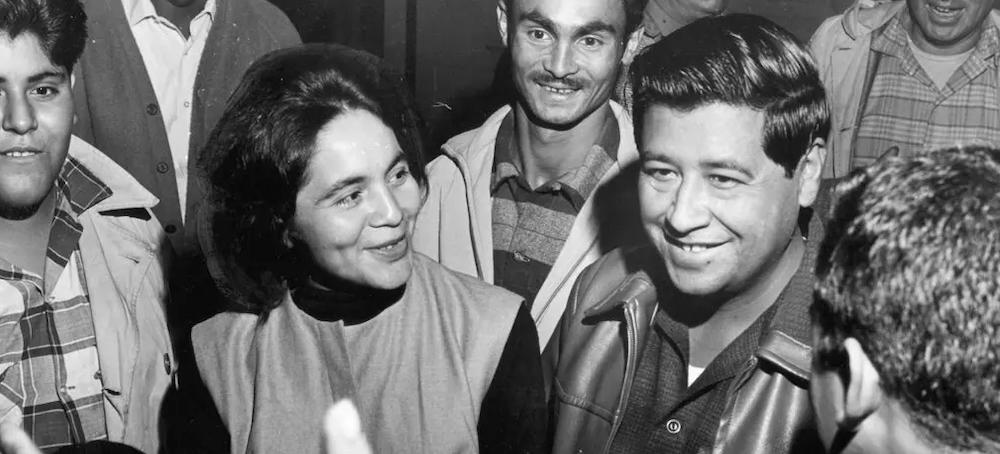 Dolores Huerta, left, and Cesar Chavez in Fresno, California, in 1965. (photo: Carl Crawford/Fresno Bee/ZUMA Press/Reuters)
Today, civil rights leader Dolores Huerta issued the following statement:
I have encouraged people to always use their voice. Following the New York Times’ multi-year investigation into sexual misconduct by Cesar Chavez, I can no longer stay silent and must share my own experiences.
As a young mother in the 1960s, I experienced two separate sexual encounters with Cesar. The first time I was manipulated and pressured into having sex with him, and I didn’t feel I could say no because he was someone that I admired, my boss and the leader of the movement I had already devoted years of my life to. The second time I was forced, against my will, and in an environment where I felt trapped.
I had experienced abuse and sexual violence before, and I convinced myself these were incidents that I had to endure alone and in secret. Both sexual encounters with Cesar led to pregnancies. I chose to keep my pregnancies secret and, after the children were born, I arranged for them to be raised by other families that could give them stable lives.
Over the years, I have been fortunate to develop a deep relationship with these children, who are now close to my other children, their siblings. But even then, no one knew the full truth about how they were conceived until just a few weeks ago.
I carried this secret for as long as I did because building the movement and securing farmworker rights was my life’s work. The formation of a union was the only vehicle to accomplish and secure those rights and I wasn’t going to let Cesar or anyone else get in the way. I channeled everything I had into advocating on behalf of millions of farmworkers and others who were suffering and deserved equal rights.
I have never identified myself as a victim, but I now understand that I am a survivor — of violence, of sexual abuse, of domineering men who saw me, and other women, as property, or things to control.
I am telling my story because the New York Times has indicated that I was not the only one — there were others. Women are coming forward, sharing that they were sexually abused and assaulted by Cesar when they were girls and teenagers.
The knowledge that he hurt young girls sickens me. My heart aches for everyone who suffered alone and in silence for years. There are no words strong enough to condemn those deplorable actions that he did. Cesar’s actions do not reflect the values of our community and our movement.
The farmworker movement has always been bigger and far more important than any one individual. Cesar’s actions do not diminish the permanent improvements achieved for farmworkers with the help of thousands of people. We must continue to engage and support our community, which needs advocacy and activism now more than ever.
I will continue my commitments to workers, as well as my commitment to women’s rights, to make sure we have a voice and that our communities are treated with dignity and given the equity that they have so long been denied.
I have kept this secret long enough. My silence ends here.”
If you are a survivor or if you have been impacted by any type of sexual violence, please visit the Dolores Huerta Foundation website, where you will find a list of resources for support. https://doloreshuerta.org/sexual_assault_resources/
Cesar Chavez, a Civil Rights Icon, Is Accused of Abusing Girls for Years
by Manny Fernandez and Sarah Hurtes, The New York Times
An investigation by The New York Times found extensive evidence that the United Farm Workers co-founder groomed and sexually abused girls who worked in the movement.
Ana Murguia remembers the day the man she had regarded as a hero called her house and summoned her to see him. She walked along a dirt trail, entered the rundown building, passed his secretary and stepped into his office.
He locked the door, as he always did when he called her, and told her how lonely he had been. He brought her onto the yoga mat that he often used in his office for meditation, kissed her and pulled her pants down. “Don’t tell anyone,” he told her afterward. “They’d get jealous.”
The man, Cesar Chavez, one of the most revered figures in the Latino civil rights movement, was 45. She was 13. Ms. Murguia said she was summoned for sexual encounters with him dozens of times over the next four years.
Recently, more than 50 years later, Ms. Murguia learned that a street near her home in the Central California city of Bakersfield was in the process of being renamed. City officials want to name it in honor of her abuser.
Cesar Chavez Boulevard.
Ms. Murguia and another woman, Debra Rojas, say that Mr. Chavez sexually abused them for years when they were girls, from around 1972 to 1977. He was in his 40s and had become a powerful, charismatic figure who captured global attention as a champion of farmworker rights.
The two women have not shared their stories publicly before, and an investigation by The New York Times has uncovered extensive evidence to support their accusations and those raised by several other women against Mr. Chavez, the United Farm Workers co-founder who died in 1993 at the age of 66.
The questions raised by The Times about Mr. Chavez, one of the most consequential figures in Mexican American history, set off immediate reverberations and alarmed and disturbed his allies. Even before this article was published, upon learning of the reporters’ inquiries, the U.F.W. canceled its annual celebrations honoring Mr. Chavez, a response to what the union he once led called “profoundly shocking” accusations.
Ms. Murguia and Ms. Rojas, both of whom are now 66, were the daughters of longtime organizers who had marched in rallies alongside Mr. Chavez. He used the privacy of his California office to frequently molest Ms. Murguia, she said. He had known her since she was 8 years old. She became so traumatized that she attempted to end her life multiple times by the age of 15.
“I wanted to die,” she said.
Ms. Rojas said she was 12 when Mr. Chavez first touched her inappropriately, groping her breasts in the same office where he’d meet with Ms. Murguia. When Ms. Rojas was 15, he arranged to have her stay at a motel during a weekslong march through California, she said, and had sexual intercourse with her — rape, under state law, because she was not old enough to consent. (Ms. Murguia said Mr. Chavez molested her but never had intercourse with her.)
The abuse allegations appear to be part of a larger pattern of sexual misconduct by Mr. Chavez, much of which has never been publicly revealed. The Times investigation found that Mr. Chavez also used many of the women who worked and volunteered in his movement for his own sexual gratification. His most prominent female ally in the movement, Dolores Huerta, said in an interview that he sexually assaulted her, a disclosure she has never before made publicly.
Many of the women stayed silent for decades, both out of shame and for fear of tarnishing the image of a man who has become the face of the Latino civil rights movement, his image on school murals and his birthday a state holiday in California.
The findings are based on interviews with more than 60 people, including his top aides at the time, his relatives and former members of the U.F.W., which he co-founded with Ms. Huerta and Gilbert Padilla. The Times reviewed hundreds of pages of union records, confidential emails and photographs, as well as hours of audio recordings from U.F.W. board meetings.
The accounts of abuse from Ms. Murguia and Ms. Rojas were independently verified through interviews with those they confided in decades ago and in more recent years. Elements of their stories were also corroborated in documents, emails, itineraries and other writings from union organizers, supporters of Mr. Chavez and historians.
The Times spoke at length with Ms. Huerta, the renowned Latina activist who helped run the farmworkers’ union with Mr. Chavez and coined the social-justice rallying cry, “Sí, se puede,” loosely translated as “Yes, we can.”
She said she has held on to a dark secret for nearly 60 years.
One night during the winter of 1966 in Delano, Calif., she said, Mr. Chavez drove her out to a secluded grape field, parked and raped her inside the vehicle. Ms. Huerta, who was 36 at the time, said she chose not to report the assault to the police because of their hostility toward the movement, and she feared that no one within the union would believe her. She also described an earlier encounter in August 1960, when she said she felt pressured to have sex with him in a hotel room during a work trip in San Juan Capistrano in Southern California.
Ms. Huerta later began a long-term domestic partnership with Mr. Chavez’s brother Richard, with whom she had four children. He died in 2011.
Ms. Huerta turns 96 on April 10. Her memories of the details of the assault that night in Delano are at times hazy. But she speaks of the attack in a startlingly matter-of-fact manner.
She described being stunned by Mr. Chavez’s aggression, and then numb to it. She framed her silence at the time not as an absence of pain, but as a kind of strategic necessity, particularly as a woman fighting for respect in the male-dominated world of 1960s union organizing. Now, her accusation shatters what was a widely celebrated — and seemingly egalitarian — bond between two of the most influential Hispanic activists in U.S. history.
“Unfortunately, he used some of his great leadership to abuse women and children — it’s really awful,” Ms. Huerta said.
More than 30 years after his death, Mr. Chavez has become only more revered in the Latino community, as President Trump’s efforts to limit immigration and scale back rights threaten to destroy many of the gains secured by decades of his work.
Through a series of grueling fasts, grape boycotts and marches that captured the world’s imagination, Mr. Chavez drew a spotlight to the plight of the American farmworker. He not only improved wages, living conditions and health care for generations of farmworkers and their families but also strengthened the political power of Latinos, giving their voice and concerns an urgency and moral authority on the national stage.
He was given the Presidential Medal of Freedom, the nation’s highest civilian honor, in 1994. When Joseph R. Biden Jr. entered the White House in 2021, he put a bronze bust of Mr. Chavez on display in the Oval Office.
The allegations of rape and sexual abuse are likely to have far-reaching consequences.
On Tuesday, the United Farm Workers issued a statement saying that the organization would not take part in any activities celebrating Mr. Chavez’s birthday on March 31. The union said the “troubling allegations” that were surfacing were incompatible with the organization’s values, adding that it did not have firsthand knowledge of any misconduct.
“We need some time to get this right, including to ensure robust, trauma-informed services are available to those who may need it,” the union said in its statement.
Mr. Chavez’s family said on Tuesday night that they were “not in a position to judge” the claims. “As a family steeped in the values of equity and justice, we honor the voices of those who feel unheard and who report sexual misconduct,” they said in a statement. “These allegations are deeply painful to our family.”
A handful of Mr. Chavez’s relatives and former U.F.W. leaders have been aware for years about various allegations of sexual misconduct, but there is no evidence that they made efforts to fully investigate the accusations, acknowledge the victims or apologize to them. Instead, many of the women say they were discouraged from speaking out in order to preserve Mr. Chavez’s public image.
Internal emails dating back over a decade show union members discussing Ms. Murguia’s claims of abuse and the impact it had on her life. One of Ms. Murguia’s relatives confronted Mr. Chavez while he was still alive, in the 1980s. According to the relative, Mr. Chavez offered no defense and responded only by clearing his throat.
More than 10 years ago, members of a private Facebook group for longtime Chavez organizers and supporters were stunned to read a post from Ms. Rojas that she wrote in a fit of anger as they prepared to celebrate the holiday in his name.
Her post read, in part: “Wake up people. This man u march for every year molested me.”
Ms. Rojas deleted the message days after posting it and was accused by some who saw it or heard about it of jeopardizing all that had been accomplished by not only Mr. Chavez but her parents and those they marched alongside.
Nothing has emerged publicly to back up the claims made by Ms. Huerta. Her description of assault could not be independently verified because she said she had told no one, not even her children or closest friends, until just a few weeks ago.
But the paper trail of some of Mr. Chavez’s misconduct involving young girls can be found in the very archives built to preserve his legacy.
In one handwritten letter on girlish stationery imprinted with roses, Ms. Rojas wrote to Mr. Chavez in January 1974 at the age of 13, shifting between childlike school updates and swooning devotion. She said she wrote the letter more than a year after he first kissed and fondled her in his office in 1972, when she was a 12-year-old seventh-grader. “I’m really glad I got to see you … spend time with you, well not like that, but just to know I was near you was enough,” she wrote, adding, “I think of you all of the time. Do you think of me?”
The letter is among thousands of documents and other materials in the Walter P. Reuther Library archives at Wayne State University in Detroit.
Looking back on it now, Ms. Rojas said she believed then that Mr. Chavez wanted her to be a real part of his life. He would tell her that they would move together someday to Mexico. He told her to stay away from other boys because he’d get jealous. He told her that the Flamingos song, “I Only Have Eyes for You,” was their song, and that every time she heard it she should “just remember that I love you.”
“I had love for him,” Ms. Rojas said. “He did his grooming very well. He should get an Academy Award for all he did.”
An Initial Reckoning
Elements of Mr. Chavez’s extramarital affairs with adult women were chronicled in at least two biographies, Matt Garcia’s “From the Jaws of Victory: The Triumph and Tragedy of Cesar Chavez and the Farm Worker Movement,” published in 2012, and Miriam Pawel’s “The Crusades of Cesar Chavez: A Biography,” published in 2014.
But neither raised issues of abuse of underage girls.
While Mr. Chavez had eight children with his wife, Helen Chavez, the Times investigation showed that he also fathered at least four children with three other women. Two of these children and other family members were interviewed and confirmed the relationship. Additionally, 23andMe match results were reviewed for the four children, and they confirmed Mr. Chavez’s biological ties in each case.
Two of the children were the result of his two sexual encounters with Ms. Huerta, she told The Times, including the assault she described in 1966. Ms. Huerta said she concealed the pregnancies by wearing baggy clothes and ponchos, had the baby girls and then arranged for them to be raised by others.
The accusations involving Ms. Murguia and Ms. Rojas date back to a period when they themselves were children, with behavior they now describe as grooming beginning when they were as young as 8 or 9.
Ms. Rojas said she started seeing a therapist at the age of 16, four years after the abuse began, and continues to see one today. “I picked up a drinking habit,” she said. “A panic attack habit. A bad relationship habit.”
Ms. Murguia said she suffers from panic attacks and depression, and has trouble being in public spaces or being part of crowds.
“I feel like he’s been a shadow over my life,” Ms. Rojas said. “I want him to stop following me around. It’s time.”
With some exceptions, most of the episodes the women described occurred over the decades in the same tight-knit place — La Paz, the union’s compound in the Tehachapi Mountains more than 100 miles north of Los Angeles where he kept his home and his office.
The Murguias had been the first family to move into La Paz, in 1970, when Ana was 10. Her father was a union official and one of Mr. Chavez’s closest aides. Mr. Chavez had been the best man at his wedding three years earlier when he married Ms. Murguia’s stepmother, a union volunteer.
After Mr. Chavez and his family moved to the compound in 1971, he would sometimes ask Ms. Murguia, who was 12 by then, to help him dictate letters or work the community’s phone switchboard. She was proud of being able to mimic his signature so masterfully that she would sign it on documents.
“Dear Eddie, I’m writing this letter for Cesar,” read one letter she wrote to a union supporter in April 1972. “Cesar liked your picture very much. Sincerely, Ana Murguia.”
Initially, she said, she enjoyed spending time with him in his office. To her, he was the only adult who truly listened, a confidant who sympathized with her as she coped with schoolyard bullies and her father’s temper. He told her he was lonely, burdened by his bodyguards and unable even to use the bathroom alone. They spent hours talking.
Ms. Murguia said she was 13 when Mr. Chavez began inviting her into his office. He had an obsession with alternative healing therapies, and would sometimes put her on his desk and demonstrate the “pressure points” that could relieve stress and pain, she said. That eventually led to kissing, and then fondling. And then more.
“When I was on the yoga mat is when he would try to have sex,” Ms. Murguia said.
Ms. Murguia said she wasn’t attracted to Mr. Chavez, and was initially surprised by his touches, but said she felt chosen. “Part of it was, why would someone like that like someone like me?”
She said Mr. Chavez told her not to tell anyone because other girls and women would be jealous of their special bond.
He took her on tour with him, having her travel in his car and stand with him at events and marches. She appears next to him in several photographs — among them one of the most iconic images from the U.F.W.’s famous 1,000-Mile March in the summer of 1975, and an earlier shot alongside the folk singer Joan Baez.
But it was also during that time, two years after he first touched Ms. Murguia in his office, that things changed.
By now age 15, she had accompanied Mr. Chavez on a trip to Los Angeles. At a fund-raiser’s home in Bel Air, she walked into the kitchen and found him kissing a woman. She left quickly. “I was disgusted,” she said. On the way back to La Paz, she rode with the guards and the dogs, refusing to share a car with him.
Their time in the office grew less intimate and eventually ended. She started to ache with a quiet distress.
“I felt very alone,” she said. “I had zero support.”
She finally left La Paz at 19 but soon fell into a spiral of heroin addiction. Desperate, she thought that Mr. Chavez could help her and returned to La Paz. But this time, when she went to his office, she found a room full of men. And Mr. Chavez, she said, turned on her.
“He told me I was bringing drugs into the community and needed to get out.”
She went home in tears and remembers a family member asking what happened. “He doesn’t need me anymore,” she recalls saying. “I’m grown up. He told me to get out.”
The next day, she checked into a rehab program that Mr. Chavez had arranged for her. She never spoke to him again.
Several people corroborated her story. One family member said she learned of the abuse in the early 1980s, after Ms. Murguia told her about it. Another person said Ms. Murguia disclosed the abuse to him in 1989. One of the men present in the room when Ms. Murguia was kicked out of La Paz refused to comment. Another said he didn’t remember that time in his life.
For a long time, she felt she would be blamed for what had happened. That was how it worked back then, she said — girls were abused by family members, by people close to the family, and it was always kept quiet. And if anyone found out, she said, the question was never about the man. “It was always: ‘Well, what did you do? See what you did.’”
There was one person at La Paz she knew she could share her story with, and that was Ms. Rojas.
‘It’s Like You’re Mesmerized’
Ms. Rojas was living at La Paz in 1972 and remembers Mr. Chavez’s special mystique. She was 12 at the time. He would walk by, and it was as if a movie star had passed. One day that year, he asked her to come into his office and locked the door. He asked her about school. She remembered going up to his bookshelves to admire the many books.
Mr. Chavez touched her then for the first time. She described being frozen. He could see how nervous she was. He kissed her and touched her breasts.
“It’s a shock,” she said. “It was uncomfortable. It went from star-struck to I don’t understand this. What is happening?”
It was the first of many times he touched her sexually. After that first sexual encounter, he used to call her house and talk union business with her father, and then, before they hung up, he would ask him to put his daughter on the phone.
“I didn’t know what the word grooming was,” Ms. Rojas said. “It’s like you’re mesmerized.”
In the summer of 1975, Mr. Chavez and his aides were preparing for the 1,000-Mile March, a nearly 60-day event that was to start near California’s border with Mexico. The goal was to unionize farmworkers and draw public attention to their recent victory in Sacramento — a new state law that protected farmworkers’ rights to unionize and established a state agricultural labor relations board.
Mr. Chavez had invited Ms. Rojas, who was 15 at the time, to join them. Her parents were skeptical, Ms. Rojas recalled, but he told them that he would make sure their daughter would be safe.
“He kept calling and calling and calling for me to go on the march,” Ms. Rojas said. “My dad just wanted to be in his favor, because my parents loved him. We all loved him.”
In August 1975, the march reached Stockton, the San Joaquin Valley city about an hour south of Sacramento. One night, Ms. Rojas recalled, Mr. Chavez told her he was sending her home for a week. She was sad and confused, and thought she had done something wrong.
She was waiting at the bus station when Mr. Chavez drove up with one of his bodyguards. He invited her into the car, and they drove to a motel on Highway 99.
In the motel room he shared with her, she said, he had intercourse with her for the first time — rape, under California law. She was a virgin, and remembers that it hurt, and she was bleeding. But she also remembers the gun Mr. Chavez had placed on the night stand next to the bed. She couldn’t help but look at it every time she turned her head, and it scared her, she said.
“I said, ‘What’s that for?’” Ms. Rojas said.
“Don’t worry about it,” she said he told her.
He said because of the death threats he received, he and his security team wanted to make sure they were safe.
Several people and documents corroborated the accusations made by Ms. Rojas, including a relative who said Ms. Rojas first told her in the late 1990s that Mr. Chavez had abused her.
As the march ended, Ms. Rojas said, Mr. Chavez grew colder toward her. He told her that he needed to go back to his wife.
‘Cesar Chavez Is Just a Man’
Esmeralda Lopez’s encounters with Mr. Chavez came years later, long after Ms. Rojas and Ms. Murguia had moved away from La Paz.
She had grown up in the union, the daughter of a longtime union staff member, Cynthia Bell. In April 1988, Mr. Chavez selected Ms. Lopez to travel with him on an out-of-state speaking tour. After an event in Michigan, he invited Ms. Lopez into his camper attached to a pickup truck. She said it was just the two of them in the small camper, and they sat next to the bed. At one point, she said, Mr. Chavez pointed to a street sign outside bearing his name and suggested that he could use his influence to get something named for her if she slept with him. She was 19, and he was 61.
Shaken, Ms. Lopez rebuffed him, and he did not pursue it further. She later called her mother to say she was returning home early from the trip. When Ms. Bell asked what happened, Ms. Lopez replied: “Cesar Chavez is just a man.”
Ms. Bell told her to come home. She immediately understood what her daughter meant. In a recent interview, Ms. Bell, now 75, corroborated her daughter’s account of that day.
By then, Ms. Bell said, she had worked closely for decades with the union leader. She said Mr. Chavez had made sexual advances toward her during a dance at a fund-raiser in Bakersfield in the early 1970s, when she was in her early 20s. “I see you sometimes, like one of my daughters, but then I get these other feelings,” she said he told her as the two danced.
About 10 months after the incident in the camper, Ms. Lopez said, Mr. Chavez fired her from her job at a union health clinic.
Over the years since then, Ms. Lopez and Ms. Bell said, they have thought a lot about Ms. Lopez’s words that day back in 1988, that this icon they had dedicated so much of their lives to was just a man.
“It makes you rethink in history all those heroes,” Ms. Lopez said. “The movement — that’s the hero.”
‘A Dr. Jekyll and Mr. Hyde Situation’
In the 1970s, Mr. Chavez went almost nowhere alone.
After federal authorities uncovered a plot to assassinate him in 1971, he began traveling with a security team, moving in two-car convoys of three to six guards, coordinating by walkie-talkie. The night Mr. Chavez took Ms. Rojas’s virginity at the motel on the outskirts of Stockton, she said, she remembers that one of his bodyguards, Manuel Chavez, drove the two of them there.
A few of these bodyguards have since died, including Manuel Chavez, who was a cousin of Mr. Chavez. Several others declined to comment, including his head of security, Richard Ybarra, who married Mr. Chavez’s daughter Anna Chavez in late 1971. Others said they were certain that Mr. Chavez had not engaged in any sexual abuse and rejected the women’s claims as incompatible with the man they knew.
Frank Curiel, a former Marine, drove Mr. Chavez across California, often late into the night, and served as his bodyguard for nearly two decades beginning in the early 1970s. He lived at La Paz for nearly 30 years. “I’ll tell you this: Pedophile? Never,” Mr. Curiel said. “As far as I’m concerned, Cesar was my chief.”
Some of the other women who lived at La Paz also said they experienced nothing like what Ms. Murguia, Ms. Rojas and Ms. Lopez described, though Mr. Chavez was a frequent presence in the lives of the daughters of his loyal organizers and volunteers. They recalled his attending their family functions, taking them on tour with him, asking them to work in his office after school and exchanging letters, gifts and photographs, but several of these women said he did not pursue any sexual relationship with them.
One of them, Jessica Coriell, said Mr. Chavez was her mentor and taught her to channel her anger into books rather than violence. “If it weren’t for Cesar’s words and encouragement and kind and loving advice, I wouldn’t be where I am today,” Ms. Coriell said.
Yet many of those who look back on those years at La Paz also say that Mr. Chavez was a man who could be nurturing one moment, only to use that same emotional intimacy to manipulate and abuse the next.
Ms. Huerta said he abused her not only physically but emotionally.
Union records document an argument at La Paz between the two of them over missing financial receipts during a board meeting in 1979. Ms. Huerta demanded respect and pushed back against his suggestions that she had stolen money. Mr. Chavez responded by shouting at her with curses and insults, repeatedly calling her a stupid bitch, according to the audio recordings of board meetings The Times listened to.
Ms. Huerta struggles to reconcile the Cesar Chavez she knew, who inspired so many and achieved so much, and the man who assaulted her and publicly humiliated her. She said she was unaware of any sexual abuse of teenage girls. Moments after some of that abuse was described to her, Ms. Huerta broke down, sobbing and wailing.
“It’s kind of like a Dr. Jekyll and Mr. Hyde situation I think,” Ms. Huerta said of Mr. Chavez.
Ms. Murguia, Ms. Rojas and Ms. Huerta said they struggled for years about whether to tell their stories publicly. Some of those closest to them begged them not to, arguing that it could not be a worse time to attack a Latino hero, when immigrants were facing widespread detention and deportation and the political rights of Hispanics seemed to many to be under assault.
In the end, they said that the story of Chavez’s movement was their story, too — of the women who marched beside the men, worked in the fields, took care of the children. The movement, they said, was more than one man.
In 2013, Ms. Murguia returned to La Paz. The surrounding mountains were as beautiful as she remembered. She found her old white wooden house, its porch railing gone. The old hospital where so many had slept was boarded up.
Then she walked into the building where he had worked. The walls were lined with photos and testimonials about Mr. Chavez, celebrating his legacy. His office was down a long corridor. One of the office walls had been replaced by a large window, so visitors could peer in.
That day, Ms. Murguia looked at his desk. His chair. His tall bookshelves. And there, in the right corner, she saw something that stopped her, bringing back a rush of memories. It was the yoga mat.