How to Leave the USA
Atossa Araxia Abrahamian The New Yorker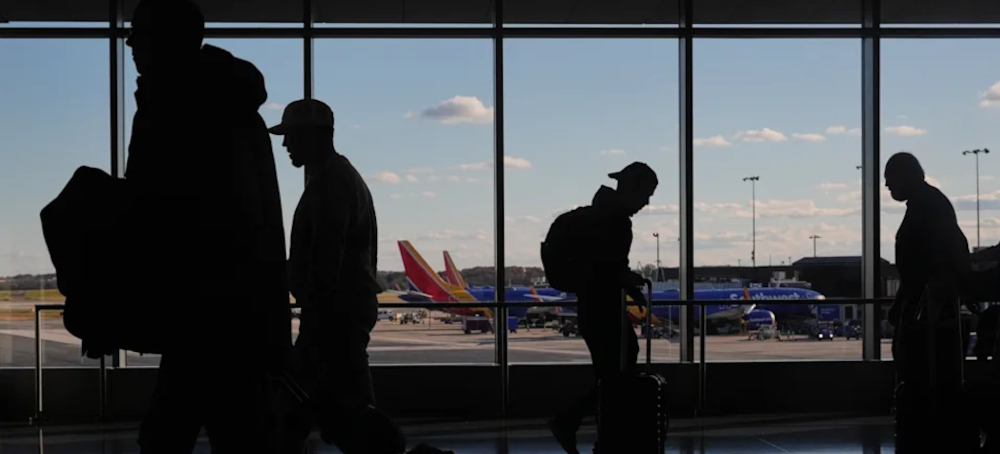 In the wake of President Trump’s reëlection, the number of aggrieved Americans seeking a new life abroad appears to be rising. (photo: iStock)
In the wake of President Trump’s reëlection, the number of aggrieved Americans seeking a new life abroad appears to be rising. The Netherlands offers one way out.
Debi and Bane, a couple from Denton, Texas, sat at a long table on the mezzanine level, admiring the space’s stained-glass windows. Debi is a forty-two-year-old project manager with an easy laugh and dark bangs that frame her heart-shaped face. “It hasn’t hit me yet that we’re here, to be honest,” she said.
Bane, thirty-seven, works as a freelance photographer and manages social media for an orthopedic surgeon. He enjoys heavy metal and complex tabletop games like Dungeons … Dragons and lets his wife do most of the talking. Debi assured me that he’d been “just giddy” at their hotel. “This is a guy who barely shows emotion,” she said.
I’d been in touch with Debi and Bane throughout the summer, as they planned their trip—and their eventual exit from the United States. They’d always thought about retiring overseas, Debi said, but they moved up their timeline last spring because of Donald Trump’s flagrant disregard of court orders; precursors, Bane noted, of full-blown authoritarianism. After he took office for the second time, “things got real,” Debi said. “At first, we were hopeful things would get better, or not worse.”
“But they didn’t,” Bane deadpanned.
The evening had been organized by G.T.F.O. Tours, a relocation service that helps aggrieved U.S. citizens start new lives abroad. The dinner was the first stop on a crash course in the Dutch way of life. The tour, Debi and Bane hoped, would help them plan a permanent move in January.
Over beers and bitterballen, breaded balls of beef stew, the conversation at the table quickly turned to politics. G.T.F.O.’s clients are liberal—they all want to escape Trump—but Bane is a democratic socialist, and Debi considers herself more of a centrist. Debi, who has two adult sons, grew up in a military family and enlisted when she was nineteen. She served as a communications specialist on bases in the U.S., Korea, Iraq, and Germany and worked as a civilian contractor in Afghanistan. Although she now feels “duped” by the government’s rationale for the war on terror, the military allowed her to pay for school and provide for her family. She enjoyed the work. “Even in Iraq, I had a great time,” she said, recalling the camaraderie.
Until Debi moved to Denton and met Bane, at a bar, in 2012, she’d voted Republican by default. “I remember being in Iraq when Obama got elected. I didn’t even know who he was,” she said. She gives Bane credit for her change of heart but also says that watching people in her community struggle made her appreciate the importance of the social safety net. “We were well taken care of in the military. You don’t realize how socialistic that is: we’re given free health care, free housing, free food,” she said. Coming out of isolation after the pandemic, Debi had a harder time countenancing the inequality around her. “I felt like it was for some reason on my shoulders to fix everything,” she recalled.
She coped by volunteering in her community, but that did little to calm her fears. The more news stories she read about Trump’s second term, the more she foresaw a time when ordinary Americans would be stripped of their civil rights and live under martial law. That didn’t look like much of a future.
Inflation had also made it hard to save money, and the couple’s economic prospects seemed uncertain. Even though she was making six figures working for a large bank, things felt tight. Debi and Bane worried about retirement. They sold blood plasma to pad their bank accounts.
“The American Dream is something you’re told about to make you part of a system that clearly doesn’t work anymore,” Bane said during one of our conversations. “I want to be where the government cares about you and takes care of you and is you.”
Every four years, a group of Americans threatens to leave the country. These proclamations tend to take place in early November and involve Canada. No mass exodus occurs. Moving is hard; moving countries is harder. There are families, jobs, pets in the mix. This time around, though, Americans seem to be acting on their desires. The State Department doesn’t keep close track of how many Americans settle abroad, but immigration lawyers told me that the number of people approaching them about it has gone up since Trump was reëlected. “Anecdotally, there’s a noticeable increase,” Sanjay Sethi, an American attorney who recently relocated to Geneva, told me. “What’s been so surprising is how much I’m hearing in my personal life—the desire to leave or get another passport.”
Migration is never simple, but money helps. At least half the world’s nations offer visas or fast-track citizenship to foreigners in exchange for investments or cash. According to Eric Major, whose company, Latitude, helps people apply for such programs, citizenship-by-investment clients once primarily came from places with limited civil and economic freedoms—Russia, China, Iran. Now the majority of them come from the U.S. “We are seeing an increase in Americans actioning a Plan A (full outright migration, with a view of leaving the US) as opposed to just securing a Plan B,” Major told me in an e-mail. “We just signed up a NASA lady (moving to Portugal), a SpaceX guy (moving to Malta), and a Cornell University professor (moving to London).”
For Americans without much money, grandparents can be a golden ticket. Tens of thousands of U.S. citizens have sought out second passports since last fall, hunting down birth registrations, marriage certificates, and records from synagogues and churches. By one estimate, forty per cent of Americans could be eligible for another citizenship. Failing that, online influencers advertise alternative paths to a beautiful, affordable, gun- and car-free life style: using Social Security payments to qualify for a Portuguese passive-income visa, skirting Thai laws with regular “visa runs” to Cambodia, or exploiting Albania’s generosity—twelve months visa-free!—to try out the Mediterranean.
This ever-proliferating content often glosses over bureaucracy, crime, and the fact that Westerners tend to sequester themselves in spaces that locals can’t afford. Anywhere must be cheaper—and less stressful—than America is today. A recent survey by the Harris Poll, a research firm, found that nearly half of its respondents had considered leaving the U.S., citing politics and the cost of living as their main factors. There’s a historical irony to these responses. Americans are looking to emigrate for the same reasons that immigrants once came to America—for safety, economic security, better opportunities, and an over-all sense that their families would have a better future.
Americans are also afraid. Between January and November, sixty-seven U.S. citizens (many of them transgender) have requested asylum in the Netherlands; last year, there were nine. No applications have been approved this year. In October, a Rutgers professor named Mark Bray moved to Spain after receiving death threats at his home prompted by a petition, from the school’s chapter of the conservative group Turning Point USA, to have him fired. Bray is a scholar of antifascism, “so the dynamics of this aren’t alien to me per se,” he told me. “But you know the Nietzsche quote ‘If you stare long enough into the void, the void stares back’? Everything I’d been writing about was suddenly looking at me through the void.”
Debi and Bane’s contingency planning was frantic at first, spurred on by “extreme, zombie-apocalypse scenarios,” as Debi remembered it. They envisioned having their passports revoked, or being detained for having said the wrong things. Debi was especially preoccupied with Project 2025, a blueprint for the country conceived by the Heritage Foundation. Trump had distanced himself from the conservative think tank during his campaign, but once in office he openly pushed to sign its prescriptions into law.
When her life went on as usual, albeit against a backdrop of disturbing headlines, she said, “it evolved to ‘Why do we have to wait for something extreme to happen?’ ”
She and Bane couldn’t afford to drop hundreds of thousands of dollars on a Caribbean investor passport. They looked into Canada—Americans assume they’re welcome there—but did not qualify for permits based on their work or education. They found no prospects in Spain, Portugal, or the U.K., either.
Then, while browsing Facebook in the spring, Debi discovered G.T.F.O. tours. The company’s founders, Jana Sanchez and Bethany Quinn, posted links and comments that spoke to Debi’s concerns about Trump’s America, but they seemed also to have practical advice. In a Zoom call, Sanchez explained that, thanks to the Dutch-American Friendship Treaty (DAFT), an agreement signed in 1956 to promote bilateral investment, Bane could register his business in the Netherlands, capitalize it with forty-five hundred euros, and bring Debi along. They could be gone in a matter of months.
Debi had never given the Netherlands, a country of eighteen million people, all that much thought. She’d visited Amsterdam in her twenties, and she’d learned in school that the Pilgrims had lived there before setting off for the New World. Then she remembered that the art works in her home with Bane—a pair of paintings from his grandparents, a set of cookie molds hanging on a wall, and prints of paintings by van Gogh and Vermeer—were all Dutch. “I love antiquing, and I found this cute little lithograph that I thought was maybe a street in Paris,” Debi told me. “A few weeks ago, I got a hunch and put it through Google Lens. And, sure enough, it’s Amsterdam. Who has all this Dutch art work?” she marvelled. It seemed as sure a sign as any.
In Haarlem, on Sunday, the Americans convened in the lobby of their hotel to meet a real-estate agent, or makelaar, named Daniel Pilon, who had immigrated to the Netherlands from South Africa. The number of Americans approaching Pilon this year has increased tenfold—“It’s the political situation,” he told me—but many give up, he said, when they can’t find an apartment. “It’s difficult, because they are serious, but not serious enough,” he said.
The Netherlands’ cities have a persistent housing shortage. It’s not unusual for there to be forty people at an apartment viewing, Pilon explained, each with higher salaries and better references than the last. Someone asked him what a perfect candidate looked like. “The single person coming on a work contract for two years, working for a big company,” he replied without missing a beat.
Self-employed workers arriving on the DAFT visa are at a disadvantage: landlords prefer Dutch work contracts as proof of income, so Americans sometimes offer a year’s rent up front. Sanchez pressed Pilon for the monthly cost, in euros. “How much would you suggest for a budget?” she prompted.
“Two and a half thousand,” he said.
“Are you only competing with other expats?”
“Also Dutch people. Most Dutch people will not be paying over three thousand.”
“Dutch people buy,” Sanchez added. “The interest rates here are, like, three per cent. If you have a Dutch contract, you’re loving life.”
Sanchez lives on the bank of a Haarlem canal in a town house with her Dutch husband, Edwin; they bought the place in 2000. At sixty-one, Sanchez, who has hazel eyes, freckles, and leonine gray hair that she pulls back with a scrunchie, is intensely personable, if prone to hyperbole. She describes her role with G.T.F.O. as an “escaping-fascism doula” and seemed a little hurt when I said I wasn’t making plans to leave the States. “Nobody thinks their great-grandparents left Germany too early,” she and Quinn reminded me on several occasions.
On the desk of her home office are two canonical texts of the American resistance—“How Fascism Works,” by Jason Stanley, and “On Tyranny,” by Timothy Snyder. Both authors recently left Yale to work at the University of Toronto.
Sanchez was born in California and raised in Texas. Her grandfather was a migrant farmworker from Mexico; she was the first in her immediate family to attend college, graduating from Rice University and going on to work in political fund-raising in California. After a stint as a news reporter in the Netherlands and London, she switched to communications—coaching executives has been the source of most of her income—and, along the way, she met Edwin online. They married in 2001, and Sanchez became a Dutch citizen three years later.
In 2014, the couple divorced. Sanchez returned to the U.S., where she planned to settle down with her dog, focus on her business, and bask in the election of America’s first woman President. She was in Texas, practicing with her country-music band (“They’re all MAGA now,” she says), when the 2016 election results started coming in. Her friends back in Europe texted, pushing Sanchez to return. “I was, like, Shit, how would I do that?” she recalled. “I had my dog, my car.”
The next morning, a friend urged her to run for office. They were both in a state of shock from the night before. “But, at the time, it seemed reasonable,” Sanchez said.
She threw herself into a campaign for a House seat in Texas’s Sixth Congressional District. “It was exhausting, and I was broke,” she told me. She lost the election to a local conservative politician, Ronald Wright. When Wright died after contracting COVID, three years later, she ran for his seat again—and lost again.
That year, Sanchez had got back together with Edwin, and they’d talked about making a go of it in the States. But, when Trump was reëlected, “I was just done,” she said. “I’d fought the fight.” In January, she returned to Haarlem.
Sanchez had survivor’s guilt about having left, so she started organizing weekly Zoom sessions to educate Americans about their options abroad. The most promising was the DAFT visa. It is affordable and quick, and it offers a path to citizenship after five years. Crucially, spouses of applicants receive work permits, and children can enroll in language schools to learn Dutch.
On the “DAFThub,” a Facebook page, Sanchez met Bethany Quinn, a former corporate recruiter who had moved to the Netherlands in 2022. Over drinks and tapas in Amsterdam, they devised a plan to offer relocation tours and coaching. Quinn came up with the name: Get the Fuck Out. It captured the mood.
One of G.T.F.O.’s selling points is, perhaps paradoxically, how very American its approach is. Sanchez has a warm Southern confidence, addressing clients, waitstaff, even strangers on the commuter rail, like old pals. She also has a habit of reading alarming news headlines off her phone out loud. That, I suppose, is part of her pitch. Her own Facebook page is full of memes of a distinctly #resistance flavor. “I shitpost a lot,” she once told me, cackling.
Sanchez’s Americanness is rivalled only by Quinn’s. A forty-year-old from the Washington, D.C., area with theatre-kid energy, Quinn worked in policy for the Service Employees International Union and has an M.B.A. from Johns Hopkins. She believes that Americans are traumatized by Trump’s assaults on both the Constitution and their constitutions. “When I come to the Netherlands, I feel my blood pressure drop,” she remarked in Haarlem. “And then I go to the U.S. and it’s back up again.”
In addition to Debi and Bane, the G.T.F.O. group had three participants—a Pennsylvania resident who didn’t want to be identified, and a couple in their early forties named Rita and Chris. They, like Debi, were military veterans. After our session with the real-estate agent in Haarlem, we took the train to Utrecht, a university town about thirty miles away.
An American musician in his fifties named Jeffrey Scott Pearson served as our guide. He’d left the U.S. back in 2017; not long after his move, he had a heart attack. “I was in the hospital for two, three weeks, and as an American I wondered what that would cost me,” he said, rolling up his left sleeve to reveal a long, skinny scar from where his surgeon had taken a blood vessel to graft. “But, when the bill came back, it was three hundred and twelve euros—and all of it was for parking and the pizza I ordered from the commissary.”
He added, “Even with health insurance, in the U.S., it would have cost me thirty-five thousand dollars.”
The Americans nodded in sober recognition. They all had conditions to manage—asthma, A.D.H.D., rheumatoid arthritis, various injuries—and had found medical care expensive and hard to navigate. According to a Harris poll, thirty-eight per cent of those surveyed cited health care as a reason for considering a move abroad.
Rita and Chris have spent their lives chasing stability. They grew up in Colorado, in chaotic families, and met in a high-school Spanish class when Rita was a freshman and Chris a senior. They married four years later. Their wedding reception was at Denny’s—“They had a military discount,” Rita recalls—and, the next day, Chris left for field training, in preparation for going to Iraq.
Chris, who has short blond hair and an athletic build, had been offered a scholarship to run track at Michigan State but couldn’t afford to go, because his family could not complete his financial-aid paperwork. He says he joined the military “to break the cycle of poverty”; he served two tours before he was caught in an explosion and a serious spinal-cord injury put him in retirement. Chris’s body is still peppered with shrapnel, and, even after surgery, the right side of his face is a little dented.
Rita couldn’t afford college initially, either, so she did odd jobs and entered beauty pageants for extra cash. It’s hard today to picture Rita in a pageant uttering sentences such as “My journey is all about the red-white-and-blue.” With a long brown braid and an austere personal style, Rita reminded me of a Dorothea Lange portrait mixed with a bit of “American Gothic.” She served in the Navy as a logistics specialist and enrolled in college as a reservist while Chris convalesced, waiting for his disability payments. She went on to get a master’s degree in organizational leadership.
In 2021, the pair moved to Iowa, where Rita ran a student-veteran center at a local college. She had a bad feeling when the state’s Board of Regents began scrapping diversity-equity-and-inclusion programs in 2023. But when Trump was elected again her instincts told her to run. “We’d watch the news, Chris and I, and we’d see something really bad and say, ‘We gotta get out,’ ” Rita recalled.
The President reminded them of all the things that had been wrong with the United States for as long as they could remember. They were “bamboozled,” in Rita’s words, about the Iraq War. “And now they’re using the military against their own people,” Chris lamented.
Rita channelled her anxiety into cleaning, in preparation for leaving the country. “You could tell it was a bad news day because you could look at the bedroom and see every piece of clothing had been gone through,” she said. “Our house got empty pretty quick at the start of the new Administration.”
Rita and Chris aren’t ideological. They like Bernie Sanders and Elizabeth Warren’s economic positions but would have been O.K. with a Republican such as Mitt Romney or the late John McCain in office. They weren’t planning to leave during Trump’s first term, either. “Trump Derangement Syndrome” this is not. Rather, Rita and Chris have come to understand their experience as U.S. citizens as a form of moral injury, or the distress a person feels after witnessing an event that transgresses one’s deeply held values. Chris already struggled to square his own sense of what was right with the orders he received in Iraq, where the war is estimated to have killed more than two hundred thousand civilians.
As with Debi and Bane, the couple’s unease had to do with everyday ethical concerns. “If you have any kind of empathy, it’s hard to live in the U.S. and watch what’s happening,” Chris said.
“I feel like I’m screaming at the top of my lungs, saying, ‘The house is on fire!’ while there are people actively telling me the house isn’t on fire, and they’re actively being burned,” Rita said.
Their exit was financially possible thanks to Rita’s foresight. A long time ago, she had put them on an intense saving plan, following the tenets of the Financial Independence, Retire Early, or FIRE, movement, and for years they lived in austerity. First, she got them out of credit-card debt, then they built a nest egg. “My goal was to be un-fuck-with-able,” Rita told me.
Over lunch in Utrecht, Rita and Chris surprised the group with an announcement. They were buying an apartment in the city of Delft. It seemed a bit rash—they’d been in the Netherlands for only a few weeks—but the couple knew that they would not be returning home. Earlier that summer, they’d sold their split-level house in Iowa and most of their belongings. Then they drove around the U.S. saying goodbye to friends and family. Many of Rita’s friends were sympathetic, even envious, but conversations with her family were trickier (angry relatives are a recurring theme in online expatriation forums). With them, she explained, “I’ve focussed more on the ‘I’ve always wanted to travel’ angle.”
After their goodbye tour, Rita and Chris flew to St. Kitts and Nevis, a Caribbean nation that bundles citizenship with a housing purchase beginning at three hundred and twenty-five thousand dollars. But, exploring St. Kitts’s lush greenery, sandy beaches, and garish condos, they couldn’t see themselves there long term. So they flew to Spain, hiked the Camino de Santiago trail, and discussed where else they might go.
Rita, the methodical half of the couple, led the search. She learned about the DAFT on social media and rushed to make a move. Given Trump’s posturing, a friendship treaty with a foreign government seemed like a fragile thing, and their European visas would be valid only into October. They talked to a lawyer and, on August 26th, landed at Amsterdam Airport Schiphol. Their Dutch life was about to begin.
Still, the past is never too far away. On the afternoon of our tour of Utrecht, the group attended an English-language comedy show, and an Iraqi-born comedian named Maryam Ameer told stories about her life in her native country. Ameer recalled a moment during wartime when her father was trying to corral his family into a shelter. Her sister, she said, refused to go; she wanted to sleep. Her brothers were at the final level of a game on their PlayStation. “You’re gonna die,” their father said, to which they responded, “At least we’ll die with an achievement!” Ameer was in the kitchen, eating. Her dad likewise implored her to leave. “But I said, ‘I don’t want to die on an empty stomach.’ ”
Chris, Rita, and Debi laughed politely, but I could tell they were uncomfortable. Later, they shared their own war stories: the time Chris ignored evacuation orders so that he could grab a lemon-meringue pie at the chow hall; Debi’s pact with a roommate to stay in their room at night so that they could at least die well rested. I told them that their stories sounded remarkably like Ameer’s.
“It was really awkward,” Debi said.
“I wanted so badly to apologize to her after the show, but I didn’t have the balls,” Chris said.
They took comfort in the fact that they were all there—in the same city, in the same bar, drinking beer and laughing at the same jokes.
The Netherlands is a natural place for an American to seek refuge. The Dutch influence is everywhere in America: in architecture (barns, stoops, gabled roofs); food (waffles, doughnuts, tiny pancakes); and oligarchs, from the Vanderbilt dynasty to the Koch brothers. The language sounds like American English until you realize you don’t understand a word. Reading Dutch is quite the opposite experience, however. Stare hard enough at its abundance of strange vowels, and you’ll uncover meaning. Nieuw. Brouwerij. Koekje.
Not that it matters. English is spoken widely and well by citizens of all ages, which makes Dutch hard to practice. “They respond in English because it’s more efficient,” Sanchez said.
Culturally, the Dutch are sometimes known on the Continent as the Americans of Europe, owing to their large stature, loud voices, and blunt manners. This stops being true the moment actual Americans come to town and proceed to outweigh, outtalk, and generally out-everything the locals. Out-apologize, too: for blocking the bike path, mispronouncing a word, ordering the wrong condiment. “My husband gets so embarrassed when I ask for ketchup. Horribly embarrassed,” Sanchez said over fries at lunch one day.
Sanchez is quick to say she’s sorry, because she knows what the Dutch are thinking. There is a perception that Americans bring with them American problems, like higher costs, fake news, and bad food. (Come on, though—bitterballen?) As a class, expats are seen as transient, insular, and rich—some can even benefit from a thirty-per-cent tax break originating from a 1964 ruling designed to attract skilled foreign workers. Sanchez encourages tour participants to be humble and not make trouble. “We’re immigrants, not expats,” she says. “You have to think like an immigrant.”
DAFTers, as they call themselves, have, in fact, taken on the characteristics of other immigrant communities defined not by their privilege but by necessity—giving one another work, for instance. On the tour, I met Chris O’Connell, a genial forty-eight-year-old with dark hair pulled back in a bun. O’Connell’s ancestors fled Ireland for California during the potato famine; O’Connell left his home in Salem, Oregon, in May, 2024, because he felt physically unsafe around his neighbors, who shot guns all night and jeered at his rainbow bumper stickers. When he recalls his final years in the U.S., he sounds like a man under siege. “Hate in my face is the way I came to look at it,” he said. “It really wore on me.”
O’Connell and his wife arrived in Amsterdam six weeks after speaking to a lawyer about DAFT, in the hope that his eldest child, who was about to turn eighteen, would qualify for a visa. Also travelling were two dogs, four cats, a bearded dragon, and a crested gecko: Noah’s ark. It was O’Connell’s first time in the Netherlands.
O’Connell used to work in the wine industry. He now does brisk business shuttling new arrivals (and their animals) home from airports around Europe in a big blue van. “I think I helped seventeen groups in July and another thirteen or fifteen in August,” he said. “All Americans.” He also assists with errands, like IKEA runs, “because no one here has a car.”
This mode of transacting—scrappy, insular, focussed on survival—is typical of lower-class immigrant communities, as opposed to professionals arriving on expat packages. Anthropologists might call this a migrant network. But to describe a group of white middle-class Americans in such a way feels dissonant.
James Rosow, a former New Yorker who moved to Madrid twelve years ago, is the clinical director for the Truman Group, a psychology practice that specializes in treating expats. Rosow understands why his compatriots want to leave, but he worries that social media is misleading them. Videos about farmer’s markets and bike commutes are more appealing than posts outlining the drudgery of applying for a state I.D. “The biggest misconception is that it’ll be really easy once you get yourself here,” he said.
At the same time, he’s noticed that, on Facebook forums for Americans in Spain, requests for advice by those looking to move get mocked by Americans already in the country. He doesn’t partake, but he understands. “I left America to be outside America. And now it feels like they’re coming,” he told me.
About a quarter of the Truman Group’s patients are current or former U.S. government employees. After the Administration made deep cuts to U.S.A.I.D. and other programs, not all of those laid off overseas were eager to return. “I know a family in an African country, and they decided, ‘We’re not going home,’ ” Rosow said. “So they worked out a digital-nomad visa.”
Rosow and his wife had assumed they’d move back when their adult daughters, who arrived in Spain as small children, started college in the U.S.—or at least when they started families of their own. Now, he said, “I’m hoping they move here.”
When migration scholars describe why people move, they generalize motivations into “pull” factors, or reasons to come, and “push” factors, or reasons to go. For G.T.F.O.’s clientele, the push is self-evident, but the pull is somewhat less defined. The Netherlands has many good qualities, such as excellent social services, great infrastructure, proximity to European capitals. For this group, though, its primary appeal is the country it is not.
It’s also hard to overstate the influence of social media on Americans’ escape fantasies. One morning, as Sanchez showed us around Haarlem, Debi waved down a man in a beanie who was filming a video on the street. “Are you Sky?” she called out. She turned back to the group. “He’s a very popular YouTuber!”
The man was, in fact, Sky, or, as he’s known online, Itz SKY. “You’ve been a huge inspiration for us!” Debi said.
Sky, who’s Black, grew up on Chicago’s South Side and had been living in Los Angeles before he left the country, five years ago. His wife has an Irish passport, which gave them their pick of E.U. countries. They now live in Haarlem with their two young children. Sky works for an American TV network, and on the side he makes videos about being an American in the Netherlands. He doesn’t glamorize life abroad as much as some other influencers, but you can tell he’s happy with his decision. In one clip, Sky lists the ways his life has changed. He doesn’t worry about his children’s safety, there are no mass shootings, his health insurance is affordable. He doesn’t get harassed by the police, either. “Cops don’t make me feel safe until I moved here,” he says.
Sanchez invited Sky to walk with us, and on our way to a park he asked where the group was from.
“We’re from Texas,” Debi said.
“How’s Texas?” Sky asked.
“Well, we’re here,” she noted.
“We’re moving on January 20th,” Bane said, newly decisive.
“I get it,” Sky replied. “I remember one time I was home with my son, and my wife went to a mall where there was a shooting,” he went on. “Glendale Galleria.”
“It happens so frequently we don’t even know about the Glendale shooting,” Debi said.
We arrived at the park, and Sky left for work. It was damp and chilly, and we stood before a statue commemorating Hannie Schaft, a young Dutch resistance fighter known as “the girl with the red hair.” “There were women who weren’t afraid to pick up a gun and kill a Nazi,” Sanchez said.
There was much talk of antifascism (and anti-antifascism) during our tour. Back home, Americans were reeling from the assassination of Charlie Kirk, the founder of Turning Point USA. But lurking in the background on our Dutch tour was the question of whether European nations were themselves delaying an inevitable descent into Trump-style demagoguery. In October, a few weeks after our visit, the Netherlands elected a center-left party, D66, to lead the next government, but the country has also produced Geert Wilders, a proto-Trump figure whose Party for Freedom came in a close second. Over the past decade, countries around the world have either elected right-wing leaders or come awfully close. If these politics are what Americans are fleeing, is anywhere truly safe?
One day, on the train, as Sanchez worried aloud about Trump’s plans to persecute his ideological foes, a passenger chimed in, speaking in accentless English, to point out that it was happening in the Netherlands as well. The week before, Wilders had called on parliament to designate Antifa a terrorist organization. He won a majority. (In the Dutch parliamentary process, these motions function as recommendations for government ministers.)
“But you don’t have crazy far-right religious fanatics,” Sanchez replied.
“That’s true,” the passenger conceded.
The next day, on a trip to The Hague, we encountered a bedraggled-looking group of anti-abortion protesters outside the train station. They were waving signs about Christianity and fetal personhood. It all felt very familiar.
Sanchez, irate, scared off an elderly man who tried to hand her a flyer. “No! Absolutely not!” she snapped.
We were walking with our guide, a young architectural-history student named Oskar Oonk. He ushered us through a field where, three nights before, fifteen hundred anti-immigration protesters had set fire to a police car and smashed the windows of D66’s offices. As we watched workers clean up the debris, Sanchez asked Oonk, for the benefit of the group, whether the anti-migrant protests were also about Americans, or just asylum seekers.
“You’re privileged—you’d be exposed to people who keep their opinions to themselves,” Oonk demurred. The truth is that white-collar (and just white) foreigners are very much a part of the country’s immigration culture wars. Rob Jetten, the leader of D66, defended them, telling a Dutch news site, “The idea that expats come in here like some kind of predators and then leave is simply untrue.”
Ambivalent as some Dutch citizens might be about immigration, the country has a robust infrastructure for welcoming outsiders. The municipality of The Hague, where about half the residents are first- or second-generation immigrants, operates a gleaming International Center, and on Wednesday a young woman named Sarah Feid hosted our group there for a seminar on relocation logistics and integration.
Feid explained some local customs: manners (the Dutch are very direct); how to find a good bike; and the polder model, the Dutch approach to making decisions in a spirit of collaboration, consensus, and compromise. “We are a very equal, nonhierarchical society,” Feid said. “The cleaning lady, the C.E.O., the intern, the junior, the senior—everybody’s input is valued.” The Americans (myself included) seemed a little disbelieving, until Feid’s intern vigorously agreed.
Feid also told us about Tikkie, a popular mobile app that splits checks down to the cent. Going Dutch is, it turns out, Dutch.
On the last full day of the tour, G.T.F.O. travelled to Rotterdam. A taller, starker, and more contemporary Dutch city than the ones we had seen, it lacks its neighbors’ lopsided appeal, having been almost entirely rebuilt after the Second World War. It was cold and gusty, and none of the participants seemed that charmed.
While the group went on a three-hour walk (more than twenty-two thousand steps, they informed me), I fought a cold brought on by the Netherlands’ terrible weather and sought refuge in Fenix, a museum built inside a converted warehouse, dedicated to migration. There, I visited a two-hundred-photo exhibit titled “The Family of Migrants.”
The collection was a tribute to “The Family of Man,” a 1955 MOMA show, curated by Edward Steichen, which captured people in every stage of life, from birth to the grave. The show was intended as a postwar “declaration of global solidarity,” but critics panned Steichen for eliding “the determining weight of history—of genuine and historically embedded differences, injustices, and conflicts,” as Susan Sontag put it. Perhaps because of such schmaltzy sentimentality, the show was a hit, and ten million people saw it on its world tour.
“The Family of Migrants” goes further, and in doing so it addresses Sontag’s gripes: by leaving home (or, in some cases, by returning), the subjects of these photographs are exercising what little agency they have within their unique historical contexts.
Some of the images were familiar—Dorothea Lange’s portrait “Migrant Mother,” Steve McCurry’s “Afghan Girl,” Albert Einstein at his U.S. naturalization ceremony. The photos were taken at ports and customs checkpoints, behind fences and walls, on boats and trains, in airports. They depicted migration’s push and pull factors while capturing something that’s overlooked in a lot of literature about the topic—the simple desire for a different life.
Many of the Americans I’d met in the Netherlands had a lot in common with the subjects of the exhibit. They, too, would leave their loved ones behind. They, too, would haul around their belongings, fill out paperwork, and arrive at their destinations a little dazed. They would leave because they felt they had to, and because they wanted to. They would leave because they could.
G.T.F.O.’s participants are not refugees in the traditional sense—at least, not yet. None were in immediate danger. They could move to Vermont, Massachusetts, or California. They’d all thought about changing states, of course, but had concluded it wasn’t enough. These decisions, I think, say more about the U.S. than they do about the people making them.
Nevertheless, “The Family of Migrants” was a reminder that Americans’ growing appetite for expatriation is a historical anomaly. For centuries, tens of millions of impoverished immigrants have settled in the U.S. seeking safety, prosperity, and happiness, transforming the country in indelible, wonderful ways. I came to the U.S. from Switzerland as a student in 2004, and ran the gantlet of visa and green-card applications before naturalizing, in 2022, but I’m not so sure I’d be welcome now. I’m not even sure I’d move here at all.
Is there anything worth staying for? I asked myself this question a lot during my week immersed in the Dutch way of life. I came back to the same old reasons—family, community, work.
Then, for a moment at the museum, a portrait by Chien-Chi Chang made me remember what I love about New York City—and, I suppose, an idea about America that’s still hard to shake. In the photo, a recent Chinese immigrant is in his underwear, eating a bowl of noodles on a fire escape. He has chopsticks in one hand and holds a bowl up to his mouth with the other. The man’s perch overlooks the Bowery, and the cars pass beneath him, oblivious of his presence. He has the best seat in the house. He looks free.
Walking around Haarlem at dusk, I’d noticed that the occupants of the loveliest town houses along the canals made a point of leaving their blinds open—perhaps to show, in the old Calvinist tradition, that they have nothing to hide. I admired the tidy interiors, the high, beamed ceilings, the moldings that reminded me of Brooklyn brownstones. I wandered for hours through winding alleys and waterfront streets, peering into windows. I saw no one eating noodles in his underwear.