How the Supreme Court
Jeannie Suk Gersen The New Yorker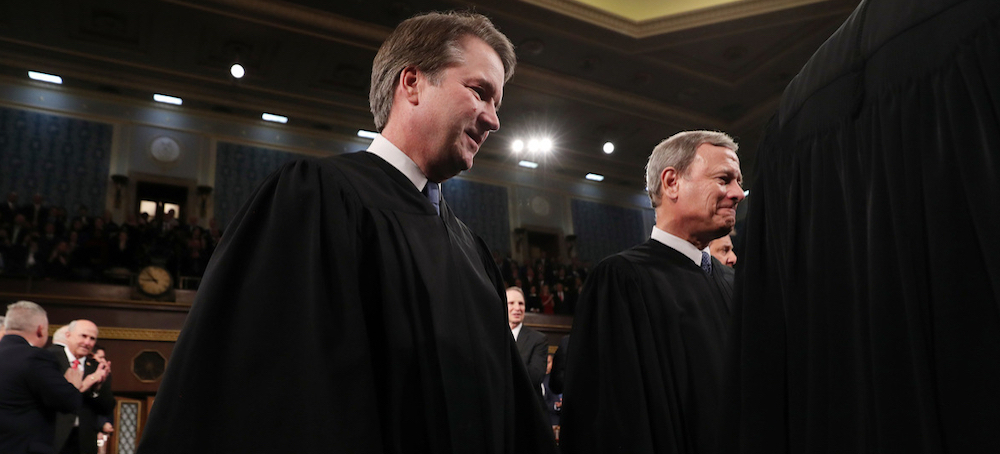 Justice Brett Kavanaugh and Chief Justice John Roberts. (photo: Getty Images)
For two decades, the conservative Justices worked to eliminate a bulwark of the civil-rights era.
Ratified a few years after the Civil War, the Fifteenth Amendment provides that citizens’ right to vote “shall not be denied or abridged by the United States or by any State on account of race, color, or previous condition of servitude.” The amendment gives Congress the power to enact “appropriate legislation” to enforce it, and—after a century marked by racial violence and intimidation, and myriad schemes, supposedly race-neutral, to disenfranchise Black citizens—Congress used that authority to enact the Voting Rights Act of 1965, to fight against the constant attempts to suppress the Black vote. Section 2 of the V.R.A. initially prohibited states from imposing any rules “to deny or abridge” the right to vote “on account of race or color.” In 1980, in a case in which Black plaintiffs alleged that the city of Mobile, Alabama’s at-large election system for choosing members of a commission diluted Black votes, the Supreme Court interpreted the V.R.A. provision to mean that a state does not violate it unless its action is “motivated by a discriminatory purpose.” In response, Congress changed the statute’s text to what it says today: that states must not implement any electoral rule that “results in a denial or abridgement” of voting rights on account of race.
By Section 2’s terms, a violation can be proved by showing, based on the “totality of the circumstances,” that a state’s electoral processes “are not equally open to participation” by members of a racial group, in that they “have less opportunity than other members of the electorate to participate in the political process and to elect representatives of their choice.” Section 2 explicitly indicates that one of the circumstances to consider in determining a violation is the extent to which members of the racial group “have been elected to office in the State.” It also specifies that racial groups do not have a right to be “elected in numbers equal to their proportion in the population.” In other words, the V.R.A. does not require racially proportional representation, yet it makes clear that equal electoral opportunity means the chance to elect one’s preferred representatives, who may include representatives of one’s racial group. If, for example, a state’s Black voters are concentrated in a city, but the state’s electoral map is drawn to disperse them into multiple districts, where white majorities can be expected to vote against their preferences, Black voters will perhaps have no opportunity “to elect representatives of their choice.” Thus, the V.R.A.’s equal-opportunity requirement has meant that a state may be required to create one or more majority-minority districts in order to provide racial minorities a chance to elect their preferred representatives.
For the past forty years, courts have had to acknowledge that Congress in Section 2 meant to address racially discriminatory effects on voting, regardless of discriminatory intent. But, as the Supreme Court became increasingly clear in its view that not being color-blind amounts to racial discrimination, a Catch-22 developed, wherein states’ attempts to avoid violating the V.R.A. on one side might risk a constitutional violation on the other side, with each move resulting in a possible finding of racial discrimination. In 2022, a federal district court found that Louisiana had likely violated Section 2 of the V.R.A. by creating only one majority-Black electoral district in its map drawn after the 2020 census. But when the state then attempted to comply by creating a second majority-Black district, a group of non-Black voters challenged the new map as an allegedly unconstitutional racial gerrymander. A three-judge federal district court held that the map was a racial gerrymander that violates the equal-protection clause of the Fourteenth Amendment. (Federal law provided for direct appeal to the Supreme Court.)
This week, the Supreme Court affirmed that ruling, holding that Louisiana’s map with the second majority-Black district violated the Constitution. The Court called the drawing of the district “racial discrimination” for which the state had no “compelling interest”—because the V.R.A., when “properly interpreted,” the Court concluded, did not require it to exist. (The Court did not say that the first majority-Black district was unconstitutional, but it left little reason to assume that it couldn’t be successfully challenged as well.) The Court reached this decision by narrowing the meaning of Section 2 to what it was before Congress amended the statute in 1982. The Court’s new interpretation is that the only way for a state to violate Section 2 is to intentionally discriminate, despite Congress having made clear through the statutory amendment that Section 2’s concern was discriminatory effect, not intent. Justice Alito justified this reading by asserting that, because the Fifteenth Amendment itself can only be violated by intentional discrimination, Congress would have exceeded its Fifteenth Amendment authority if it had legislated to prohibit “mere disparate impact.”
This drastically diminished interpretation of the V.R.A., combined with the Court’s long-building view that majority-minority districts are forms of “racial discrimination” that the Constitution “almost never permits,” has momentous practical consequences for the electoral system. After Callais, every existing majority-minority district is vulnerable to being deemed an unconstitutional act of racial discrimination. We can immediately expect a cascade of lawsuits challenging states’ districting maps, and some states may rid themselves of majority-minority districts without waiting to be sued. Though Alito did not say majority-minority districts could never be required, the upshot of his opinion is that it will be impossible, except in the rarest circumstances, for a plaintiff to show that a state’s refusal to create—or its elimination of—a majority-minority district has intentionally discriminated based on race.
Justice Alito didn’t stop there. He went on to write what amounts to an instruction manual for Republican-led state legislatures on how best to justify districting practices that have a clear discriminatory effect on Black voters. His unmistakable advice was to use the fact that Black voters tend to vote Democratic to defend drawing a map that severely weakens Black voting power, by framing the districting as having a partisan—rather than a racial—purpose. Alito made the point that, because of the 2019 case Rucho v. Common Cause, which established that federal courts will not hear constitutional challenges to partisan gerrymandering, states are free to draw districts to “achieve partisan advantage,” even to an extreme degree—say, to insure that every electoral district in a state is a lock for a Republican victory. Concern for the rights of Black voters barely broke to the surface of Alito’s opinion. He did, however, zealously guard states’ prerogative to gerrymander, warning that “litigants cannot circumvent” Rucho by “dressing their political-gerrymandering claims in racial garb.” Alito’s message to states is: Go ahead and gerrymander the hell out of your electoral districts in ways that effectively eliminate the voting power of racial minorities. The Court has your back.
In a piercing and animated dissenting opinion, Justice Elena Kagan, joined by Justices Sonia Sotomayor and Ketanji Brown Jackson, sized up the Court’s decision as “straight-facedly” holding that “the Voting Rights Act must be brought low to make the world safe for partisan gerrymanders.” What will ensue, she predicted, is the worsening of how “this country’s two major parties compete in a race to the bottom.” Her dissent was not only concerned about partisanship; Kagan warned that the Callais decision threatens the fundamentals of how our constitutional democracy works. It is Congress’s job to make laws, and it did so in the Voting Rights Act. The Court’s job is to interpret the law—not to rewrite a statute that Justices do not like. As Kagan recounted, the Court’s conservative majority “has had its sights set on the Voting Rights Act” since 2013, when it eviscerated Section 5 of the statute, which required jurisdictions with a history of voting discrimination to seek federal preclearance of any new voting rules. And in 2021 the Court required Section 2 plaintiffs challenging burdens on casting ballots to focus on discriminatory intent rather than discriminatory effect, with the result that no Section 2 challenge since then has succeeded. In the Court’s inexorable march “to destroy” the V.R.A., Callais, Kagan wrote, was the final piece in the “now-completed demolition of the Voting Rights Act.” The statute, she continued, “was born of the literal blood of Union soldiers and civil rights marchers. It ushered in awe-inspiring change, bringing this Nation closer to fulfilling the ideals of democracy and racial equality. And it has been repeatedly, and overwhelmingly, reauthorized by the people’s representatives in Congress. Only they have the right to say it is no longer needed—not the Members of this Court.”
Through its long-sought destruction of the Voting Rights Act, the Supreme Court has provided an illustration of how our democracy fails. It has usurped the work of Congress, and effectively vetoed legislation that was intended to achieve the democratic ideals of a multiracial people. Justice Kagan has sometimes been viewed as a strategist rather than a polemicist, who tries to forge agreements with the Court’s more moderate conservative members. But, in this dissent—which may well be remembered as her greatest—she freely displayed her virtuosic incandescence. She concluded, “I dissent because Congress elected otherwise. I dissent because the Court betrays its duty to faithfully implement the great statute Congress wrote. I dissent because the Court’s decision will set back the foundational right Congress granted of racial equality in electoral opportunity. I dissent.”