How the Bombing of Schoolchildren Fits Into Trump’s War
Zak Cheney-Rice New York Times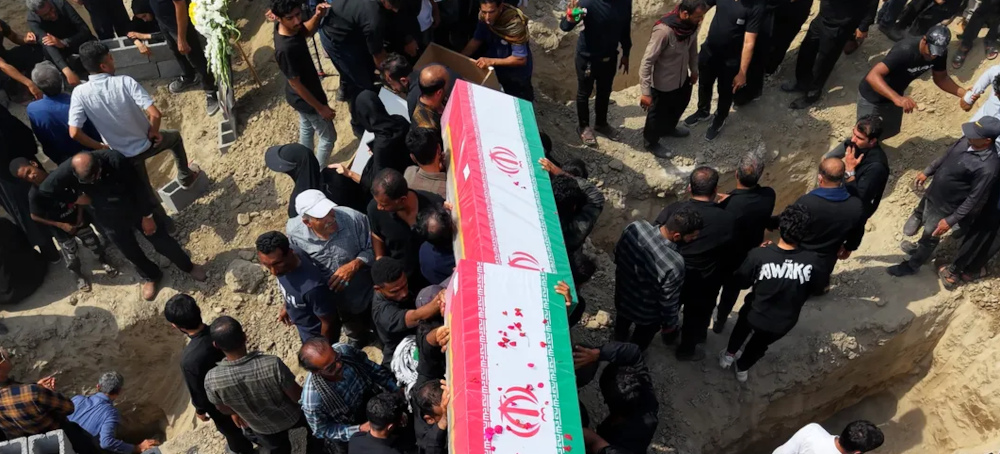 The coffins of students killed in a strike on a girls’ primary school in Minab, Iran. (photo: Getty)
The administration has gone silent on its vague humanitarian reasons for attacking Iran.
Trump appeared to be referring to unverified claims about Hamas’s attack on October 7 and Iran’s role in funding the group. But his retort, however specious, also reflected an old Washington logic used many times over the past few decades to justify war: that U.S. atrocities are negligible when the broader incursion is justifiable. “Take a look at what they’ve done over the last 47 years,” Trump said of Iran. Because “they” are “evil,” by edict of the U.S. president, the usual legal standards of warfare do not apply.
What’s very different this time is the Trump administration’s almost total lack of interest in justifying the broader incursion at all.
From the beginning of this war, the administration’s rationale for attacking the Islamic Republic has been all over the map. Secretary of Defense Pete Hegseth said it was not intended to be a “regime-change war” — but then again, it isn’t not one, either. (“The regime sure did change and the world is better off for it,” he said at the Pentagon last week.) Secretary of State Marco Rubio has offered increasingly convoluted explanations ranging from, essentially, “Israel pulled us into it” to “No, Israel didn’t,” because that would look bad. Trump, for his part, has meandered distractedly from offering dubious national security justifications (stopping nuclear war) to vaguely humanitarian ones (defending anti-regime protesters).
It’s all deeply cynical — the baldest expression yet of Trump’s inflated sense of political invulnerability. In part because the president has barely bothered to explain himself to American voters, this campaign is ”the most unpopular war at launch in the history of modern polling,” as data journalist G. Elliott Morris pointed out. It’s simply an attack on Iran “without mercy,” as Secretary of War Pete Hegseth has promised — with the predictable result that raining “Epic Fury” on so-called evildoers who harm women and children has become cover for the fact that we are killing women and children ourselves.
The most graphic example yet of this occurred on February 28 when the U.S. and Israel launched their joint attack on Iran. A missile destroyed much of the Shajarah Tayyebeh girls’ elementary school in the southern city of Minab, reportedly killing over 100 children. Footage from the wreckage of the strike, which happened shortly after parents dropped off their kids, captures a chorus of screams and locals clutching their heads in horror and disbelief. Dazed Iranian mourners lay the children’s bodies in rows as construction vehicles are brought in to dig dozens of tiny graves. One dead girl, curled into a fetal position inside an unzipped body bag, is still wearing her pink backpack. Several U.S.- and Europe-based news outlets — including Bellingcat, the Associated Press, and the New York Times — have since reported that it was almost certainly an American Tomahawk, launched from a U.S. Navy vessel, that killed the girls.
Yet the Trump Administration has pulled out all the stops to evade responsibility. “In my opinion, based on what I’ve seen, that was done by Iran,” Trump told reporters when first asked about the strike. Hegseth seemed less certain, saying the government was “investigating” but “the only side that targets civilians is Iran.” Karoline Leavitt seconded Hegseth. “The United States of America does not target civilians,” she told reporters on March 4. “And unfortunately, many people in this room have fallen for that propaganda.” Leavitt started changing her tune as evidence accumulated showing the U.S. was at fault, saying on March 10 that, in spite of his denial, Trump would accept the findings of the government’s investigation. After the report came out showing it was an American missile, reporters asked Trump about it again. “I don’t know about it,” he said. Notably missing from these denials was any further articulation of how the shock that Trump has sent through Iranian society is ostensibly protecting human rights.
A smattering of conservative influencers and media figures is essentially tasked with doing that propaganda legwork for the administration. Eric Daugherty, who runs content for a pair of right-wing media outlets, posted on X a video of women protesting outside Trump Tower in New York. “Imagine being THIS insufferable and vile,” he wrote in the caption. “They won’t say a WORD about Trump helping free Iranian women from tyrannical Islam!” A viral TikTok video showed an influencer interviewing “liberal women” on college campuses; in an effort to “gotcha” them into broadcasting their supposed Trump derangement, she asked them who they believed was worse for women’s rights, the U.S. president or the Iranian regime.
Trump is starting to busy himself instead with selective shows of benevolence — intended not to actually help Iranian women, whom he doesn’t really care about, but to discredit their oppressors and demand favors from allies. On March 2, members of the Iranian women’s soccer team declined to sing along with their country’s national anthem as a form of protest ahead of their first Asian Cup match in Australia. Iranian state media branded them traitors and called for them to be punished once they returned home. Frightened for their safety, several team members asked the host government for humanitarian asylum. As Australian officials took most of the following week to consider the request, Trump took to social media to apply pressure. “Mr. Prime Minister, give ASYLUM,” he wrote. “The U.S. will take them if you won’t.” It was a rare show of generosity Trump has withheld from almost every other Iranian. At least twice, he has issued racist immigration bans on all Iranian entry to the U.S. — including in asylum cases.
The obvious difference today is that the president is carrying out a deadly military campaign that is responsible for killing dozens of Iranian girls. And it’s working out for him so far. Australia’s home-affairs minister extended asylum offers to all 26 women on the soccer team on Monday; the five who accepted were moved to a safe location by federal police and had their visas finalized. Authoritarianism is, among other things, a system in which rights are distributed as favors. Even as his hero fantasy fell apart in Iran, Trump got to indulge his delusion that rights — of asylum, of civilians to not be targeted in war — were his to give or take away.