How People Reacted to the Nazis
Ben Rhodes Substack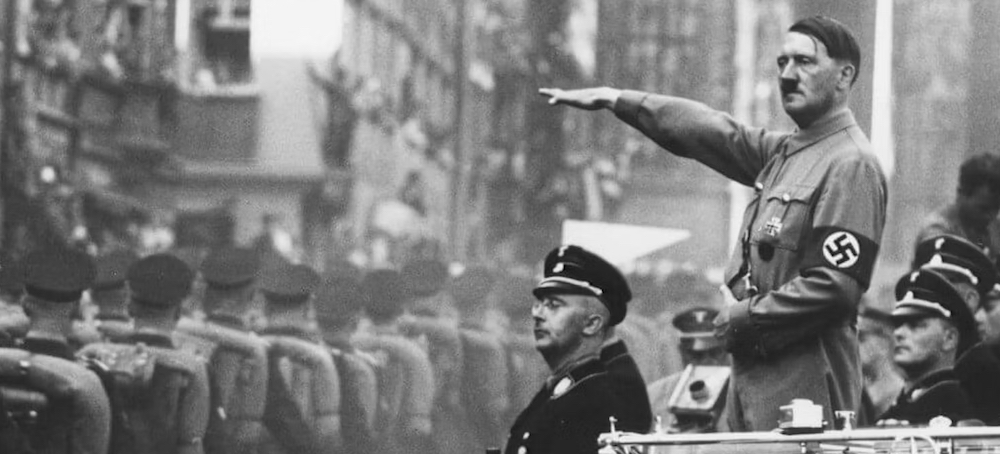 Adolf Hitler. (photo: USHMM)
ALSO SEE: Ben Rhodes | Notes on the Stories We Tell - (Substack)
I’ve long had a morbid fascination with this question of how people responded to Nazi Germany at the time. Part of this is because I have German Jewish ancestors, including some who were killed in the Holocaust. But over the last decade, as we’ve lived through the rise of authoritarian politics, the question has taken on a different kind of urgency.
Of course, events in the United States are not as extreme as 1930s Germany: this is not yet a totalitarian state with all the grotesque excesses of those times. But from the masked men in the streets, to the targeting of certain groups, to the denial of objective reality itself, there are enough echoes from history to compel us to learn from it.
I recently read Boyd’s book in the evocative location of Munich and drew several lessons from how so many travelers got it wrong. First, I was struck by the sheer scale of travel to the Third Reich. For instance: in 1937, on the cusp of war, a half million Americans visited. There was similarly a regular flow of British travelers. And while some did see the Nazis for what they were, others whitewashed what they saw – or even celebrated it. Why?
Confirming Priors
Many people went to Germany with preconceived notions about what they’d find there. If you were on the political left, you were more likely to see evil; if you were on the right, you were more likely to excuse, explain away, or admire the Nazis. “They went to Germany (as indeed they did to Soviet Russia) intent on confirming rather than confronting their expectations,” Body writes.
The Nazis understood this and eagerly indulged these expectations. “Foreigners were lectured incessantly,” Boyd writes, “on how only Germany stood between Europe and the Red hordes poised to sweep across the continent and destroy civilization.”
Indeed, those from the political right who were inclined to see Hitler as a bulwark against Communism or a legitimate vessel for German nationalism could easily tip over into believing things that were untrue – no matter what Hitler said. Wyndham Lewis, the British writer, incomprehensibly returned from one visit to report, “It is essential to understand that Adolf Hitler is not a saber-rattler” even though he was. Lewis even wrote a book with a chapter entitled: “Adolf Hitler: Man of Peace.”
This is a reminder, particularly in these polarized times, to beware of always believing that the enemy of my enemy is my friend.
Real Grievances Don’t Justify Fascism
Many travelers allowed their sympathy for the German people to extend to the Nazis. During the Weimar period following World War I, visitors encountered a country that was economically devastated and politically weakened. “Germans from all walks of life told them repeatedly how betrayed they felt,” Boyd recounts, “by the Kaiser, their politicians and generals and especially by President Wilson and the Treaty of Versailles.”
One could feel sympathy for this sense of anguish set against the extreme insecurity on display. Berlin, at the dawn of the Nazi era, “seethed with unemployment, malnutrition, stock market panic, hatred of the Versailles treaty and other potent ingredients.” Having encountered that brew, some travelers chose to rationalize Germans’ attachment to a strongman like Hitler, who promised to restore the nation’s dignity and sense of purpose.
Those travelers who felt an affinity for Germans made the mistake of rationalizing their support for the Nazis. Just because people have legitimate grievances against a failed establishment does not mean they are justified in turning to fascism.
Excitement for the Extraordinary
There is something seductive about living through historic times. Boyd’s accounts often portray visitors who were seduced by the pageantry of authoritarianism, that sense of witnessing history. Owen Tweedy, for instance, was captivated by the solidarity and spectacle of Naziism, describing it as “buoyant, exciting, and alive.”
Of course, if you were a Jew, a leftist, or simply an ordinary German who expressed misgivings about the new regime, you could be murdered, disappeared, or sent to one of the concentration camps which were common knowledge at the time. But some travelers still got swept up in the iconography of Nazi authoritarianism. “The incessant marching and beating of drums,” Boyd recounts of the Nuremberg rallies, “the sweeping searchlights, flaming torches, and thousands upon thousands of gigantic red and black swastikas flapping in the breeze, were all skillfully deployed to pay homage to the one supreme chieftain, the demi-god pre-ordained to lead his tribe out of darkness.”
The proper reaction to this cultish spectacle was revulsion and concern about where those displays – coupled with anti-Semitic, messianic, and militaristic rhetoric – could lead. But even highly educated people chose to see something else. Arthur Remy, a professor at Columbia, came back from one trip to Germany declaring: “I believe on the whole the celebration was dignified and impressive….the presence of black or brown uniforms can certainly not be construed as of sinister significance.”
A strongman capitalizes on the very human instinct to want to be a part of something big, new, and transformative. In the 1930s, far too many people felt that tug of history and fell for the spectacle, without regard for who it was hurting and where it could lead.
Propaganda Matters
Propaganda reinforced this willful ignorance, redirecting ones’ vision to an alternative reality that did not really exist. For instance, the 1936 Summer Olympic Games represented a propaganda coup. The Games were an impressive feat of stagecraft, showcasing Nazi expertise in organization and imagery without pointing to what ends those skills could be put.
While presiding over the Games as the singular leader, Hitler could also be unusually accessible – a fact often lost to history. “He gave his autograph as willingly as Babe Ruth,” one visitor recalled. Indeed, Nazi propaganda often showcased these two contrasting sides of Hitler’s identity – the demigod worshipped by the Nazi throngs at Nuremberg, and the paternal figure greeting young people or meeting foreign visitors who were regularly given audiences with the strongman.
Hitler could also be disarming in private in ways that filtered out to the public, as when he told former Prime Minister David Lloyd George that he was responsible for Britain’s victory in World War I. After this meeting, Lloyd George reported to the British back home that Hitler, “is a born leader of men. A magnetic, dynamic personality with a single-minded purpose, a resolute will and a dauntless heart.”
Another reminder: just because someone can present themselves in a certain light doesn’t mean you can ignore their darkness.
Refusal to Confront Uncomfortable Truths
Several of the travelers profiled by Boyd visited German concentration camps. They were always given Potemkin shows, sometimes with the camp’s guards posing as prisoners to hide the brutality and starvation taking place. Time and again, people credulously accepted this false version of reality – perhaps because they didn’t want to believe the horrifying reports about what was really happening.
Indeed, Boyd shows us enough people who could see exactly what was going on at the time because, well, it wasn’t hard to find the truth. For instance, the Black American leader W.E.B DuBois left Germany reporting, “the campaign against the Jews surpasses in vindictive cruelty and public insult anything I have ever seen, and I have seen much.”
The boycotts of Jewish businesses, murderous anti-Semitic rhetoric, and brutality against Jewish people was a feature – not a bug – of Nazi Germany throughout the 1930s. Yet for some Americans, confronting this reality raised uncomfortable questions about their own country. “Amy derogatory comment regarding the persecution of Jews,” Boyd writes, “invited comparison with the United States’ treatment of its black population – an avenue few ordinary Americans were anxious to explore.
Often, those visitors who tried to sound the alarm about the Nazis were dismissed as hyperbolic or overly negative. For instance, many extraordinary journalists tried to report the truth. “Their reports were repeatedly edited or cut,” Boyd recounts, “or they were accused of exaggeration.”
This aversion to seeing uncomfortable truths, or fealty to an objectivity that insists upon two sides to every story, can blind people to imminent danger. Even when it is staring you in the face.
Individuals Have Agency
Ultimately, people decide how to respond to fascism. In Boyd’s book, we see individuals making their own choice – to ignore, support, or confront what was happening in Germany.
Compassion can be the most powerful choice. One British couple encountered a Jewish woman with a disabled daughter. The woman begged the couple to take her daughter out of the country. “Having seen enough on their holiday to realize that the outlook for a crippled Jewish girl in Nazy German was anything but rosy,” Boyd recounts, “she agreed on the spot.”
Because of that decision, one person – at least – was saved. It’s a reminder that even when we cannot arrest the momentum of political events, we can help our fellow human beings and in doing so preserve our own humanity. Keep that in mind the next time ICE comes to your neighborhood.
There is much more to be said about the choices that Germans themselves made – for an incredible book about this, see Amy Buller’s Darkness Over Germany. In that book, Buller records – contemporaneously – just how many elites, institutions, and individuals capitulated to the Nazis and how they rationalized that choice.
But it is also instructive to see Nazi Germany – indeed, to see fascism itself – through the eyes of these British and American travelers. “Perhaps the most chilling fact to emerge from these travelers’ tales,” Boyd concludes, “is that so many perfectly decent people could return home from Hitler’s Germany singing its praises.”
Those people were often educated, influential, or perceived as upstanding citizens. Many went on to change their tune. By then, though, it was too late.
How should we interpret, today, what is going on right in front of our eyes? By seeing it clearly, calling it out, and opposing it. Before it is too late.