How Legal Immigration Became a Deportation Trap
Jonathan Blitzer The New Yorker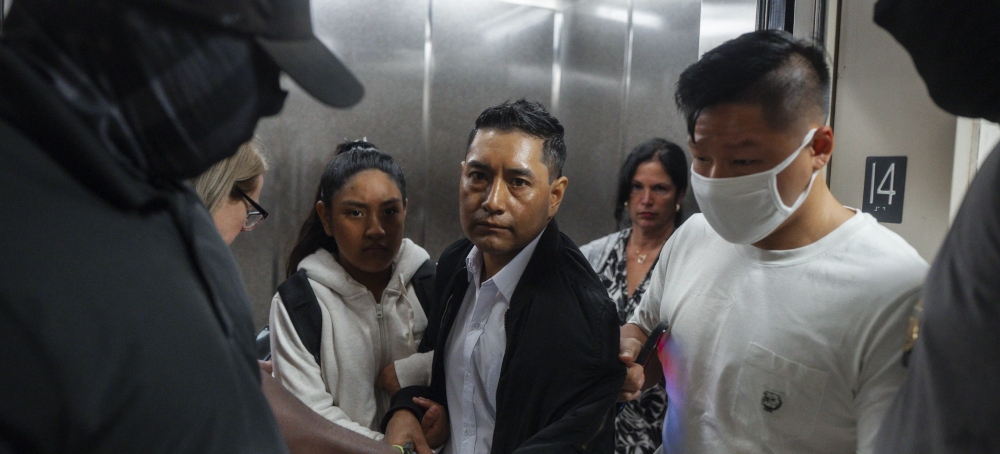 Immigration and Customs Enforcement agents pull a man out of an elevator as he and his daughter attempt to leave following a hearing in immigration court, Friday, Sept. 5, 2025, in New York. (photo: AP)
Under Trump, the Homeland Security agency responsible for processing visas and green cards has become a site for easy arrests.
Anna’s first thought was to explain that there was some mistake. “I wasn’t afraid,” she later told me. At the end of 2024, she and her family, including her four children, who are from a country in Central Africa, were granted refugee status in the U.S. The federal government had resettled them in Minnesota, a state which they found cold and strange but mercifully quiet. Her immigration papers, which she always carried with her, were in order. “I thought I was going to talk to the man and show him my documents,” Anna said. Instead, as soon as she opened her car door, he put her in handcuffs.
For the next several hours, Anna sat in a room at a local Immigration and Customs Enforcement office, forbidden from calling her family or a lawyer. No one told her what was happening. At around eleven that night, wearing shackles around her wrists and ankles, she was put on a plane and flown to an immigration jail in Texas. Outside the cell where she would spend the next five days was a makeshift sign that read “USCIS Cases.”
Anna knew the abbreviation: U.S. Citizenship and Immigration Services was the government agency to which she’d been submitting her legal documents. Since its creation, in 2002, U.S.C.I.S. has been the lone immigration agency at the Department of Homeland Security that doesn’t make arrests or participate in enforcement sweeps. Unlike the armed agents of ice and Border Patrol, the roughly twenty thousand officials at U.S.C.I.S., none of whom have traditionally carried weapons, primarily act as administrators of the legal-immigration system. Almost all of the agency’s budget is funded by fees paid by immigrants applying for visas, residency status, and benefits. The applicants are often referred to as “customers” by agency staff. At U.S.C.I.S., one former official told me, “We were seen as the friendly, supportive side—the agency that tried to help people.”
Even as Donald Trump has turned the agencies of D.H.S. into something of a roving personal police force, his Administration has prosecuted a quieter but no less ambitious assault on legal immigration. Green cards and visas for people from dozens of countries have been frozen indefinitely, and the Administration has cancelled naturalization ceremonies. Immigrants and asylum seekers in the middle of the application process have been detained during routine interviews. Last April, Mohsen Mahdawi, a student at Columbia University who had a green card, was arrested during his citizenship interview, for which he’d waited a decade. “Is this a trap?” he recalled thinking, after U.S.C.I.S. called him in for an appointment; masked ice agents took him away just after he’d signed the Pledge of Allegiance. The wife of a green-card applicant who was arrested in Salt Lake City said, “We’ve tried to do everything the right way. We have, and [now] he’s not here.”
In July, leadership at U.S.C.I.S. announced that the agency’s staff would soon have the power to make arrests and carry guns. New job postings no longer emphasized the provision of government services, but instead began advertising positions called Homeland Defenders, with responsibilities such as “defend your culture.” “It’s astonishing how swiftly the agency has shifted,” the former staffer told me. After Trump leaves office, another said, “there’s going to be some kind of bureaucratic husk called U.S.C.I.S., but that entity won’t have the ability to adjudicate requests for immigration benefits.”
By the start of the year, the Administration’s weaponization of U.S.C.I.S. reached new extremes. Anna was arrested as part of a new Department of Homeland Security policy in Minnesota called Operation parris, a U.S.C.I.S. initiative that was created, according to a press release, because the state had become “ground zero for the war on fraud.” The targets of Operation parris were some fifty-six hundred refugees who’d been vetted and admitted to the country by the Biden Administration. They had already gone through extensive interviews, background checks, and biometric scans. Yet U.S.C.I.S. officers were conducting their refugee interviews again, to look for grounds to strip them of their status retroactively. “No statute authorizes these warrantless arrests,” a group of lawyers led by the International Refugee Assistance Project wrote in a court filing challenging the policy. “ICE’s own guidance states that there is no authority to detain refugees merely because they have not yet adjusted their status.”
By law, a refugee has to wait a year before applying for a green card that confers permanent residency. The idea behind the operation was seemingly to impose a final roadblock; once someone has permanent residency it becomes much more difficult for the government to take it away. Around the time that the new operation was announced, Stephen Miller, Trump’s top immigration adviser, ordered U.S.C.I.S. officials to draft a rule that would allow the Administration to cancel someone’s refugee status without providing the person with advance notice or an opportunity to respond. The agency’s director, Joe Edlow, was dispatched to Minnesota along with a deputy; almost three dozen other officers were being sent to the Minneapolis suburb of Bloomington, according to an internal agency document, to “conduct visits on employment-based immigration benefits” and “applications submitted by foreign students.”
Three days after arriving in Texas, Anna was interviewed by someone who told her that he was “in charge of immigration” and that they could “talk like they were friends.” According to a source with knowledge of the agency, the interviewer was likely an official at U.S.C.I.S. who worked in the fraud-detection unit. “He already knew everything about my story,” Anna told me. Yet his questions were confusingly disconnected. Did she want to be brought back to her home country? Why couldn’t she go home? Had she ever committed a crime? “I didn’t understand what these questions had to do with what was happening to me,” Anna said. “I was depressed. I was crying. What did I do to be here?”
The interview lasted three hours. Two days later, having still not received an explanation for why she was being detained, Anna was taken to the gate outside the facility and told she could go. It was up to her to figure out how to make it home to Minnesota. When we spoke, nearly two weeks later, she still didn’t have her immigration papers. The government had confiscated them.
Last year, approximately three hundred and fifty-two thousand civil servants left their jobs, fulfilling one of the Administration’s stated goals of dismantling the government bureaucracy and demoralizing the federal workforce. Roughly eighteen hundred of those employees were at U.S.C.I.S. “Re-engineering” the staff at the agency, five former officials recently wrote in a recent Newsweek op-ed, served “both as a goal in itself and as a means of reshaping the legal immigration system.”
It began, last February, with a seemingly mundane change. Since the pandemic, a large share of U.S.C.I.S. officials had been performing some configuration of hybrid or remote work. Within days of the President’s Inauguration, the agency’s staffers received the first of a series of directives instructing them to return to the office. But there was no accompanying plan to insure that everyone would have a place to work. “The agency had grown through telework that outpaced the agency’s footprint,” Kate Angustia, who worked in the chief counsel’s office, in Washington, told me. “There were lawyers with computers sitting on radiators and the floor, working in hallways and storage closets.” At an agency office in Chicago, the city fire marshal was called because of overcrowding. On February 13th, the agency’s networks crashed from overuse.
Edlow, the President’s pick to head the agency, was said to be skeptical of the back-to-office policy, but, because of the slow nomination process, it would be seven months before he officially took over. In the meantime, a group of ideologues inside the agency were elevated to the role of senior advisers in its top office. “Most of the people who were picked came from the Fraud Detection and National Security Directorate,” Sarah Pierce, who worked in the agency’s Office of Policy and Strategy at the time, told me. Fraud Detection and National Security was one of U.S.C.I.S.’s seven internal divisions. During Trump’s first term, its budget grew substantially, doubling for fraud detection and tripling for national security. But it still had a reputation for being populated by people who, a former staffer said, “felt like they were not part of the agency and had a chip on their shoulder.”
In the past, the early months of a new Administration had been a period of transition at U.S.C.I.S. while personnel waited for a new director to be sworn in. This time, a rash of policies began immediately. Some of the activity was a consequence of the President signing a series of executive orders on the first day of his term to halt the refugee-resettlement program and suspend asylum at the southern border. Rob Law, a senior counsellor at the department, was closely aligned with Miller, who’d openly clashed with high-ranking U.S.C.I.S. personnel during Trump’s first term. “Miller’s turning U.S.C.I.S. into an enforcement arm is making it seem like the reason we have an immigration system is to keep people out,” a former senior agency official told me.
Several policy priorities followed from Miller’s long-standing fixations, such as denying immigrants work authorization while their legal cases were pending and penalizing applicants who used public benefits. Pierce, whose portfolio included work on refugee and asylum services, was told that her office, by virtue of specializing in humanitarian relief, was undermining the President’s agenda. “I was asked to find data showing fraud in the asylum system—that most asylum cases are fraudulent or frivolous and that that’s why we shouldn’t be granting work authorization.” When her research contradicted the premise, she was chastised for failing to come up with enough evidence. “The referral and denial numbers for fraud alone were exceedingly low,” Pierce said. “This raised a significant red flag for the Office of Chief Counsel, since the entire premise of the regulatory changes was that fraud was high.” (An agency spokesperson said, “Immigration fraud represents an existential threat to our nation.”)
A group of agency insiders proved willing to carry out the Administration’s orders to restrict immigration through U.S.C.I.S. Michael McDermott and Nicolas Bartell, two career officials, were named senior advisers in the director’s office and for a time effectively ran the agency. McDermott, who began working at U.S.C.I.S. in 2013, had extensive experience investigating allegations of fraud in the agency’s visa programs. Near the end of Trump’s first term, he was assigned to a special detail at ice; when he returned to U.S.C.I.S., it was to work in the Fraud Detection and National Security Directorate. His view, many colleagues felt, was ideological, whereas Bartell’s seemed more opportunistic. He had led the agency’s field office in Montgomery, Alabama, before moving to the director’s office during the Biden years. Most of his colleagues left the office during the transition to Trump’s second term, but he told them he was staying, “for continuity.” In meetings, however, he would often laugh and make quips about how Biden’s policies were coming to an end. (Bartell, who did not respond to a request for comment, is currently stationed in Minnesota, running Operation parris.)
“These were people seeking personal vendettas with personal pet projects,” Sarah Krieger, who worked in the Office of Policy and Strategy, told me. According to multiple sources, McDermott and Bartell attacked anyone who disagreed with them and dismissed legal analysis that didn’t immediately validate their positions. (The agency spokesperson said these claims were “baseless smear attacks against career public servants” whose “work has been exemplary.”) They also wanted to go further than the President’s Day One orders by limiting humanitarian visas and ending policies such as “deferred action,” which was supposed to protect from arrest people whose applications had passed a preliminary review but were still pending in the agency backlog.
Typically, when the agency changed a policy, staff would prepare a “decision memo,” in which different offices shared their views. Lawyers at the Office of Policy and Strategy were frequently told to remove their findings from the main text of agency documents and include them as an addendum. “A senior adviser would walk a memo over to an attorney and say, ‘You have ten minutes. Tell me if this is legally sufficient, and don’t tell anyone you looked at this,’ ” Krieger said. At one point, when she told McDermott that one of his demands contradicted an existing statute and might be at odds with the agency’s stance in pending litigation, he responded, “We don’t care what the statute says. We don’t care about court orders, and we don’t care about litigation risk.” (McDermott did not respond to a request for comment.)
Looming over the agency, meanwhile, was the threat of layoffs. Throughout the winter and early spring, Elon Musk’s Department of Government Efficiency (doge) was slashing the federal workforce, in part, by offering buyouts to career officials. At the same time, the White House Office of Management and Budget was beginning to reclassify tens of thousands of civil servants to make them easier to fire. In April, Kristi Noem, the D.H.S. Secretary, sent an e-mail to department staff titled “Reshaping the DHS Workforce,” in which she gave career officials the option of offering their resignations or opting for an early retirement. Many staffers at U.S.C.I.S. were particularly nervous about getting fired, because they were generally considered to be pro-immigrant and therefore hostile to Trump. During the 2024 campaign, a right-wing organization called the American Accountability Foundation—with ties to the Conservative Partnership Institute, the Heritage Foundation, and the authors of Project 2025—prepared for a second Trump Presidency by publishing the names and profiles of individual department staffers who might be disloyal; their information is accessible on a site called The D.H.S. Watchlist.
“Our bosses were pushing us to be more anti-immigrant and not to fight for small wins,” Pierce told me. “They were, like, ‘We need to keep a seat at the table.’ ” At meetings with political appointees, staffers were encouraged to describe their work as combating fraud in the immigration system. Those who disagreed with McDermott and Bartell, or who expressed anything short of unadulterated enthusiasm for the Administration’s new policies, were accused of leaking plans to the press and blocking the President’s agenda. E-mails and calls made to anyone outside the agency had to be “logged” in a spreadsheet, with a corresponding explanation of who had initiated the exchange. In one case, involving a dubious report about “special immigrant juveniles” who were suspected of being gang members, a group of agency officials weighed in using the standard protocol: they noted their reservations on the decision memo that was circulated within the agency. A few months later, they were called in to be polygraphed. This quickly became a pattern. The stories of a half-dozen staffers who’d been subjected to hours-long polygraphs spread inside the agency. Almost all of them had worked in offices that handled humanitarian benefits. Officials who refused to be polygraphed were put on administrative leave; one of them was seen being escorted out of the building by security guards. “That’s when it got really scary,” Krieger said. “We knew it could happen to anybody at any time. The choice was to get polygraphed or lose your job.”
The interviews began with the officials being Mirandized and told that their responses were under oath, which raised the possibility that they might later be charged with perjury. Yet the questions seemed inexplicably broad and subjective. One was whether the officials had ever lied, either to people close to them or to someone in a position of authority. “There wasn’t even a guise that this was about suspected leaks,” one of the former officials told me. Krieger said, “People left not because they had anything to hide but because they were afraid of how what they said could be used against them.”
Juan and his wife got married last June, in San Diego. They had met in high school, in 2021. She was a U.S. citizen; Juan, who was born in Mexico, wasn’t. He had arrived in the U.S. with his parents when he was twelve, and had never left. “A lot of ice protests were going on in L.A. when we got married,” he told me recently. “My wife was, like, ‘I’m afraid that something might happen to you. Let’s start doing the process to get your residency. I don’t want them to take you from me.’ ”
The spouses and parents of citizens and permanent residents can apply for a green card through U.S.C.I.S., even if they have overstayed a visa or fallen out of status themselves. This has been the case for decades. But last November, about a week before Juan’s appointment, he received a call from his lawyer, who said that he’d heard the government was arresting people at the U.S.C.I.S. office in downtown San Diego. “He said he didn’t yet have a client arrested but that there was a chance,” Juan told me. “We were scared. But if it’s going to happen, it’s going to happen either way.”
Juan and his wife scheduled an interview at a federal building in downtown San Diego. The session seemed completely prosaic. A female U.S.C.I.S. officer asked how they’d met and explained the paperwork that the couple would have to file in the future. “She told me, ‘You’re being approved,’ ” he said. “I felt peace. It all happened.”
Then the woman stood up from her desk as though she were stepping out to use the bathroom. “There are two other officers here who want to ask you questions,” she told him as she left the office. Two ice officers in jeans and flannel shirts walked in. “Do you know why we’re here?” one of them asked. “No,” Juan replied. He’d assumed that they were part of U.S.C.I.S., following up to confirm basic details about his green-card application. The officer continued, “You came in with a visa that’s now expired, so you’re illegal here. We’re going to arrest you.”
At U.S.C.I.S., staff had begun to hear about such arrests as early as last June. “They were just arresting people who didn’t have arrest records,” Kate Angustia, from the chief counsel’s office, told me. “In the past, for people who were married to U.S. citizens, Congress had a statute in place: if they overstayed a visa, it was waivable. Now everyone is a lame duck.” By the fall, individual field offices, in their eagerness to fulfill the Administration’s wider mission, were beginning to arrest not just green-card applicants but asylum seekers who were showing up for administrative hearings and biometrics appointments.
A leaked field-office memo provided “instructions” for how U.S.C.I.S. officers should coördinate with ice to entrap people. “Please provide an update approximately thirty minutes before the anticipated end of the interview,” it read. “ICE will be walked into your office, once you state that you are 5 minutes from concluding the interview.”
Juan was led to a white van in the building’s parking lot. He was handcuffed and had a chain placed around his waist, but the ice officers, he told me, were “super chill.” One of them told him, “You’ll be O.K. This is the process now.” He waited in the van for five hours while the officers went back inside to arrest more people. Eventually Juan was joined by four or five others, and they were driven to an immigration jail along the border. “The officers who took us there were telling us that we were just numbers, that we were easy targets.” Two weeks later, after a bond hearing, he was released.
His attorney, Jan Bejar, has been practicing immigration law in the San Diego area for forty-two years. “We’re talking thousands of clients,” he told me in December. “Never in my life have I had to deal with this.” Juan and his wife had already paid U.S.C.I.S. roughly two thousand dollars to get his green card, and had to fight his detention case anyway. “They go fishing in an aquarium, and they say, ‘Look how many fish we caught,’ ” Bejar said, of the government.
Juan’s case was hardly an isolated incident. In mid-December, I spoke with Jeremy Lower, a thirty-three-year-old maintenance technician from Ohio who had gone with his wife, a Mexican national, to a U.S.C.I.S. office, in Cleveland, for a preliminary green-card interview. It was the Monday before Thanksgiving, and Lower had taken the day off from work. “We were going to celebrate,” he said. “We’d been waiting for this day for two and a half years.” The officer conducted their interviews separately, so Lower was in the waiting room when two ice officers took his wife into custody. “She was told she was being deported,” he told me. By the end of the day, the government had flown her to a detention center in Texas, and the couple’s lawyer had to intervene to halt her removal. She spent a month in detention before being released, which was especially puzzling given the fact that Lower had checked on the status of his wife’s U.S.C.I.S. petition the day she was taken into custody. It had been approved.
In April, Sarah Krieger received an e-mail about a trafficking victim, who had recently been arrested by ice. The woman, who’d been a witness for the prosecution in an ongoing case, had applied for a temporary benefit known as a T visa, which confers legal protection to trafficking victims who coöperate with federal law enforcement. She had waited more than six months, but hadn’t received a notice from U.S.C.I.S. acknowledging receipt of her application. “There are thousands of applications that are sitting unopened in regional offices because so many staff have left the agency,” Krieger told me. “Literally boxes in mailrooms.” Krieger managed to find the woman’s application and sent an agency receipt to ice. She was deported anyway.
Last October, the Center for Human Rights and Constitutional Law filed a lawsuit against the Department of Homeland Security on behalf of at least eight immigrants who had applied for visas as victims of trafficking, criminal acts, or gender-based violence. Because of processing delays that could take years, the Biden Administration created a policy that allowed for a preliminary review of a person’s case file to determine if they were a “bona fide” applicant; if so, U.S.C.I.S. gave them a special designation for deferred action, meaning that they wouldn’t be arrested while their application was pending. “Now U.S.C.I.S. simply refuses to look at the application,” Sarah Kahn, a lawyer at the center, told me.
Even those whose applications U.S.C.I.S. had reviewed during the past Administration were being arrested—this was the specific basis for the center’s lawsuit. In late December, I spoke on the phone with one of the plaintiffs, Jackie Merlos, a forty-four-year-old Honduran mother of four U.S. citizens who’s lived in the country with her husband for the past twenty-two years. In March, 2024, the couple was sitting on their porch, in Portland, Oregon, when a burglar, who was trying to break into a truck across the street, threatened them at gunpoint. They reported him to the police and coöperated with the ensuing investigation, which qualified them for a so-called U visa. That December, the agency finally conducted a preliminary review of Merlos’s application and determined it was “bona fide.” Last June, however, she and her children were arrested and jailed in Washington State. For two weeks, her children—a seven year-old and nine-year-old triplets—were held with her, despite being U.S. citizens themselves. “You’re here because you’re a criminal,” an agent had told her in front of her kids. “He just wanted to get rid of us,” she told me. It would be four months before she was finally released on bond. By then, the construction business she ran with her husband had closed. “I barely leave the house now,” she said.
Late last year, when I started speaking to current and former agency officials, the President announced that the government was indefinitely pausing all asylum and green-card applications from Afghanistan and eighteen other countries. At the time, an Afghan national who’d worked with American forces in the country before getting asylum in the U.S. had allegedly shot two National Guard troops in D.C. The Administration immediately moved to exploit the tragedy. Individual acts of wrongdoing became the pretext for the vilification of entire nationalities. Operation parris, for example, began in the wake of a scandal in Minnesota, in which some eighty Somali Americans were found to be defrauding the state’s public benefits system.
At U.S.C.I.S., the targeting of specific nationalities wasn’t a matter of mere rhetoric but actual policy. Earlier this year, the Administration announced that it was indefinitely pausing green-card applications for people from seventy-five countries. By law, there are roughly two hundred and twenty-six thousand green cards issued each year to the adult children and siblings of current citizens as well as spouses and minor children of permanent residents; if these green cards aren’t used, they are reassigned to a different branch of the system tied to employment-based benefits. “The administration has always hated family-based immigration,” the former senior U.S.C.I.S. official told me. “Most employment-based green cards go to people who are already here.” It remains to be seen whether U.S.C.I.S. will apply the unused green cards to the employment side of the system this year. If it doesn’t, the green cards will be lost permanently. Whittling away the core functions of the agency has starved U.S.C.I.S. of the bureaucratic capacity it once had. “If they want, they can just be ‘unprepared to process’ ” the leftover green cards, the official said.
Meanwhile, the White House has called on U.S.C.I.S. to initiate between a hundred and two hundred “denaturalization” cases each month, which consists of stripping naturalized citizens of their existing legal status. Miller had pushed a similar but far less ambitious agenda during Trump’s first term, but it failed to materialize, largely because of legal constraints. (The government had filed a hundred and two denaturalization cases in the entirety of the first Trump Administration, according to figures from the Justice Department.) “Once you naturalize, the file gets ‘retired’ ” and sent to the National Records Center, Krieger told me. “Files are hard to find.” The obvious question, multiple sources told me, is where U.S.C.I.S. officials would even begin the denaturalization process. “You’re going to have to pick some characteristic to be the basis for calling up these files and scrutinizing them,” one of them told me. “Probably they’ll just go down a list, and start going country by country, targeting people from each one.”