How ICE Defies Judges’ Orders to Release Detainees, Step by Step
Kyle Cheney POLITICO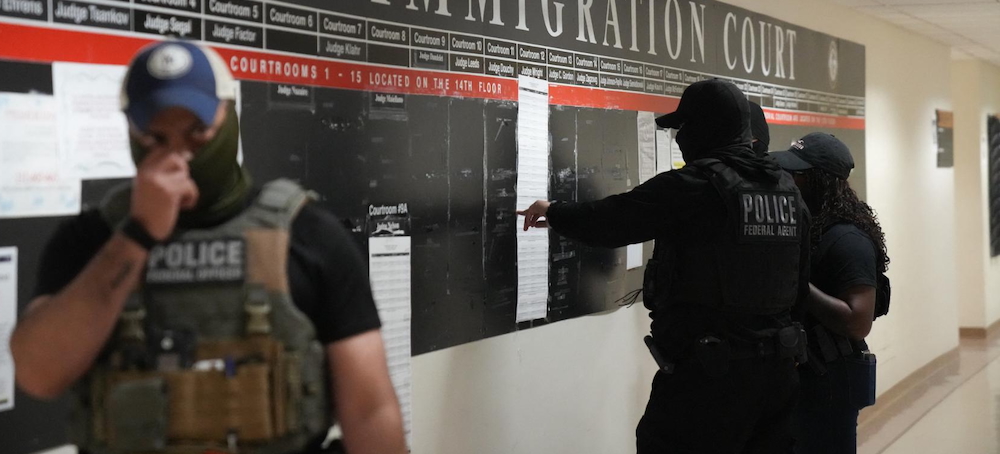 US Immigration and Customs Enforcement (ICE) agents look over lists of names and their hearing times and locations inside a courthouse. (photo: Bryan R. Smith/AFP/Getty Images)
A POLITICO review of hundreds of cases brought by ICE detainees shows a pattern of noncompliance that has frustrated judges across the country.
But the Trump administration has slow-walked or outright defied judges’ orders demanding the release of people scooped up by Immigration and Customs Enforcement at an increasingly rapid clip.
Sometimes, ICE has raced detainees across state lines in ways judges say are designed to thwart legal proceedings. Other times, they’re detaining people for days or weeks after judges have ordered them released. ICE officials have at times ignored other arms of the federal government trying to ensure compliance with court orders. And sometimes the administration has given judges bad or incomplete information.
A POLITICO review of hundreds of cases brought by ICE detainees across the country shows judges increasingly furious and exhausted by the Trump administration’s tactics.
“There has been an undeniable move by the Government in the past month to defy court orders or at least to stretch the legal process to the breaking point in an attempt to deny noncitizens their due process rights,” U.S. District Judge Michael Davis, a Clinton appointee from Minnesota, said in a recent order.
As a result, judges have issued more detailed and prescriptive orders to head off potential loopholes or hair-splitting results. And when all else fails, they threaten to hold administration officials in contempt.
Asked about the deepening conflict with courts, Homeland Security spokesperson Tricia McLaughlin reissued previous statements criticizing “activist judges” for trying to “thwart President Trump from fulfilling the American people’s mandate for mass deportations.” The statement didn’t directly address judges’ complaints about their orders being violated.
These issues have reached a crescendo in Minnesota, where the administration’s deportation hammer has fallen hardest in recent weeks, flooding the courts and overwhelming even the Trump Justice Department’s own attorneys.
Here’s how the administration’s noncompliance plays out:
ICE whisks people out of state
People fighting for release from federal custody must, in nearly all cases, sue in the district where they’re being held — even if it’s not where they were arrested or where they are from.
But that gets complicated when ICE rushes detainees out of state and bounces them around the country while they’re attempting to hire lawyers or decide where to file lawsuits. Judges have tried to counter this by issuing quick orders barring transfers outside of their districts. But that has been met with halting success. And judges across the country have repeatedly rapped the Trump administration for using these transfers as a way to stymie meritorious habeas corpus petitions, a legal right to due process allowing people to challenge detention by the government.
“These practices are deeply concerning and generally suggest that ICE is attempting to hide the location of detainees, and thus, make habeas proceedings more difficult for a petitioner and their counsel,” said Donovan Frank, a Clinton-appointed judge in Minnesota, who deemed the tactic a “pattern of obfuscation.”
Other judges have raised similar alarms. U.S. District Judge John Gerrard, an Obama appointee based in Nebraska who is helping handle a backlog of Minnesota cases scolded the Trump administration for an effort “to frustrate judicial review by moving detainees around the country repeatedly.”
In a particularly dramatic case, ICE detained a 19-year-old woman on Jan. 14 — the night she witnessed an alleged assault on a federal agent that resulted in an agent shooting a man in the leg — and quickly transported her to Texas and then New Mexico, frustrating her attorney’s attempt to file a habeas petition in Minnesota. Her attorney then raced to file petitions in her other two known locations to ensure they were lodged before she could be deported. ICE moved her despite a Minnesota judge’s order to bar her deportation because of her potential testimony in the criminal case.
The saga ended late Thursday when a federal judge in New Mexico — who had already deemed the Trump administration’s mass detention practices illegal in other cases — ordered the woman’s immediate return to Minnesota and release from custody. The reason: Her 1-year-old son, whom she was separated from while in detention, was badly burned and required emergency surgery.
Remarkably, another man from the same building as the woman was arrested that night as well and shipped quickly to Texas, first El Paso then San Antonio. In that case, another judge ripped the administration’s rapid-fire transfers and ordered the man returned and released.
When detainees sue, DOJ crawls
It’s become an epidemic — not only in Minnesota but across the country. An overwhelmed Justice Department has simply blown off court-ordered deadlines to respond to habeas petitions or defend its detention decisions.
In some cases, the missed deadlines have resulted in orders to immediately release detainees from ICE custody — even from judges who previously sided with the administration’s underlying mass detention policies.
The Justice Department said in a statement that it is complying with court orders and enforcing federal immigration law: “If rogue judges followed the law in adjudicating cases and respected the Government’s obligation to properly prepare cases, there wouldn’t be an ’overwhelming’ habeas caseload or concern over following orders.”
When detainees win release, ICE delays
The most acute concern from judges has been a recent surge of violations that occur after judges have ordered ICE to release people. In a growing number of cases, ICE has taken days or weeks to comply, sometimes requiring emergency motions by detainees’ lawyers and contempt threats from judges.
“Detention without lawful authority is not just a technical defect, it is a constitutional injury that unfairly falls on the heads of those who have done nothing wrong to justify it,” U.S. District Judge Jerry Blackwell, a Biden appointee based in Minnesota, said during a hearing Tuesday. “The individuals affected are people. The overwhelming majority of the hundreds seen by this Court have been found to be lawfully present as of now in the country. They live in their communities. Some are separated from their families.”
The Justice Department has repeatedly cited failed efforts to communicate with their ICE counterparts to carry out court orders and the fact that they are drowning in habeas cases driven by the Trump administration’s mass deportation strategy. But the delayed releases also add to the burdens on the court system and lawyers for detainees.
Minnesota’s chief federal judge, Patrick Schiltz, cited these delayed releases in a public rebuke of the Trump administration’s conduct. The George W. Bush appointee had threatened to haul ICE chief Todd Lyons into court on Jan. 30, only to rescind the demand once the administration released a man he had ordered released a week earlier.
Detainees released without belongings, devices or documents
In recent days, judges in Minnesota have expressed frustration that even when complying with their orders, ICE has been doing so in bad faith. Detainees that the agency had whisked to Texas, for example, were being released far from home with no way to contact loved ones or lawyers, and sometimes without their phones, documents or other possessions.
U.S. District Judge John Tunheim, a Minnesota-based Clinton appointee, recently included a requirement that a released detainee should not be “left outside in dangerous cold” and emphasized that ICE should coordinate the release with a detainee’s lawyer to “ensure humane treatment.”
Frank recently required that if ICE ultimately released a detainee, they must do so: “(1) in Minnesota; (2) with all personal documents and belongings, such as his driver’s license, passport, other immigration documents, and cell phone; (3) without conditions such as ankle monitors or tracking devices; and (4) with all clothing and outerwear he was wearing at the time of detention, or other proper winter attire.”
After a released detainee complained that ICE withheld his crucial documents and identification after releasing him from a Texas facility, U.S. District Judge Susan Nelson, a Minnesota-based Obama appointee, went as far as personally monitoring a UPS tracking number to ensure that the man’s belongings were returned to him. “It appears that the file was delivered today, February 6, 2026, at 9:50 a.m., and was received by a person named ’Brian,” Nelson wrote in a Saturday order.
Blackwell said the increasingly specific conditions judges were applying to their release orders were responsive to hair splitting by the administration.
“If we say, release the person immediately, then we learn that, having transported him to El Paso or New Mexico, you don’t bring him back. We learn that somebody is put out on the street with just the clothes on their backs and have to figure out how to get back here when they should not have been arrested here in the first place, let alone flown halfway across the continent of North America,” Blackwell said in the Tuesday hearing.
“All right, so you brought them back,” he continued. “We can’t have them released when it’s minus 14 outside. And so now we have to address that. Don’t release them in the circumstances that might endanger their health or safety.”
ICE monitors people in defiance of judges’ release orders
Even when ICE releases someone — in the right place and with their belongings — the story isn’t over. Judges have bristled at indications that ICE is also imposing “conditions of release” on detainees they ruled should never have been arrested in the first place. Those conditions, akin to what criminal defendants face when they await trial, can include GPS monitoring and other restrictions on their liberty. Judges say that these conditions are violations of their orders to return released detainees to the status quo before their arrest.
“As this Court has observed now on too many occasions, [administration officials] continue to advance legal positions that are indefensible and illogical,” U.S. District Judge Christine O’Hearn, a New Jersey-based Biden appointee, wrote in a recent order. “This was not a misunderstanding or lack of clarity; it was knowing and purposeful.”
U.S. District Judge Charlotte Sweeney, a Colorado-based Biden appointee, ordered the release of a man who was placed on improper conditions — and then re-arrested for purportedly violating them. The judge lamented the repeated rulings she’d had to issue rejecting the administration’s legal positions on matters of mass detention.
“While Respondents get to repeat themselves, they don’t get to repeatedly violate Petitioner’s due process rights,” she wrote.
McLaughlin did not respond to the complaint by judges that monitoring conditions were violations of their orders, but she said the use of ankle monitors were “an enforcement tool that helps ICE ensure illegal aliens comply with removal proceedings.”
“Any illegal alien who is worried about having to wear an ankle monitor or any other GPS devices should accept the $2,600 stipend from the U.S. government and free flight home by self-deporting through the CBP Home App,” she said.
When a court-ordered bond hearing isn’t enough
More recently, judges who have ordered the administration to hold bond hearings for detainees before an immigration court — administered by the executive branch rather than the judiciary — have been frustrated to learn that those bond hearings were, effectively, stacked against detainees from the start.
Administration officials “may not shield their unlawful arrest of Petitioner by hiding behind an [immigration judge]’s conclusory, two-line determination of flight risk,” U.S. District Judge Pamela Chen, a New York-based Obama appointee, wrote in a Feb. 4 decision.
U.S. District Judge Max Cogburn, an Obama appointee based in Charlotte, ruled Wednesday that a bond hearing he ordered in December turned out to be constitutionally deficient. The immigration judge in the case, he said, failed to permit the detainee to offer evidence in support of his release and relied on uncorroborated claims to support his continued detention.
Cogburn ordered a new bond hearing for the man, saying his original order had “presupposed that this hearing would be conducted in accordance with Petitioner’s due process rights. It was not.”
And U.S. District Judge John McConnell, an Obama appointee in Rhode Island, ordered a man freed Monday after concluding that two bond hearings conducted by immigration judges were constitutionally deficient — including one in which a judge ordered the man detained as a danger to the community over an uncorroborated report that the man drove 90-mph in a 55-mph zone.
Errors abound in habeas cases
Above all else has been a parade of mistakes: crucial attachments left off court filings or filled with incorrect information, claims that detainees are being housed in one state only to learn they were in another.
But the mistakes are at their most severe when they lead to deportations in violation of court orders. Judge Jill Parrish, the chief federal judge in Utah, recently confronted this when the administration acknowledged shuttling a man to Wyoming and deporting him to Mexico despite her order to block his immediate deportation.
“When a court exercises jurisdiction over a petitioner’s claims, Respondents may not ’deport first, litigate later,’” the Obama appointee wrote.
It’s happened a handful of times in recent months. And the administration has, at times, facilitated their return to ensure they receive due process.
In another recent case, the Trump administration told a judge that a man seeking release from custody had been deported — when in fact he had not. Because of the administration’s representation, U.S. District Judge Kyle Dudek, a Florida-based Trump appointee, tossed his habeas case, saying it was moot.
“There is no live controversy left to adjudicate, and the Court is powerless to grant relief for a detention that has already ended,” Dudek wrote.
But on Thursday, Dudek rescinded his ruling.
“The Court dismissed this habeas action as moot on the representation that Petitioner was deported. That fact turned out to be untrue,” he wrote.
Judges increasingly lose patience with ICE
The incessant skirmishing between the courts and ICE has begun to wear on judges, who have made their fury known in increasingly pointed rulings and orders. They have, in some cases, personally rejected dozens of detentions as illegal and taken note as their colleagues around the country have done so in more than 3,000 cases — compared to just over 100 cases in which judges have sided with the mass detention strategy.
U.S. District Judge Jerry Edwards, Jr., a Biden appointee in Louisiana, said he was “fatigued” by the deluge. Chen, the New York-based Obama appointee, lamented “the toll Respondents have exacted on the judiciary by continuing to pursue their new mandatory detention policy, despite its near-universal rejection.”
But it was U.S. District Judge Harvey Bartle III, a George H.W. Bush appointee in Pennsylvania, who wrote most animatedly.
“These petitions are filed due to the illegal actions of Immigration and Customs Enforcement,” he wrote. “Despite hundreds of similar rulings in this and other courts resoundingly in favor of the ICE-detainee petitioners, ICE continues to act contrary to law, to spend taxpayer money needlessly, and to waste the scarce resources of the judiciary.”