How Courts Can Stop Trump From Using ICE Raids Against Hospitals
Eric Reinhart Slate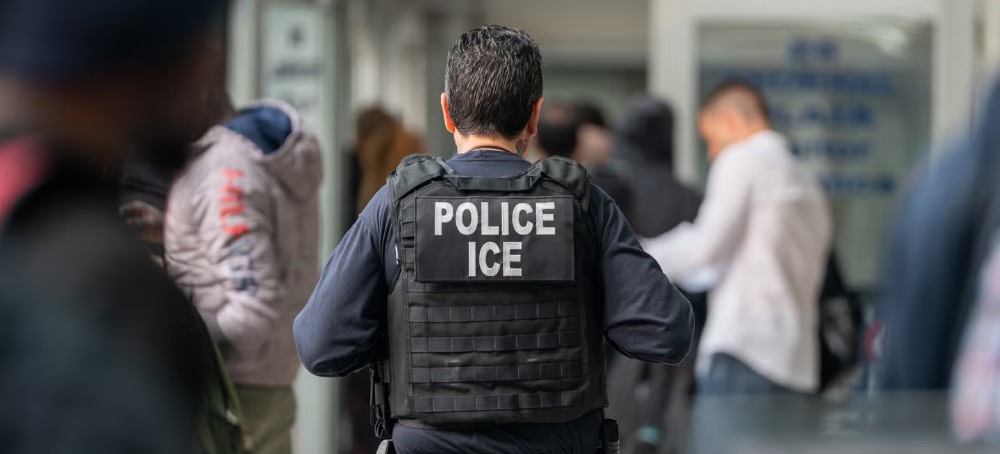 An ICE agent monitors asylum-seekers being processed in the Jacob K. Javits Federal Building, in New York, in June 2023. (photo: David Dee Delgado/Getty)
Hospitals and clinics are not ordinary spaces. They are vital lifelines where individuals seek care free from fear or judgment. For immigrants lacking permanent legal status, as well as their families, this sanctuary is now under threat. When ICE targets these spaces, the repercussions ripple across entire communities, driving people away from essential medical care. The consequences are stark: untreated infectious diseases, worsening chronic illnesses and mental health, delays in addressing emergencies like heart attacks and strokes, and preventable maternal and infant deaths. These outcomes are not hypothetical—they are well-documented realities from past instances when state-fomented fear kept vulnerable immigrant populations from seeking care.
Judges must apply the discretion that the law affords them to act as a bulwark against this erosion of public health. They have the power—and the responsibility—to prevent the misuse of judicial authority in ways that harm the most vulnerable. By refusing to issue warrants for ICE raids in medical facilities, judges can do their duty to uphold the Fourth Amendment protections that safeguard privacy and ensure that the judiciary does not become complicit in undermining public health and medical ethics.
The Fourth Amendment requires that warrants be issued based on probable cause and that they describe the specific place to be searched and the items or individuals to be seized. For ICE, this means that any incursion into private areas of a hospital—such as patient-care units—must be justified with detailed evidence. Yet, as legal scholars and immigrant rights advocates have noted, ICE often uses vague or boilerplate warrant applications that fail to meet these standards. Judges should scrutinize these requests rigorously and reject them when they fail to justify the intrusion into protected spaces.
Judges can refuse to issue ICE warrants for hospital access on several legal grounds. These can include lack of adequate probable cause supported by sufficient credible evidence, an excessively broad or vague scope of a warrant, or concerns that ICE actions may risk violating individuals’ constitutional rights (e.g., unlawful searches, due-process violations, or discriminatory practices). And although ICE’s formal restrictions on enforcement at “sensitive locations” (like hospitals, schools, and places of worship) have been rescinded by the Trump administration, judges may still contemplate the public interest and potential harm caused by enforcement actions in these spaces should they believe they might undermine public safety, compromise public health, or interrupt essential services in ways that are not outweighed by the government’s interest in enforcing an immigration law at a particular time or place. Warrants for searching hospitals implicate broader ethical and public interest concerns, as granting such requests undermines public trust in health care systems and risks significant harm to population health. Courts must weigh these consequences carefully and recognize that their role is not only to enforce the law but also to ensure that its application does not facilitate unconstitutional or harmful actions. In this context, denying improper warrants is a legal necessity and a moral imperative.
Beyond legal technicalities, there is a broader ethical imperative at stake. Public trust in both the judiciary and the health care system depends on their ability to prioritize institutional stability and the public interest over partisan politics and political personalities. When judges authorize ICE raids in hospitals, they send a chilling message: No place is safe. This generates terror for individuals who have entered the country illegally, as well as their communities, and undercuts the public trust upon which public health efforts like disease surveillance, preventive primary care, and vaccination campaigns depend. It also creates fear for the rest of us, just going about our daily lives, when these supposedly safe spaces are invaded by law enforcement.
Judges and health care workers are not the only ones with essential roles to play in preventing the misuse of ICE’s authority to further damage public health. Policymakers at the state and federal levels must strengthen legal support for hospitals, clinics, schools, and places of worship—all of which Trump has made fair game for ICE raids. And the general public should also do its part by rallying around immigrant communities to prepare for and protect people from ICE raids, applying tactics honed during the Obama administration, when deportations reached record levels and earned Obama the title of “deporter in chief.”
These tactics involve rapid-alert systems within communities—using social media and other means to share real-time ICE activity—alongside intensive community-education campaigns, so that people know their rights when confronted by ICE. They also involve creating rotating spaces of refuge for migrants while refusing to allow ICE agents entry to private spaces or to give them any information unless they have a valid search warrant issued by a U.S. district court or state court that specifies the area to be searched and the persons or things to be seized. This means investing in mutual aid networks to provide housing and financial support to families under threat or who are facing lost income after the arrest of a family member. And it means ensuring that health care workers organize with others to make themselves available to provide care to those in need, whether or not they can make it to a hospital.
Today judges face a moment of moral and legal reckoning. History has shown that the judiciary can serve as a critical check on executive overreach and abusive policing systems, if they have the courage and conviction to do so. By refusing to issue warrants for ICE raids in hospitals and other key sites for the provision of care, especially schools, they can bolster the increasingly tenuous claim that the law exists to protect society and the public trust, not simply to serve the interests of the powerful.
The judiciary cannot solve our political crises. But judges can take a stand against perverse uses of the law to harm public health, violate basic medical ethics, and erode the foundations of trust in our most essential institutions. They must refuse to let the president turn hospitals into battlegrounds.