Hegseth Lashed Out at DOGE Official in Tense Pentagon Confrontation
Dan Lamothe The Washington Post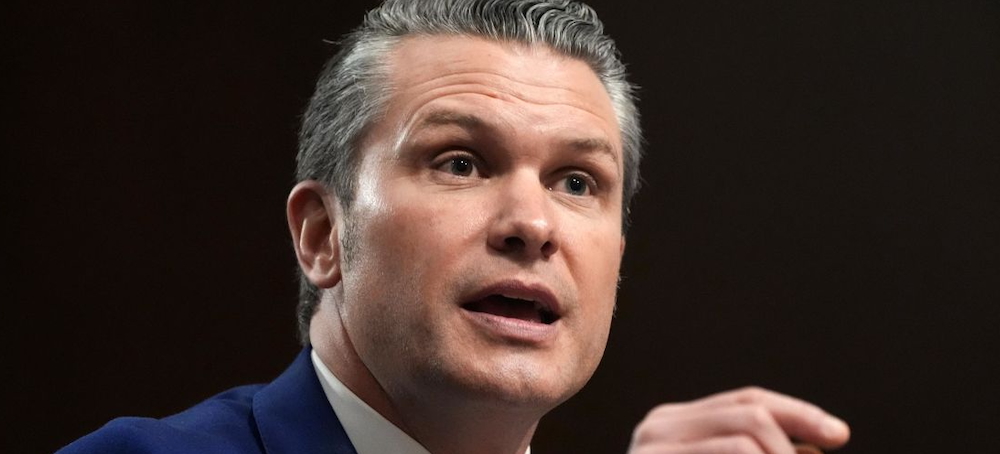 Hegseth speaks during his confirmation hearing. (photo: Jacquelyn Martin/AP)
The episode was sparked by claims that a team leader with Elon Musk’s cost-cutting organization had called law enforcement on a colleague, people familiar with the matter said.
The tense encounter in early April occurred with Yinon Weiss, a tech entrepreneur and military veteran like the secretary who had just become Musk’s team lead at the Defense Department. Raising his voice at times, Hegseth demanded that Weiss explain why he thought he possessed such authority, these people said, all speaking on the condition of anonymity to avoid reprisal by the Trump administration.
The altercation, which has not been reported previously, was set in motion after a DOGE lieutenant at the time, Justin Fulcher, stormed out of a one-on-one meeting with Weiss and went to Hegseth’s office to complain that he thought Weiss had reported him to the Pentagon Force Protection Agency, an internal police and security force. It’s unclear what triggered the dispute between Fulcher and Weiss, or whether law enforcement was ever called. However, the possibility that a DOGE official had acted unilaterally to evict someone from government property upset Hegseth, who considered it an unacceptable overreach, people familiar with the matter said.
It is unusual for a Cabinet secretary to engage so directly with seemingly minor disciplinary matters involving lower-level staff. The episode coincided with a tumultuous period for Hegseth after the disclosure in March that he used an unclassified group chat with other top administration officials to relay highly sensitive military planning for an attack on Houthi militants in Yemen. It also spotlights the friction that has sometimes existed between senior Pentagon officials and those assigned to DOGE, whose mandate to dramatically gut the federal workforce and slash government spending has been complicated by national security concerns.
While Hegseth has praised DOGE’s work in public, behind the scenes he has expressed frustration about some of the organization’s actions and inconsistent communication, especially earlier in the administration, people familiar with the matter said. Still, Hegseth did not appear to blame Fulcher for those issues or for the April 4 showdown with Weiss. Instead, he provided Fulcher with office space and, days later, named him a senior adviser.
Two people familiar with their argument said Weiss tried to explain to Hegseth that he had contacted another government official, not the Pentagon police, with his complaint about Fulcher. One person said that Weiss instead contacted the Pentagon transition office that assists newly arriving political appointees.
The Pentagon declined to comment on the incident between Hegseth and Weiss, and has sought to downplay what Democrats and some Republicans say is an endemic dysfunction there under the former Fox News personality. “Our senior advisors at the Department of Defense are unified and working together to carry out President Trump and Secretary Hegseth’s agenda,” Sean Parnell, a spokesman, said in a statement.
When contacted for comment about the incident, Fulcher, who turns 33 next week, told The Washington Post in a text message that it is his “understanding that no police were called and I didn’t see any.” He said, however, “there was one person who was making claims that he was going to call PFPA — that was clear,” referring to the Pentagon Force Protection Agency. Asked to clarify whether he was referring to Weiss, Fulcher stopped responding.
Weiss, who departed DOGE this month, did not respond to questions from The Post.
The White House, which handles media inquiries for DOGE-related issues, did not respond to a request for comment.
Officials with the PFPA’s communications office said they were not aware of a report involving Fulcher or Weiss, but would look into the issue.
In the weeks surrounding Hegseth’s confrontation with Weiss, his inner circle at the Pentagon was awash in controversy.
Days before the Atlantic magazine revealed Hegseth’s disclosure of the Yemen attack plans, the New York Times reported that his team at the Defense Department was preparing to provide Musk, the tech mogul who led DOGE before a stunning fallout with Trump, with a classified briefing on U.S. war plans in the event of a conflict with China. An internal investigation into unauthorized communications with the news media soon followed, and Hegseth later told the House Armed Services Committee that while he had invited Musk to the Pentagon, it was not for a classified briefing about China.
In mid-April, Hegseth fired three senior Pentagon officials and accused them of leaking to the news media. They, in turn, denied the allegation and accused Hegseth’s team of slander.
Other unflattering revelations followed, including reports about infighting among Hegseth’s remaining team, his wife’s unorthodox role at the Pentagon, and his struggle to find a new chief of staff deemed acceptable to the White House. No replacement has been announced since Joe Kasper voluntarily departed in late April, citing a desire to return to the private sector.
Fulcher, too, has been embroiled in more controversy, most notably after the Guardian reported last month that he told Kasper and Hegseth’s personal attorney, Tim Parlatore, that he knew of surveillance measures that could be used to find leakers at the Pentagon.
Fulcher joined Parlatore, who has assisted Hegseth in the Pentagon as a reserve officer in the Navy, in the search, but administration officials at the White House and the Pentagon determined that Fulcher had exaggerated his usefulness and the purported evidence he had alluded to did not exist, people familiar with the matter said. In light of that, some of Hegseth’s other advisers have cast doubt on Fulcher’s long-term standing.
Parlatore declined to comment.
Fulcher, though still a senior adviser to the defense secretary, recently was relocated outside Hegseth’s main office to a desk down the hall. He told The Post that the move is temporary and because of maintenance work. Others familiar with the matter affirmed the move appears to be temporary, but some said it has nonetheless raised new questions about his fate as Hegseth works to suppress any perception of persistent dysfunction.
Before joining DOGE, Fulcher founded a telehealth company in Singapore called RingMD. After a dispute with investors, the company declared bankruptcy and restructured in 2018, a development previously reported by Forbes.
Fulcher said in a podcast episode published this year that the crisis at his company was trying. He attributed the dispute to a disagreement over whether to charge users in the developing world for RingMD’s service. Many were receiving health care for the first time, he said. Fulcher is no longer affiliated with the company, and did not mention his work for DOGE or at the Pentagon on the podcast.
Since Musk’s split with Trump, DOGE, too, has continued to experience churn. At the Pentagon, Weiss left his role as team lead this month to return to his company, Stress-Free Auto Care in Austin. He co-founded the business in 2020, seeking to integrate artificial intelligence and software into the auto repair industry and make it more friendly to customers.
The new DOGE team lead at the Pentagon is Owen West, a Marine Corps veteran, author and former financial analyst at Goldman Sachs, a defense official said, speaking on the condition of anonymity to discuss personnel moves. He served as an assistant secretary of defense for about two years during the first Trump administration, overseeing special operations policy.
West has played an influential role in Hegseth’s recently announced effort to press for what the secretary has called “drone dominance.” The effort calls for bolstering the U.S. industrial base, arming combat units with a greater array of drones, and assuming more risk in the name of experimentation and keeping up with rapid advances on the field.
It’s a marked departure from the aggressive cost-cutting central to DOGE’s mission elsewhere in the government, though not one the Pentagon was necessarily eager to acknowledge. In announcing the effort last week, officials distributed a memo signed by Hegseth that accidentally included internal information revealing the document was “DOGE controlled” and identifying West as the chief point of contact.
Before the memo’s release on Thursday, the Pentagon had declined to clarify who was the new team lead for DOGE. But after its mistaken publication, defense officials acknowledged that West now oversees DOGE efforts there.