Guess Whose Rights the Supreme Court Thinks Come With a Stopwatch
Dahlia Lithwick and Alexis Romero Slate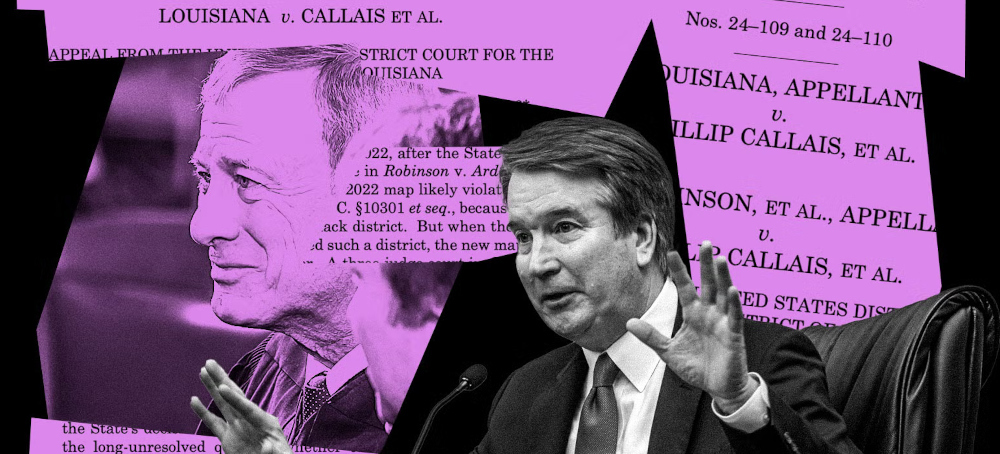 Chief Justice Roberts and Justice Kavanaugh lead a pivotal Supreme Court debate on the Voting Rights Act. (photo: Getty)
On Monday, the court allowed that decision to go into immediate effect so that Louisiana can cancel its already-begun primary and rewrite its maps to remove at least one district that had been drawn to allow Black Democrats to vote for their candidate of choice. In doing so, the court brushed off its longtime regulation that its decisions not go into full effect until 32 days after an opinion is finalized. This, rather than Callais itself, is what spurred Monday’s angry back-and-forth. Throughout the tense exchange in Justice Samuel Alito’s concurrence and Justice Ketanji Brown Jackson’s dissent, they spar over when the clock of the rule of law should start and stop.
If the Callais decision itself didn’t make it clear enough, the subsequent order made it obvious just how much of a massive win for voter disenfranchisement efforts the Supreme Court has given the Republican Party in these upcoming midterms and beyond—and how largely that conservative-majority determined clock now looms over all of us. You don’t have to take our word for it. As Mississippi’s Republican governor, Tate Reeves, put it: “First Dobbs. Now Callais. Just Mississippi and Louisiana down here saving our country!” Dobbs was, of course, the decision that overturned Roe v. Wade, a conservative scheme for decades. And the dismantling of the Voting Rights Act was a similar effort; indeed, for the chief justice, it was a long-standing personal project, going back to the act’s amendment in 1982, when a young John Roberts lobbied against it as a lawyer in the Reagan White House. In some ways, the clock has been ticking for 44 years.
Despite the disrespect for precedent shown in both Dobbs and Callais, the cases represent two different ways of manipulating law, text, the role of Congress, and the remediation of harm. Dobbs showcases a radical adherence to “history” as a means of affording states the “right” to make abortion illegal. Callais showcases how some Republican appointees are willing to brutalize, even modernize, their own vaunted methodology of an originalism rooted in text and history to achieve results they favor politically. Callais, like its 2013 predecessor Shelby County v. Holder, subordinates text and history to state prerogatives. Perhaps more pointedly, the conflicting results reveal that in the minds of the court’s conservatives, some “rights” are enduring, forever worthy of protection, while others are fleeting, with the court standing as sole arbiter of when the clock has run on basic freedom and equality.
It is true that some laws are substantive and some are remedial, even temporary. But it is also true that the Reconstruction Amendments declared Congress, and not the courts, to be the arbiter of when there has been “too much enforcement” of voting rights ,and when the time for a set of constitutional or statutory protections is no longer necessary. When Roberts, on behalf of the court’s conservative wing, first announced in Shelby County v. Holder that the Civil Rights Act’s preclearance procedures had reached some kind of historical sell-by date, despite multiple reauthorizations by Congress, he did so by breezily announcing that he had run some numbers and “our country has changed.” In fact, “things have changed dramatically,” to the point where the preclearance mandated by the Voting Rights Act was both unconstitutional and unnecessary. In response, in 2021 and 2022, 19 states passed more than 30 laws making it harder to vote. As Michael Miller and Kevin Morris wrote in Slate last week, these changes worked like a charm in disenfranchising the historically marginalized voters the VRA and its reauthorizations had been written to protect. It seems that in the 13 years since Shelby killed another key plank of the act—but undetected this time by the Roberts court majority—things have “changed” yet again, for the worse for voters of color. For this court, however, change works only in a single direction. So in Callais, the court, yet again, announced that the past is in the past and the VRA needed to be “updated” once more to reflect the majority’s view that racism is a thing of the ancient past. As Alito asserted, “Social change has occurred throughout the country and particularly in the South.” Case closed.
And the justice found even more changes to celebrate. New elections! New party lines! New computer programs! So very, very many modern developments exist today (and also so much cherry-picked evidence!) that the harms from long ago that required remediation by the VRA are all to be shrugged off. As Alito puts it, “Discrimination that occurred some time ago, as well as present-day disparities that are characterized as the ongoing ‘effects of social discrimination,’ are entitled to much less weight.” Indeed, so much has changed that the same chief justice who decried “Alabama’s attempt to remake our §2 jurisprudence anew” in Allen v. Milligan, just three years ago, said yes when Louisiana attempted it in 2026. Progress!
What does this mean for the court’s various “originalist” and “textualist” projects? Well, instead of doing law, text, history, or statutory construction, some members of the court are just watching an egg timer to see when the clock has run down on racism.
Again, the egg timer really works only in a single direction. Consider how little modern societal progress mattered to Alito when he blithely overturned Roe v. Wade in Dobbs, opting to ignore the raft of economic, health, criminal, and other impacts of stripping women of their right to terminate a pregnancy that had been amassed by experts. Nothing about women’s lives as experienced in the modern era colored his originalist reading of reproductive freedom. Consider, too, how little the development of lethal weapons affected the court’s originalist reading of the Second Amendment right to bear arms as reinforced in New York State Rifle … Pistol Assn. v. Bruen in 2022. The high court showed no regard for modern technologies, data, or societal change when it demanded that lower courts consider which laws prohibited rusty 18th-century muskets to determine whether high-capacity semiautomatic rifles could be regulated. It seems that while the right to reproductive autonomy or to express your will at the voting booth can become obsolete over time, the right to murder schoolchildren using weapons of war is enshrined by our history.
Indeed, with this court, some rights are forever, while others have an expiration date. Take the gradual erosion of the Fourth Amendment’s exclusionary rule because modern police are now ostensibly better trained. Or the end of affirmative action in higher education because, as the court noted in 2013, “the number of minority applicants with high grades and test scores has indeed increased.” It was this other area of race remediation, in fact, that first launched the ticking-time-bomb judicial methodology. In a 2003 opinion upholding a law school’s use of race in admissions, Justice Sandra Day O’Connor, writing for the court, ends with this statement: “We expect that 25 years from now, the use of racial preferences will no longer be necessary to further the interest approved today.” In 2023 Roberts seized on this statement when it came time to kill off affirmative action in higher education once and for all. That same year, Justice Brett Kavanaugh wrote a cryptic concurrence in Milligan announcing that he would save for another day the question of whether race-based redistricting could constitutionally “extend indefinitely into the future.” Evidently it did not.
The perverse reality is that the court’s use of history in Callais couldn’t be more backward. The court cited supposedly enlightened developments, like increased Black voter turnout (something that could not have happened but for laws like the Voting Rights Act), the development of mapmaking technologies, and the court’s own 2019 decision in Rucho v. Common Cause, declaring partisan gerrymandering as justification for the VRA’s April 29 expiration date. Thus, under the guise of small changes and tweaks and adjustments to the act, the majority determines which acts of Congress change history and which are changed by history.
One of the key criticisms of the preferred originalist method of many of the court’s conservatives is that history is messy and filled with contradictory facts and anecdotes on all sides of any controversial issue. Thus, as one of us has written, “originalism [is] sufficiently malleable and inchoate that it allows for almost any cherry-picked text and any wisp of history to be determinative.” And, perhaps most relevant for Callais’ purposes, a good originalist is meant to ignore any change to society that may have happened in the years since the law was passed, to avoid having the perception of letting policy judgments determine new judicial rules.
In a well-known law review article, Justice Antonin Scalia—the court’s original originalist—argued that in addition or in connection to originalism, judges should create their own hard-and-fast rules. But, he cautioned, courts must make those rules only when Congress leaves the space for judges to do so. For Scalia, as opposed to today’s originalist justices, the VRA was a law for which Congress left no such space. “One can conceive of a statute in which Congress makes clear that the totality of the circumstances is always to be considered. (See, for example, § 2(b) of the Voting Rights Act.)” In other words, Congress acted in a historically unique and exacting way in telling judges how they were supposed to decide redistricting challenges. Nevertheless, the majority in Callais readily deviates from Scalia’s directive by ignoring Congress’ once-in-a-generation effort to create a holistic test for redistricting under Section 2.
All in all, the opinion in Callais is a lot of things—arrogant, antidemocratic, and antiseptic (to borrow a phrase from Justice Elena Kagan’s dissent)—but one thing it is not is originalist.
Like the conservative justices’ time-limited approach to affirmative action and other racial issues, the court announced in Callais that so too should the nation treat voting rights as living on borrowed time. The court in this case held that modern progress in racial developments and politics permitted the effective outlawing of majority-minority districts. Well, now our country is unmistakenly headed toward a racial backslide for the ages. Judges and practitioners should take Alito at his word that when things inevitably grow worse for minorities over the next few years, these modern circumstances will change yet again, and presumably the law should as well. If modernity and social trends dictate what courts must do next, the Voting Rights Act will by necessity live as long as race-based voter suppression does. Its revival, one way or the other, will soon be proved essential.