Gorongosa — How a National Park Destroyed by Civil War Is Bouncing Back
David Pilling The Financial Times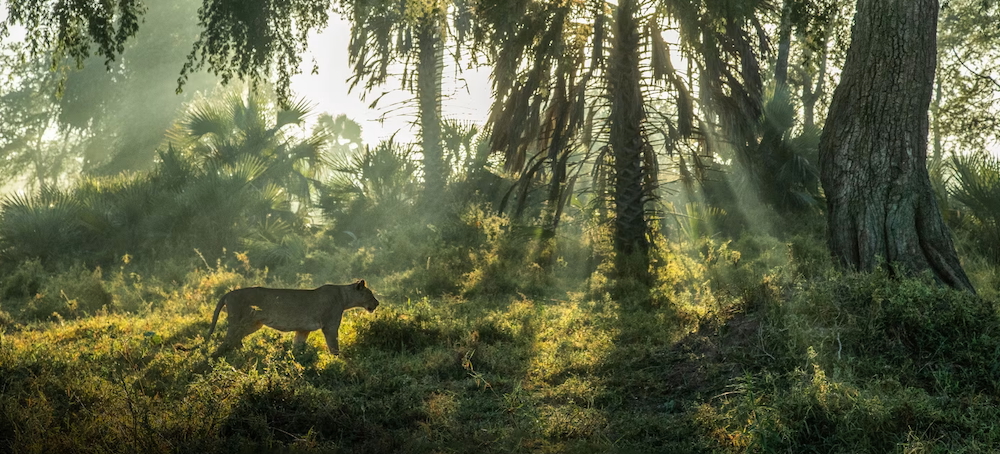 Gorongosa National Park. (photo: Gorongosa Safaris)
Once home to guerrillas — for whom it offered an airstrip and a plentiful supply of free-range meat — the Mozambican park has made a remarkable recovery
In the 1960s and 70s, when it was known as the “Serengeti of the South” or even “Africa’s Eden”, Gorongosa was a premier safari destination. Apollo astronauts, just back from the moon, came to visit, as did Hollywood celebrities from John Wayne to Joan Crawford. So impressed by the lions was the actress Tippi Hedren that she was inspired to keep one in her California home. As well as its big cats, the park was renowned for the diversity of its landscapes and for densities of wildlife that rivalled any on the continent.
It all came to an abrupt halt in August 1973 when guerrilla fighters from the Frente de Libertação de Moçambique (Frelimo) fired shots at the main camp, sending the well-heeled clientele scattering. Gorongosa became a military headquarters first to Frelimo, which was fighting Portuguese colonialism, and later to Renamo, a western-backed guerrilla group which fought a long civil war after Mozambique gained independence in 1975. To both it offered an airstrip, forest cover and plenty of free-range meat.
By the early 2000s, there was not much left. Though the war had ended in 1992, the animals were gone and the park was littered with unexploded mines. “I went on a three-hour safari,” recalls Vasco Galante, now the park’s communications director, who fell in love with the idea of Gorongosa after watching a film of the park in its heyday. “It was a disaster. I saw one baboon and the butt of an antelope.”
In 2008, Greg Carr, an American billionaire, signed a 20-year co-management agreement with Mozambique’s government to try to revive the park, which covers about 4,000 sq km. Since then he has invested more than $100mn of his own money and corralled more from other donors, including the US Agency for International Development (though its closure by Elon Musk in February has put that funding in doubt). Until now, at least, Gorongosa has been able to count on an annual budget of $25mn, much of which is spent on surrounding communities.
I am due to meet Carr in Gorongosa to discuss his approach to conservation. But whatever he and the Mozambican government are doing is apparently working. These days, like a real-life Jurassic Park, I am told, the park is again teeming with wildlife.
We get there in a small prop plane from Beira, a port city in central Mozambique. Though my visit falls, theoretically, in the dry season, we hit a storm shortly before landing. Visibility is so poor that the plane’s propellers vanish in mist as sheets of rain clatter on the fuselage.
As we bump earthward, as if down a flight of stairs, the co-pilot gamely holds up a plastic bottle to catch water streaming through the windscreen. We aquaplane along the half-submerged runway. I only fully realise how fraught the landing has been when I flash the pilot a smile and he returns a stony look.
We splosh to our rooms, circular concrete structures designed to resemble village huts. Chitengo, scene of the 1973 attack, is the first of three camps we will sample in the course of a week. Operated by Montebelo hotels, it is the most basic of the three, though perfectly comfortable, and reasonable at about £100 per night for a double room. Later we will sleep at a more remote mobile safari camp, ending with two nights in the high-end Muzimu Lodge on a bend of the Mussicadzi river.
The next morning, the rain clears and the sun starts to beat down intensely. Waterlogged vultures shake themselves and flap back into the air. As we drive out of camp, Gorongosa, vast and mysterious, slowly unfolds in all its misty glory. The unusually varied landscape includes yellow-green fever-tree forests, alluvial floodplains, rivers churning with crocodiles, palm forests with a surprisingly south-east Asian feel and rare sand forests.
The unifying theme is life. Lots of life. For long stretches, it is impossible to look in any direction without contemplating animals of some kind. I am left marvelling at the myriad ways in which living creatures move: warthogs daintily trot, crocodiles scuttle, baboons scamper, impalas bound . . . while lions mostly seem to sleep.
The birds, too, each have distinct modes of aerial locomotion. Huge marabou storks come into land in languorous looping circles, kingfishers dart and splash and hornbills undulate. Thousands of sparrow-sized queleas whirr in squadron-like formation, forming and reforming into patterns like a living lava lamp. Somehow they never bump into one another, a phenomenon researchers in the field of biomimicry have studied for applications in driverless vehicles.
The floodplain is dense with grazers, with dots as far as the eye can see. “Ten years ago you wouldn’t see a single animal here. Now it’s wall to wall,” says Rob Janisch, our guide.
With an initial lack of predators — little more than a few three-legged lions that had escaped the snares and traps of the war years — warthogs and baboons had a field day at the start of the park’s revival. Antelopes bounded back, quite literally, in prodigious numbers. There are 18 species from the park’s smallest, the shy blue duiker at a mere 4kg, to the stately eland, 1.6 meters tall, and weighing in close to a tonne.
Waterbucks have done best of all. On our first drive, we stop to observe a lone buck twitching in its doe-eyed beauty. There are an estimated 65,000 in Gorongosa; soon we are racing nonchalantly past vast herds. On a night drive, the vehicle’s spotlight sweeps the foliage to pick out a furtive mongoose, genet, civet, punk-haired porcupine or bright-eyed bush baby.
The restoration project, interrupted in 2013 by a brief re-ignition of the civil war, has adopted a laissez-faire approach. With poaching now under better control, distortions in the make-up of the animal life resulting from the park’s turbulent past have been allowed, more or less, to shape the recovering ecosystem. Thus warthogs, baboons and antelope have proliferated to an unnatural extent without enough predators to thin their numbers.
That is changing. The full complement of predators is gradually returning, with hyenas, jackals, wild dogs and, thankfully, a good number of quadrupedal lions making a comeback. Some were shipped in from other parks and some returned naturally to what is now a safer environment — and a well-stocked larder.
In an age of concern about irreversible tipping points, Gorongosa demonstrates nature’s ability to bounce back — if given a chance.
I meet Carr, a facilitator of that process, over lunch on the wooden decking of Muzimu Lodge. A man of liberal leanings, after making his fortune as an early developer of digital voicemail, his first philanthropic endeavours were an experimental theatre and a Harvard research centre dedicated to human rights.
He sees Gorongosa, where he now spends most of his time, as less of a conservation project and more of what he calls a “nature-based special economic zone” — a would-be motor for development for the 200,000 people who live in the 10km “buffer zone” outside the park’s perimeter.
With its healthy annual budget, Gorongosa has done some conventional things, such as building a 260-strong team of well-equipped rangers and replenishing the park’s gene pool through the translocation of animals. But more unconventionally it has sunk the bulk of its budget into schools, farms and businesses in a radical experiment aimed at upending the model of “fortress conservation”.
Gorongosa employs 1,800 people in furniture production, beekeeping, regenerative farming, teaching, community nursing and midwifery — making it, according to Carr, the biggest single employer in central Mozambique. These are not small acts of corporate social responsibility: 100 primary schools have been built and staffed, and 100 pre-schools are planned.
In lean times, the park even serves as a source of protein. Animals like buffalo are slaughtered to provide meat for local communities. “We have calculated that we can harvest 200,000kg of meat per year without affecting the wildlife numbers in the park in a meaningful way,” Carr tells me.
The idea, he says, is to stop poaching with jobs, not guns, and with community engagement, not fences. Slightly deaf in one ear, Carr has a hokey, Jimmy Carterish way about him. “If the people are happy, nature will do the rest. Trees know how to grow and elephants know how to make more elephants,” he drawls. “We’re a landscape that happens to include a national park, not a national park with a token community project.”
The park also offers higher education opportunities. Uniquely, it runs a Masters programme in conservation biology at the purpose-built EO Wilson Biodiversity Laboratory, named after the renowned biologist who championed Gorongosa towards the end of his long life.
Dominique Gonçalves grew up in a poor family in Beira but is now doing postdoctoral studies at Princeton, studying the behaviour of elephants traumatised by years of war and slaughter. Now head of Gorongosa’s elephant ecology project, Gonçalves walks us around the laboratory’s specimen collection: jars of snakes, lizards, bats and rodents and drawer upon drawer of butterflies, moths, beetles, katydids and ants, each neatly pinned to cards next to its Latin name. About 200 are new to science.
“We don’t think there’s anything like this in another protected area in Africa or anywhere in the world,” she says.
It’s one thing to see Gorongosa’s smaller inhabitants with a pin through their thorax, but quite another to witness them in action. On one of two spectacular “walking safaris”, we come upon a thick column of Matabele ants, named after a warrior tribe and known for their raids on fortified termite cities. They are streaming back from battle, each one carrying trophies of war: termite larvae.
The termites would have defended their thick-walled fortress to the death, Janisch explains, tearing off the limbs of ant-assailants as they entered. New scientific research shows how specialist “paramedic ants” treat their injured brethren, mixing up chemicals to make an antibiotic to cauterise the wound. The intervention restores 90 per cent of ants back to battle-ready fitness.
We don’t see only small creatures on our walks. Once, in the dappled morning light, we chance upon two lions sleeping by a tree. The highlight, though, comes when our guide notices an eerie stillness and a total absence of antelopes. “Wild dogs,” he whispers, motioning us to hit the ground. There, splashing in a shallow pool in the sand forest, is a pack of dogs, also known as “painted wolves” for their spectacular markings. Only an estimated 660 wild packs are left, 12 of those in Gorongosa after a decades-long absence.
On our last evening, we stumble upon the same pack again. The dogs are performing an extraordinary pre-hunt ritual in which they stand on their hind legs to form a sort of thrashing canine maypole. After nearly an hour of whipping themselves into a collaborative frenzy, they lope off menacingly into the fading light.
We end our evening on the roof of the lion house — an abandoned lodge from previous times — climbing the same spiral staircase once used by big cats padding up to the roof for a better view of the menu on the floodplain below. The fiery sun slips over the horizon like a molten coin into its earthly slot. Somewhere out there, the wild dogs are hunting.