Going Nuclear Without Blowing Up
Robin Wright The New Yorker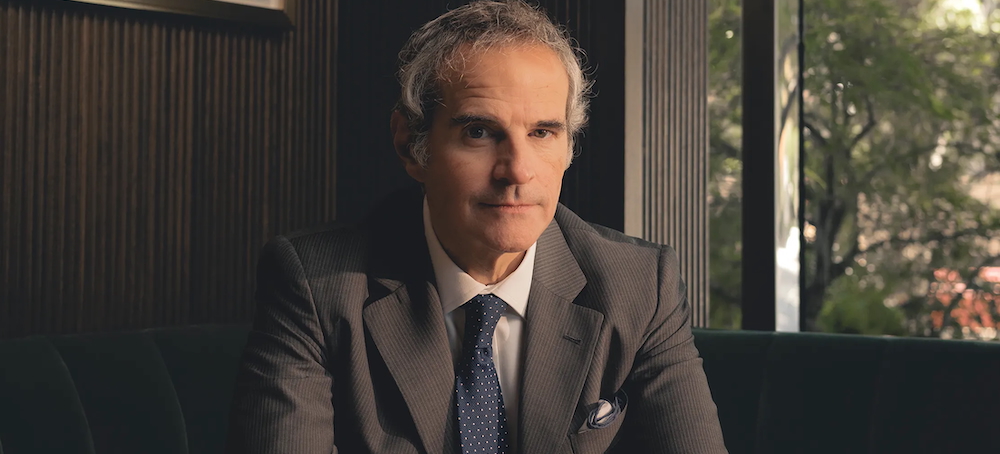 Rafael Grossi. (photo: Greg Kahn/New Yorker)
How Rafael Grossi risks his life tracking the world’s most dangerous material.
There are now about four hundred nuclear power plants worldwide, in over thirty countries on five continents, with sixty more under construction. Another thirty countries are considering or planning to build nuclear power plants as global energy demand soars, especially to fuel the data centers that support artificial intelligence. “We are on the brink of a renaissance of the nuclear industry,” Serhii Plokhy, a Harvard historian, writes, in “The Nuclear Age: An Epic Race for Arms, Power, and Survival.” Russia’s seizure of Zaporizhzhia suggests that reactors “can be used as weapons of war.”
Plokhy and other experts worry about two types of nuclear proliferation. Vertical proliferation is when the nations that already have nuclear bombs—there are nine—add to their arsenals, as China is doing now. In October, President Trump pledged to re-start nuclear-weapons tests, which haven’t been carried out by the U.S. since 1992, deepening fears about a new era of brinkmanship. But the I.A.E.A. is most concerned about horizontal proliferation, as additional countries, non-state actors, or terrorist groups develop nuclear weapons—by purchase, creation, or theft of the technology. Grossi warned, “At the risk of being provocative, horizontal proliferation is far more destabilizing than vertical proliferation.” At least thirty nations beyond the nuclear nine may have the capacity to develop nuclear weapons, according to the I.A.E.A. Plokhy puts it closer to forty.
Near Zaporizhzhia, Grossi encouraged his experts—all of whom had volunteered for the mission—to think about their families. “I will always remember this guy,” Grossi told me. “He was from Moldova—a short, stocky guy, but very determined. He said, ’I’m with you.’ ” The convoy began to cross the no man’s land. “At certain moments, you have to push the envelope a little bit,” Grossi said. “People are not going to receive you with a red carpet. It’s a war. What we did had never been done before.” He recalled seeing “carcasses of cars, debris, shoes of someone who was blown up, rotten pigs, scorched houses.” The team members entered Russian-held territory and established a presence at Zaporizhzhia. They have monitored it ever since. Amid renewed U.S. diplomacy to end the war, Grossi has insisted that Zaporizhzhia get “special status” in any peace deal—and that I.A.E.A. inspectors, who rotate in and out every few weeks, continue to insure safety at the plant.
“That’s not a cookie-pushing bureaucrat,” Daniel Poneman, a former Deputy Secretary of Energy, told me. Grossi “really goes toe to toe” with difficult people on both sides of a crisis. He has met an equal number of times with the Russian President, Vladimir Putin, and with President Volodymyr Zelensky, of Ukraine. Zelensky initially had limited nuclear expertise; he was also angry that Grossi was dealing with Russia on Zaporizhzhia, which Ukraine claimed as sovereign territory. Putin, whom Grossi has talked with one on one, across a small table in the Kremlin, has displayed a “surprisingly high level of technical knowledge,” Grossi said. Laura Holgate, a former U.S. Ambassador to the I.A.E.A., told me that Grossi “is always very careful when moving into new space to say, ’This is the authority under which I’m doing this.’ ” His predecessor, Yukiya Amano, would have been “very poorly equipped” to manage the Zaporizhzhia crisis, she added. “He would be hiding under his desk.” Amano, a Japanese diplomat, died on the job, in 2019; Grossi, his deputy, was elected by the I.A.E.A. board of governors to succeed him. Holgate noted that Grossi has since “boldly” expanded the agency’s mission more than anyone who came before.
Dwight Eisenhower proposed the I.A.E.A., in 1953, in his “Atoms for Peace” speech to the United Nations. Amid the escalating race for nuclear weapons, Eisenhower sought to promote global disarmament; he called for knowledge of the atom to serve “peaceful pursuits” in medicine, agriculture, and electric energy in “power-starved” countries. The I.A.E.A. was created four years later, and headquartered in Vienna. It had a tumultuous start, as member states quarrelled over leadership and mission. The Cold War “raged more fiercely in the Board room of the I.A.E.A. than in the halls of the U.N.,” the diplomat and Nobel Peace Prize winner Ralph Bunche reportedly said during a visit, in 1958, on behalf of the U.N. Secretary-General Dag Hammarskjöld.
Grossi is the son of Italian intellectuals—his mother was a sculptor, his father a journalist—who immigrated to Argentina. He was born in January, 1961, early in the nuclear age. Disarmament seemed distant at the time. In October of that year, the Soviet Union detonated Tsar Bomba over the Arctic. It still ranks as the largest bomb ever exploded—three thousand times more powerful than the one that the U.S. dropped on Hiroshima, in 1945, killing an estimated hundred and forty thousand people. The so-called Nuclear Club included the U.S., the Soviet Union, Britain, and France; China soon joined, too. By the end of the nineteen-sixties, the five nations had almost forty thousand warheads. Interest in nuclear arms increased in other countries, too.
Argentina was the first Latin American country to have a nuclear-research reactor, a product of the Atoms for Peace program. Under military rule in the late seventies and early eighties, it “amply demonstrated” interest in producing fuel that could be used for a bomb, according to the C.I.A. The I.A.E.A. surveillance system discovered “accounting gaps” in the plutonium fuel being loaded and removed at the Atucha I nuclear plant, outside Buenos Aires. After Argentina’s return to civilian rule in 1983, the government acknowledged the covert program and abandoned it.
Adolfo Saracho, a senior diplomat and arms expert, soon created the Department for Nuclear Affairs and Disarmament in the Argentinean Foreign Ministry. “Saracho was a kind of Pied Piper, who was surrounded by young, smart, passionate kids he mentored,” Poneman, a nuclear-security expert who was in Buenos Aires at the time, recalled. Grossi was “a wet-behind-the-ears, newly minted diplomat” in Saracho’s orbit, Poneman said. “Rafa always had a kind of vision, even for a kid at that point, in his tender years, with a lively intellect, already charismatic, and with genuine gravitas. He stood out.”
Grossi has now spent four decades on the issues outlined in Eisenhower’s speech. In 2023, he addressed the U.N. General Assembly from the same dais where Eisenhower had spoken. “Atoms for Peace is more relevant than ever,” he said. “Every day on every continent, the I.A.E.A. supports nations in overcoming challenges like disease, poverty, hunger, pollution, and climate change by seizing opportunities to improve health care, agriculture, and energy systems through the power of nuclear science and technology.”
This year, Grossi persuaded the World Bank to end its decades-long ban on funding nuclear-energy projects; the agreement was signed in June, opening the way for the bank to support initiatives in developing countries. Grossi also created the Rays of Hope program, to expand global access to cancer detection and care. As a medical treatment, radiation had saved millions of lives “by turning cancers that were death sentences into curable diseases,” he said, in a speech in Ethiopia launching the initiative. “But these lifesaving advances have passed half the world by.”
Still, Grossi has generated more headlines in his role as the watchdog checking for cheaters—as Argentina once was. The Nuclear Non-Proliferation Treaty, or N.P.T., which went into effect in 1970, authorizes Grossi’s agency to monitor the nuclear facilities in all countries that have signed it; the I.A.E.A. can deploy cameras, conduct on-site inspections, and investigate suspicious activity. (The treaty currently has a hundred and ninety-one signatories.)
Iran was one of the original signatories. It is now the I.A.E.A.’s crisis case. A year ago, Grossi visited Fordo, the most advanced nuclear facility in the country. It was “very unassuming,” he told me. “Think about it as an underground parking garage. The difference is, instead of cars, it had labs and centrifuge halls and research-and-development places. It is a major piece of architecture.” Trucks could transport personnel and equipment into the complex; Grossi’s team opted to walk down a circular ramp almost three hundred feet underground. The facility is at the edge of the Alborz Mountains, a range considered in ancient times to be the home of mythical gods and an entrance to the afterlife. In the twenty-first century, it has hidden the centerpiece of Iran’s contentious nuclear program.
In June, the I.A.E.A. board of governors declared for the first time in two decades that Iran had violated the safeguard provisions outlined in the N.P.T. It cited the Islamic Republic for “many failures to uphold its obligations since 2019” on nuclear material and activities at multiple undeclared locations in Iran. I.A.E.A. declarations are based on reports prepared by Grossi. “That report did not say anything that we had not said before,” Grossi told me. “Of course, it was stern and serious about Iran’s lack of answers and coöperation on many fronts. At the same time, I said in black-and-white that there was no systematic nuclear-weapons program in Iran.” (The board includes representatives from the first five nuclear powers and thirty other rotating members. Nineteen countries supported the Iran resolution, eleven abstained, two declined to vote, and three—China, Russia, and Burkina Faso—opposed it.)
Shortly after the I.A.E.A. resolution, Israel bombed military, nuclear, and political headquarters across Iran, including Fordo’s surface facilities and access roads. U.S. B-2 stealth warplanes later dropped a dozen bunker-busting bombs, each weighing thirty thousand pounds, directly into Fordo. Ali Larijani, the head of Iran’s Supreme National Security Council, blamed Grossi personally for what would later be dubbed the Twelve-Day War; he vowed that Iran would “settle” with the I.A.E.A. director-general after it ended. Kayhan, a hard-line newspaper considered the mouthpiece of Supreme Leader Ayatollah Ali Khamenei, called Grossi, who is Catholic, a Mossad agent. It warned that he would be tried and executed if he returned to Iran. There have since been more graphic threats.
When I asked Grossi about all this, he sighed in frustration. “We live in a world of perceptions,” he said. “People who talk about my report have never read it in reality. And so they peddle things. So they chose to do this.” In Vienna, Grossi now has round-the-clock protection from Cobra, Austria’s antiterrorism police force.
Grossi is still dealing with the aftermath of the war—and the lingering questions about Iran’s nuclear assets. President Trump claimed that the U.S. had “obliterated” Fordo; separate U.S. airstrikes had also hit nuclear facilities at Isfahan and Natanz. Grossi, who is meticulous in composing his reports, told me, “There’s political language, and there is technical language, and they are not necessarily contradictory.” The damage at Fordo was “extremely serious, if not total,” he said. Centrifuges are used to separate liquids from solids, blood from plasma, fat from milk—or lighter uranium molecules from heavier ones to produce an enriched fuel. They are like “very sophisticated washing machines” that spin at furious velocity, he explained. “So all these systems, when you have such shocks, become unstable, unusable.”
The big unknown is the fate of Iran’s huge stockpile of uranium—some four hundred kilograms—which had been enriched before the war. Under the former nuclear deal between Iran and the U.S., France, Britain, Germany, China, and Russia, Tehran was allowed three hundred kilograms of uranium enriched to less than four per cent, limiting the material’s use to civilian power and medical research. (Under the N.P.T., the country has the right to produce nuclear energy.) But, in 2018, Trump abandoned the deal. Iran countered by developing more advanced and faster centrifuges and enriching uranium to sixty per cent—a short technical step away from ninety per cent, which is bomb grade.
In October, Grossi estimated that Iran could already fuel up to ten bombs with uranium enriched to sixty per cent, if the government made the political decision to weaponize. (Other steps are required to marry the fuel and warheads with delivery systems.) Grossi still communicates with the Iranian Foreign Minister, Abbas Araghchi, about I.A.E.A. inspectors returning to Fordo, Isfahan, and Natanz. He wants to determine if Iran is covertly using its stockpile. On October 29th, Grossi said that the I.A.E.A. had detected movement near where the stockpiles had been stored. Recent satellite images also reveal that Iran has continued to tunnel deep under the Zagros Mountains on a different facility—called Pickaxe Mountain, or Kuh-e Kolang Gaz La, in Farsi—near Natanz. It was not hit during the Twelve-Day War, and experts claim that it may be beyond the reach of U.S. bunker-busting bombs. Grossi has pressed Iran for an explanation and access, but has been repeatedly rebuffed.
Grossi, who speaks seven languages and dreams in several of them, too, keeps a regimented schedule. He wakes up at 5 A.M. and runs for two hours. He has one coffee at eight, then eats nothing until 1 P.M., when he has what staff call his “leaves.” Grossi nibbled on a small kale salad when I met him in D.C. He has tea—loaded with sugar—at 5 P.M., and then a late dinner, his only full meal. He used to run outdoors in Vienna, and in the city’s annual marathon. Now, owing to safety concerns, he uses treadmills in a converted garage, where he listens to classic jazz, like John Coltrane; podcasts on history and philosophy; or, under the influence of his only son, Benjamin, contemporary music, like Bad Bunny.
On weekends, Grossi insists on being in Vienna, where he is the assistant coach for Benjamin’s soccer team. Grossi is a self-described soccer fanatic, and still wears two V.I.P. wristbands from the 2022 World Cup, won by Argentina. At his son’s games, he is charged with preventing parents of both teams from fighting. “So he’s kind of the security guard,” Mariela Fogante, an arms expert who heads his office, told me. “I always laugh because, oh, my God, he’s so fragile.” Grossi insists he’s just coaching and keeping stats. The I.A.E.A. staff know to leave him alone during games.
Grossi also has seven daughters, now adults, who have influenced his agenda: one of the major changes at the I.A.E.A. under Grossi, as Holgate, the former U.S. Ambassador, noted, has been the creation of new opportunities for women. When he joined, the head of human resources told Grossi that twenty-eight per cent of the staff was female. “I said, ’That’s not possible,’ ” he recalled. “ ’What’s the problem?’ ” The staff is now fifty-two-per-cent female.
On November 26th, Argentina nominated Grossi to be the next U.N. Secretary-General. The Foreign Ministry cited “his deep knowledge of the multilateral system,” and a “proven performance” in dealing with conflict and international crises. The Secretary-General position—which is held for five years, with potential reëlection to a second term—rotates among regions. This time, it’s Latin America and the Caribbean’s turn. The election will take place next year. Grossi wants the job, even though the international body has been hamstrung by infighting and failed to use political leverage to prevent or end recent conflicts. “There is a widespread idea that the U.N. has become unwieldy and, having a thousand things to do, doesn’t do one well,” he told me. “It cannot be that out of all the crises that you see in the world, the U.N. is completely absent.”
In his “vision statement” after the nomination, Grossi wrote, “The world does not need more declarations. It needs a United Nations capable of responding to the real demands of our time.” Since the U.N. was founded, eighty years ago, it has spawned “overlapping mandates and fragmented functions,” he added. Long-sought reforms have become “stuck in self-serving bureaucratic loops.” The world still needs the U.N., he said. “But it must be a United Nations that works.”
In some ways, the I.A.E.A. is a microcosm of the U.N. Both tackle crises around the world but neither has the military means to enforce decisions. Both navigate among rival powers with opposite positions. The I.A.E.A. board of governors is akin to the fifteen-member U.N. Security Council; both include the five original nuclear powers. “There is no such thing as an intractable problem,” Grossi told me. “I don’t want to sound arrogant, but I know what the organization needs.” What works at the I.A.E.A. can be applied to the United Nations, he says. “I’m really convinced about that.”
Ernest Moniz, a former United States Secretary of Energy and nuclear negotiator, said that Grossi would bring a “very interesting new perspective” to the U.N. Scott Roecker, a former director for nuclear-threat reduction at the U.S. National Security Council, cited Grossi’s “boundless energy and optimism in solving some of the most difficult problems in the world.” Given the U.N.’s current state, “new blood with a spirit of coöperation and ability to have a positive impact is sorely needed,” Roecker said. But even long-standing colleagues are cynical about Grossi’s potential impact. “I don’t think God himself could restore the credibility of the U.N.,” Gary Samore, the former czar for weapons of mass destruction at the National Security Council during the Obama Administration, said. Divisions among the major powers, which all have vetoes, are too deep. The formal campaign for Secretary-General does not begin until next year, but Grossi told me that he would not challenge core U.N. pillars—peace and security, development, and humanitarian missions. “You don’t need to change the symphony,” he said. “The notes are the same. But the way you interpret the music can make a helluva difference in the way you play it.”