From Selma to Minneapolis
Jelani Cobb The New Yorker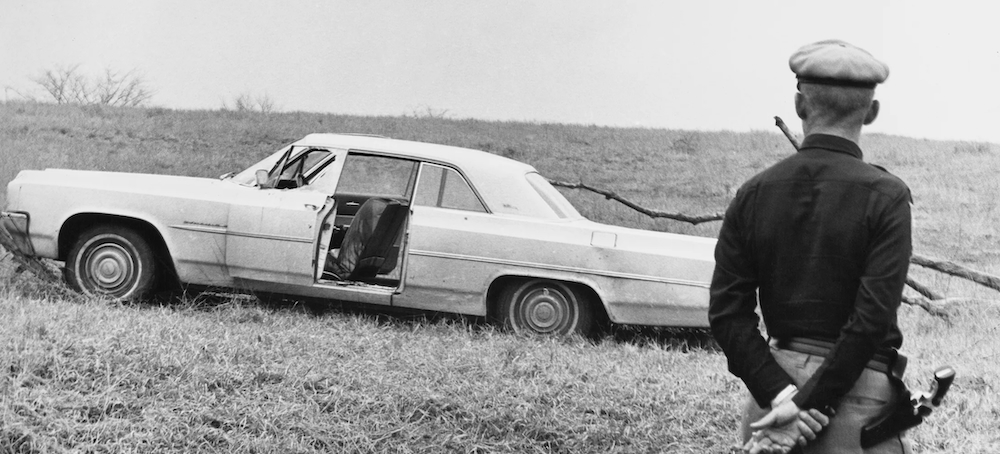 Viola Liuzzo’s car shuttled fellow-activists after the march from Selma to Montgomery. (photo: Getty Images)
On M.L.K. Day, the death of Renee Good calls to mind another woman who died protesting for the rights of others.
On March 25th, the third attempt at marching from Selma to Montgomery, the state capital, proved successful, and King delivered one of his least noted but most significant speeches on the ways in which disenfranchising Black voters had been key to gutting interracial progressive politics across the South. “Racial segregation,” King pointed out, “did not come about as a natural result of hatred between the races immediately after the Civil War.” Rather, he argued, it had evolved as part of a larger campaign to destroy the nascent alliance between former slaves and dispossessed whites that emerged during Reconstruction. Afterward, Liuzzo, who’d volunteered to transport activists between the two cities, drove toward Montgomery with Leroy Moton, a nineteen-year-old Black organizer. They never made it. Liuzzo’s car was intercepted by one carrying four men associated with the Ku Klux Klan. Bullets were fired into Liuzzo’s car, killing her. Moton, covered in Liuzzo’s blood, pretended to be dead, then set off to find help after the men departed.
The murder sent shock waves through the movement and across the nation. The civil-rights workers Andrew Goodman, James Chaney, and Michael Schwerner had been murdered in Philadelphia, Mississippi, the previous summer, and that February, Jimmie Lee Jackson, a twenty-six-year-old marcher, was fatally shot by an Alabama state trooper after a voting-rights demonstration. Two weeks before Liuzzo was attacked, the Reverend James Reeb, a Unitarian minister and a member of the Southern Christian Leadership Conference from Boston who also volunteered in the voting-rights campaign, had been beaten to death. Nonetheless, Liuzzo’s death—and, specifically, the fact that the movement’s antagonists were willing to kill a white woman—pointed to a broader conclusion. Forces arrayed against the movement did not simply represent a threat to African Americans, as was the popular perception. They were a mortal danger to anyone who disagreed with them, regardless of the person’s race, background, or gender.
Recent events have given renewed pertinence to the circumstances of Viola Liuzzo’s death. In Minneapolis, on January 7th, Renee Good, a thirty-seven-year-old poet and mother of three from Colorado, was killed by Jonathan Ross, an Immigration and Customs Enforcement agent who fired at her car as she attempted to drive away. Good, who had just dropped her youngest child off at school, had been attempting to block the street as part of a protest against a sweeping ice crackdown that has besieged Minneapolis for weeks. Superficially, the circumstances of the two deaths, separated by more than sixty years, bore some resemblance: two white women of similar age, both moved by conscience to come to the defense of vulnerable communities, both killed in their vehicles amid a much larger societal conflict playing out around them.
Yet the more disturbing similarities lie in what happened after their deaths, and in what they conveyed about the crises in which they occurred. Liuzzo’s funeral, in Detroit, drew the leaders of the movement, including King and Roy Wilkins, the executive secretary of the N.A.A.C.P., as well as luminaries from organized labor, such as Walter Reuther and Jimmy Hoffa. Nonetheless, J. Edgar Hoover’s F.B.I. immediately launched a smear campaign against Liuzzo, falsely alleging that physical evidence suggested that she had used heroin shortly before her death and implying that she’d been drawn to Alabama not by deeply held principles but by the prospect of sex with Black men. The Bureau was likely attempting to distract the public from the fact that one of the four men in the car when Liuzzo was killed was an “undercover agent”—a paid informant—who had evidently done nothing to prevent her death. Hoover may have decided that, if Liuzzo’s character could be sufficiently impugned, then any potential backlash to the Bureau’s connection to an incident involving the murder of a married white mother could be avoided.
Given the cynicism and the mendacity that have defined the second Trump Administration, it was not surprising to see a similar pattern emerge in the hours following Good’s death. Trump initially claimed that Good had run Ross over with her car, accusing her of having “behaved horribly” and implying that she was responsible for her own death. The Secretary of Homeland Security, Kristi Noem, went a step further and accused Good of engaging in an act of “domestic terrorism.” The White House press secretary, Karoline Leavitt, disparaged Good as “a deranged lunatic.” The clear objective of this campaign was to make the unconscionable appear reasonable, and the reasonable appear laudable.
Yet, for all the similarities between the harms that befell Liuzzo and Good, there is the unsettling possibility that the circumstances surrounding the latter’s death may be even more bleak. The day after Liuzzo’s murder, President Lyndon B. Johnson said that she had been “murdered by the enemies of justice who for decades have used the rope and the gun and the tar and the feathers to terrorize their neighbors.” The three men charged in her death were acquitted of murder charges in a state trial, but convicted on federal civil-rights charges, and faced a decade each in prison, though one died before the beginning of his sentence.
Good’s death occurred in a landscape in which federal involvement extends beyond the willingness to provide a cover story for Ross’s actions to the refusal of the Department of Justice to even investigate whether the shooting violated Good’s civil rights. The D.O.J., in fact, went in the opposite direction, pushing for a criminal investigation of Good’s widow, while refusing to investigate the shooter; six career federal prosecutors in Minnesota resigned in response. (On Friday, it was reported that the D.O.J. had opened a criminal investigation of the state’s governor, Tim Walz, and the mayor of Minneapolis, Jacob Frey, for alleged conspiracy to impede federal law enforcement.) Even at this early juncture, the implications of Good’s death are clear. Vice-President J. D. Vance’s claim that ice can operate with “absolute immunity” clarifies the sense that the agency operates as a kind of secret police force that can act with impunity, knowing that the mechanisms of accountability have been nullified by the President who holds their primary allegiance. ice began this chapter by antagonizing and detaining people whom it alleged were undocumented, but the danger has spread far beyond any single community to anyone—across lines of gender, background, or citizenship status—with the temerity to dissent.