Foreseeable Flaws in Gaza Aid Project Led to Shooting of Palestinians
Louisa Loveluck, Miriam Berger, Imogen Piper, Gerry Shih, Jarrett Ley and Hazem Balousha The Washington Post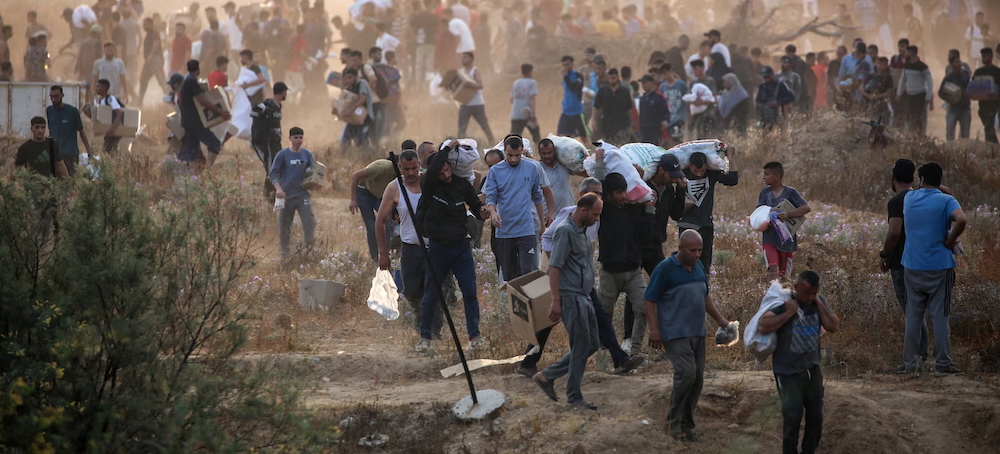 Palestinians carry Gaza Humanitarian Foundation relief supplies near an aid distribution center in the central Gaza Strip on June 8. (photo: Eyad Baba/AFP/Getty Images)
The Gaza Humanitarian Foundation program has drawn huge crowds near Israeli troops, who opened fire multiple times, according to humanitarian experts, witnesses and visual evidence.
Shortly before the centers opened, the United Nations warned in a briefing paper that the model — developed by a group of former U.S. intelligence and defense officials and business executives working in close consultation with Israel — could lead to violence sparked by overcrowding. “Israeli forces or private military security companies may use force to control crowds,” the U.N. Office for the Coordination of Humanitarian Affairs said.
A Washington Post investigation found this occurred at least three times just within the first week of operations, with witnesses saying Israeli troops shot in the direction of crowds.
Since the American-backed Gaza Humanitarian Foundation (GHF) opened the first of four distribution centers in late May in areas controlled by the Israeli military, Palestinians have been shot in the vicinity of the sites nearly every day, killing more than 400 people and wounding thousands of others, according to U.N. Office of the High Commissioner for Human Rights.
The Post found that this violence was in part the result of ignoring long-established norms for aid distribution in Gaza and the predictable result of dynamics baked into a program that repeatedly culminated, witnesses said, in Israeli forces firing toward crowds.
During the first week of operations, the Israeli military said that it fired warning shots toward “suspects” advancing on soldiers’ positions close to a Rafah distribution center on at least five occasions.
In interviews, 10 witnesses recounted that on May 27, June 1 and June 3, they saw shots fired toward or directly at Palestinian crowds that came from near locations where they had seen Israeli forces, including tanks and drones. Over those days, at least 48 people were dead on arrival at the Red Cross’s field hospital or died shortly afterward, and the facility received about 400 additional people who had been injured, most with gunshot wounds, according to the International Committee of the Red Cross.
The Israel Defense Forces said in a statement that it was reviewing reports of incidents in which civilians arriving at the GHF distribution centers were harmed and is working at “minimizing possible friction” between soldiers and the local population.
“As part of this effort, IDF forces have recently worked to reorganize the area through the installation of fences, signage placement, the opening of additional routes, and other measures,” the military said in its statement. “Following incidents in which harm to civilians who arrived at distribution facilities was reported, thorough examinations were conducted in the Southern Command and instructions were issued to forces in the field following lessons learned.”
The route toward the distribution center that Gazans had been instructed to follow by the GHF, including in Facebook posts, took them within three-quarters of a mile of two military positions visible in satellite imagery and along the same path where witnesses said they had seen tanks. Witness testimony and video evidence show that once gunfire broke out on the three occasions that first week, some people who were following the approved route to the center began running toward it and thus came even closer to the two military positions.
The GHF said that recent violent incidents in Gaza were unrelated to its aid centers and rejected the criticism of “so called experts,” saying in a statement that they were unfamiliar with the “complexity” of the group’s operations.
Israel has backed the GHF project since late last year, saying that the preexisting system that relied on U.N. agencies and a network of nongovernmental organizations to deliver aid in Gaza needed to be overhauled because, Israeli officials say, Hamas had enriched itself by seizing convoys and reselling goods. Israel has not provided public proof that Hamas systematically stole aid brought into Gaza under the U.N. system, and despite requests by The Post to officials in the IDF, the Israeli Foreign Ministry and the prime minister’s office, no evidence has been provided to substantiate reports of widespread diversion of U.N. food aid.
The U.N.’s efforts to deliver aid in Gaza have been curtailed by Israel. Most of the organization’s aid trucks have been prevented from entering the enclave, which is largely under siege by the IDF. Inside Gaza, the U.N. says its activities have been significantly restricted.
Under its model, the GHF operates four distribution centers inside areas of Gaza occupied by the Israeli military. The centers rely on armed American private contractors for security and logistics. Food is provided on a first come, first served basis without any requirement that recipients register. The centers have variable opening times posted on social media the day before.
Since late last year, the plan’s architects have envisioned a role for the Israeli military as well. The planners said that as a condition of deploying resources to Gaza, IDF forces outside the aid sites’ perimeters would have to target suspected militants with direct fire, according to internal documents reviewed by The Post.
The routing of Palestinians through a militarized landscape was just one of the flaws that experts in humanitarian affairs identified in the GHF design.
“The design, setup, layout and execution of the distribution all contributed to an environment that increased stress, tension, panic and hazardous situations for the people receiving the items,” said Alex Davies of the Norwegian Refugee Committee (NRC).
Experts working for U.N. agencies and other aid groups say that the small number of distribution centers, located 1½ miles or more from Palestinian encampment sites, was a recipe for extreme overcrowding and panic. The GHF also didn’t adopt other measures traditionally used by agencies to coordinate the provision of aid and avoid overcrowding and chaos, such as registering recipients, notifying them by text message and other means when to pick up their rations, and using vouchers that identify the timing and quantity of aid for each recipient. Instead, the GHF provided food on a first come, first served basis.
“Unless properly managed, you can easily create confusion, allow for misinformation to spread quickly, and induce panic and fear in the people waiting to receive food,” Davies said. “The biggest fear is that there is not enough for everyone — their survival is at stake.”
The GHF, in its emailed statement, defended the caliber of its operations. “Our team includes very experienced humanitarian experts who designed our model to avoid the pitfalls and failures of UN and other groups whose aid isn’t reaching aid seekers,” the group said.
The organization said that killings have occurred but added, “To date, there has not been a single casualty at or in the surrounding vicinity of any of our sites.” The GHF said: “We continue to experience a growing pattern of false information seemingly formulated by the Gaza Health Ministry, an arm of Hamas, and … echoed by the UN. It is unfortunate that … the UN continue[s] to push false information regarding our operations.”
But one GHF official acknowledged that there has been violence in connection with the operations, saying in an interview that the organization believes the repeated shootings have occurred because there have not been enough aid distribution sites. The official also said that people have drawn IDF fire by trying to take shortcuts to bypass the crowded designated route, or arriving before dawn to line up for scarce food packages, only to get lost in the dark and stray toward IDF positions.
Desperate crowds
U.N. agencies and many other humanitarian groups operating in Gaza have, over the years, developed procedures designed to provide aid in a regulated and orderly manner.
During a three-month ceasefire between Israel and Hamas this year, for example, the U.N.’s World Food Program operated 400 aid stations across the Gaza Strip, often in bakeries, hot-meal centers and elsewhere. “You avoid the chaos by making sure that there is sufficient aid and lots of locations, because people aren’t worrying about getting there first so they don’t miss out,” said one American aid worker, who spoke on the condition of anonymity because they were not allowed to speak with the press.
Aid recipients have in the past registered for assistance and been notified by text message and through community leaders of where to collect items. Some agencies provided electronic vouchers, for instance using cellphone e-wallets, entitling the recipient to obtain a certain amount of supplies based on their family’s need.
“Because the level of need has consistently been high, to mitigate the problem of crowd control, to mitigate what you’re seeing … a lot of organizations … were using smaller, community-level distributions,” said Ann Marie McKenzie, a humanitarian expert with a decade of experience, including in Gaza.
The GHF’s approach diverged from these standard practices, according to humanitarian experts.
“You cannot manage that with that many people who are starving to death … and that [overcrowding] was very foreseeable,” said another expert in aid distribution, who spoke on the condition of anonymity out of concern for their family’s safety.
In its statement, the GHF rejected this criticism, alleging that the U.N. and other humanitarian groups have failed to deliver aid to Gazans and citing the looting of aid trucks as proof. “GHF is the only one who is delivering aid directly to the Palestinian people. If the UN and others would collaborate with us, we could scale up operations,” the organization said.
In response, Olga Cherevko, a U.N. spokeswoman in Gaza, said her organization will not be part of any program “that contravenes humanitarian principles. Any operation that channels desperate civilians into militarized zones is inherently unsafe.”
Israeli troops engage
As crowds of desperate Gazans repeatedly swelled and surged toward the Rafah distribution site, they neared Israeli troops who have been engaged for a year and a half in battling Hamas militants and not managing civilians.
“These soldiers don’t have the know-how to deal with civilians. For them, everyone is a suspect, until considered otherwise,” said Nadav Weiman, executive director of Breaking the Silence, an Israeli organization of IDF veterans that has collected the testimonies of many soldiers who have fought during the conflict.
Under the military’s rules of engagement, soldiers say, troops are permitted to open fire if they believe their lives or the lives of their fellow soldiers are in danger. According to Israeli activists at multiple rights groups, this has created a permissive environment in which there are rarely significant consequences for making a wrong decision.
“When you have tens of thousands of people running toward boxes with a little bit of food, these kinds of incidents will continue happening under the current IDF rules of engagement,” Weiman said.
The Israeli military declined to answer questions about the testimonies collected by the group or about the rules of engagement under which troops are permitted to open fire. After Israel’s Haaretz newspaper reported late last month that military commanders ordered troops to open fire on aid seekers, the IDF rejected the accusations, and senior officers were quoted in local media as saying that civilians had been killed due to “inaccurate and uncalculated” artillery fire and that the army had since shifted to “other methods.”
The IDF also said last week that it had temporarily closed the initial aid distribution center, located in the Tal al-Sultan area of Rafah, and established a new one nearby in part to reduce friction with the local population. The U.N. reported that fatal shootings continued to occur outside GHF centers.
Since the early months of the Gaza war, many Israeli military leaders have argued against placing soldiers in situations where they would be in close contact with Palestinians or distributing aid directly to crowds of civilians, precisely because they feared outbreaks of chaos, unruly crowds or shooting incidents, according to current and former Israeli military officials involved in the GHF planning process. One current official, who spoke on the condition of anonymity because he was not authorized to speak publicly, cited an example from February 2024, when IDF troops protecting an aid convoy were swarmed by a crowd and opened fire, killing more than 100 Palestinians.
May 27
When the first of the four distribution centers opened in Rafah’s Tal al-Sultan neighborhood about 2 p.m. on Tuesday, May 27, it initially attracted just a trickle of people, Gazans recalled. They had walked south along the Al-Rashid coastal road from an area known as Fish Fresh in the city of Khan Younis to a place known locally as Flag Circle before turning inland toward the GHF site.
The area had been declared a closed military zone by the IDF, meaning the Israeli military had banned Palestinians from entering it. Along the route, according to photographs, were signs warning them of danger if they veered from the road. An IDF spokesman said the military had not put up the signs and it’s unclear who did.
As Muhammed, 26, turned left along the final stretch toward the aid site, he said, all appeared calm. He entered through a fenced passageway and he was checked for a weapon before he was allowed to collect a box of cooking oil, tea and rice.
On the roads outside, however, crowds were starting to grow as word spread to Khan Younis that the food center had opened, he recalled. The crowd swelled into the thousands, witnesses said. The situation eventually turned chaotic, with some Gazans pulling down the perimeter fences as they raced to reach the aid first.
Sometime after 4 p.m., according to four Palestinian witnesses, gunfire erupted in the direction of the crowd, coming from near two locations where they had seen Israeli tanks or quadcopter drones. “The gunfire happened when people [left] the path that the army set for them,” said Baha Shurrab, 49, who said he watched the scene unfold after hitting the ground.
A video from that afternoon, posted by local journalist Tamer Qishta and verified by The Post, shows several Palestinians appealing to one of the contractors for help through the wire fence. “I swear, by God, we want your safety,” the contractor shouted back through the fence. “If you don’t go, tanks will attack you,” he said in Arabic.
In a statement that night, the IDF said that it had fired “warning shots in the area outside the compound.”
Mohanned Qishta, another local journalist, said that gunshots, which he believed to be warning shots, crackled out shortly after he saw a group of children veer off the road. But people heading in the direction of the aid center along the approved route kept running toward it. “Their hunger and their desire to get food for their children outweighed their fear,” Qishta said.
About 7 p.m., local photographer Doaa al-Baz starting taking pictures of several tanks to the east of where she stood. Shortly afterward, she said, an armored vehicle on the road directly in front of her opened fire.
That day, 48 people were admitted to the Red Cross field hospital with gunshot wounds, the International Committee of the Red Cross (ICRC) said.
June 1
Similar events unfolded on subsequent days in the vicinity of the Tal al-Sultan site. On Sunday, June 1, the center opened early in the morning, and people began gathering hours before that in the hope of reaching the site before aid ran dry.
Mohammed al-Gharib, a local journalist, was among those on the Al-Rashid coastal road, close to Flag Circle, who said they heard an Israeli drone announce to the growing crowd about 4 a.m. that the site would not open until 6 a.m. Not long after, shooting began again, he said. Four witnesses said in interviews that they saw gunfire toward the crowd coming from multiple locations where they said they saw Israeli tanks or quadcopters.
The Israeli military said that troops about a kilometer from the distribution site had opened fire. “IDF troops acted to prevent several suspects from approaching,” the military said. “Warning shots were fired toward several suspects.”
A video provided to The Post by the GHF shows three tracer rounds — ammunition that leaves an illuminated trail to help with targeting — being fired over the distribution center.
“Everyone was running,” said Moaz Qishta, who had been seeking aid. Part of the problem was that “no one knew the way,” he said.
The ICRC reported that 200 people were taken to the Red Cross field hospital, most with gunshot wounds. Twenty-one of them were dead on arrival. Additional casualties were taken to other medical facilities, according doctors at those sites.
June 3
The following Tuesday, June 3, proved even more deadly. Two witnesses said they saw shots fired directly into the crowd, coming from locations where Israeli forces had been sighted.
Journalist Mohanned Qishta said that the gunfire began as he ran with a large crowd toward the distribution site. “There was constant firing on civilians trying to get the aid,” he said. “Why did they shoot at us? Because we entered the wrong way?”
When gunfire erupted, Majd Salameh dropped to the ground, he recounted. “There was direct gunfire on the people” who had gathered along the nearby coastal road as they waited for the center to open, he said.
The IDF said in a statement that it had opened fire closer to the site this time — approximately half a kilometer away — after troops “identified several suspects moving toward them, deviating from the designated access routes.” The military said the soldiers had fired warning shots and then “additional shots” near people who kept moving forward. The IDF had no further comment about how warning shots are targeted.
In video footage filmed by Mohanned Qishta about 600 meters from the GHF site, bursts of rapid gunfire are audible. He said that the shots came from an Israeli tank he saw just south of the road.
In the video, which was verified by The Post, Gazans carrying white sacks of food aid are seen streaming away from the site and toward the sea. But those who have yet to get aid continue to move toward the distribution site along the approved route. At one point, the red glare of a tracer round streams across the road as gunshots ring out. The path of the tracer fire is horizontal, near or slightly above head height, according to two ballistics experts who reviewed the video.
“The trajectory of the round is not the type of trajectory I would expect for a warning shot — especially in a humanitarian situation filled with civilians,” said Wes Bryant, a former U.S. Air Force Special Operations targeting expert and former chief of civilian harm assessments at the Pentagon. “Warning shots are not supposed to go directly at or into the entity you are warning.”
The Red Cross field hospital received 176 people who had mostly suffered gunshot wounds and an additional 27 who were dead on arrival or died shortly afterward, the ICRC reported. Other victims were treated elsewhere, doctors at other locations said.