For Iran, Trump’s Threats Are Credible. His Promises Are Not.
Bobby Ghosh Ghoshworld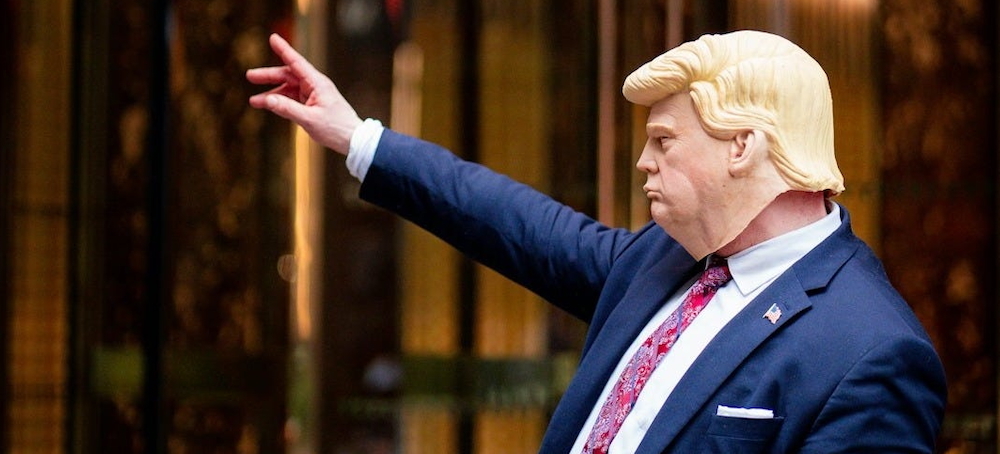 A man wearing a Donald Trump mask. (photo: Abhinav Bhardwaj/Unsplash)
Ahead of another round of negotiations, the president is playing the Nixonian madman. But that undermines his own objectives.
Deterrence, he argued, is the easy half of coercion. You are asking your adversary to keep doing what he is already doing — nothing — and the payoff, if he complies, is not being attacked. “Compellence,” a word Schelling coined, is the other half, and it is harder. You are asking your adversary to change his behaviour, and the payoff, if he complies, is not being hurt further.
Deterrence requires only a credible threat. Compellence, as Schelling put it in the phrase subsequent theorists have built on, needs a credible threat and a credible assurance.
That second half is at the root of the problem with Donald Trump’s Iran strategy, and it explains why the “madman theory” his advisers keep briefing reporters about is solving the wrong problem.
Many of the commentators arguing against the madman framing suggest it won’t work because Trump’s threats are not credible to Tehran. This, I submit, is incorrect. After the opening strikes of February 28, which killed Supreme Leader Ali Khamenei and much of the regime’s leadership; after a bombing campaign the White House describes in its own triumphal releases as having struck more than 13,000 targets; after the blockade of Iranian ports and the threats to obliterate power plants, bridges and “civilization” itself — after all this, no one in the Iranian security establishment doubts this American president’s willingness to use force. The threat is credible, and the madman framing is not needed to make it so.
The problem for Trump is the other half of Schelling’s equation. To be coerced into reopening the Strait of Hormuz, or into surrendering the enriched uranium it has left — indeed, into any of the things Trump wants — Tehran has to believe not just that refusal will be punished, but that compliance will produce relief. That is the assurance half of compellence. And there is no version of that assurance the US can currently make stick.
Consider the record from Tehran’s vantage point. In 2015, Iran signed the Joint Comprehensive Plan of Action with six world powers and accepted the most intrusive inspections regime ever imposed on a sovereign state. Three years later, Trump walked out of it. The International Atomic Energy Agency had certified Iranian compliance at the time. It made no difference.
In February of this year, Iranian envoys were negotiating with American counterparts in Oman and had tabled an offer that would have capped uranium enrichment at levels lower than the JCPOA permitted. The talks were set to resume the following week. Instead, the bombs fell on Tehran, and the officials Iran would have needed to finalize anything died in the first hours of the strikes.
Iran does not need to be taught how fearsome the US can be: even before the carnage of the current war, Tehran’s leaders twice had a ringside view of the destruction American military might wrought upon Iraq. But those leaders also have a lived experienced how unreliable Trump’s America has been as a negotiating counterparty — how little the word of a sitting president binds his own administration, let alone the one that follows.
The madman framing makes this worse rather than better. As Brown University’s Reid Pauly argues in The Art of Coercion, “actions that a coercer can take to bolster the credibility of a threat undermine the credibility of its assurance.” In other words, the quality that is supposed to make Trump’s threats credible makes his promises worthless. Pauly calls this the “assurance dilemma.”
(I highly recommend the book, and also this 2017 essay for The National Interest about Trump’s threats to pull out of the JCPOA that Pauly co-wrote with Sahar Nowrouzzadeh and Mahsa Rouhi.)
If Trump is the kind of leader who might “do anything” — as Richard Nixon wanted North Vietnam to believe of him in 1969 — then on what basis is Iran to believe that signing whatever agreement the American side brings to Islamabad will protect it from the next round of strikes? An unpredictable man’s word is a contradiction in terms. The very attribute Trump is trying to weaponize against his enemy undercuts the only tool that could plausibly bring this war to a close.
This is not the only dilemma attending the talks in Islamabad. An administration official told Axios last week that negotiators had reached what sounded like the outline of a deal — and then the Iranian team “went back and the IRGC and those kinds of people said ‘oh, no, no. You don’t speak for us.’” The official described this as a problem of Iranian factionalism, which it partly is. But the perception in Tehran’s factions is at least in part informed by Trump’s track record. Any Iranian leader who brings back a deal signed by the Trump administration is handing his domestic rivals a weapon: you traded our nuclear program and our leverage over the strait for the word of a man who has already broken his word once, on this same subject.
This would explain reports that Mohammed Bagher Ghalibaf has quit as head of the Iranian negotiating team: the speaker of the Islamic Republic’s parliament is an ambitious politician who understands the risks of having his name attached to any deal with Trump.
Robert Jervis, the late Columbia scholar whose work on misperception in international politics shaped a generation of diplomats, used to point out that the party under coercion will look at the coercer’s behavior for clues about what happens after the concession, not before it. This is the clue Trump has given. His Iran record is dominated by a single, unambiguous fact: he tore up a working deal, and then, when offered a better one, bombed its authors. The madman theory is supposed to make adversaries doubt whether his threats will be carried out. The adversary in this case is doubting whether his assurances would be.
Trump, having switched from promising destruction to offering Iran economic inducements last week, has gone back to making dire threats. But the way out of his predicament is not louder threats. It is a structure of commitment — staff-level negotiators Tehran can deal with over months and years, a formalized channel through an intermediary both sides trust, guarantees from outside powers that would bear some of the reputational cost of American backsliding — that makes American promises mean something. The president-playing-madman is offering none of those things, which means the next round of negotiations is unlikely to improve on the first.