Explosions, Black Rain, and Dead Birds: Waking Up to War in Tehran
Homayoun Ghanizadeh Rolling Stone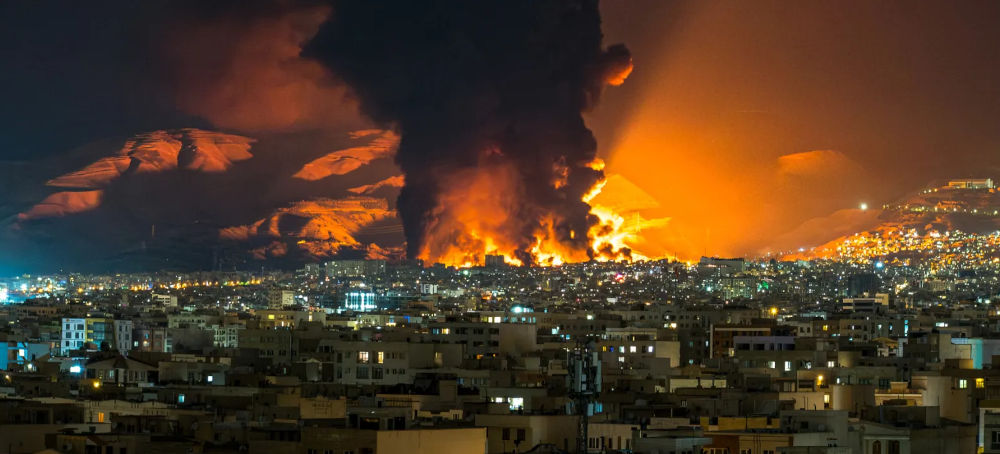 Smoke and flames rise at the site of airstrikes on an oil depot in Tehran on March 7. (photo: Sasan/Getty)
Overnight on March 7, Israel bombed fuel depots outside of Tehran, Iran’s capital city. Playwright and filmmaker Homayoun Ghanizadeh woke up the next day to black smoke and carnage. What follows is his account of a private citizen trying to maintain some normalcy in the face of a relentless bombing campaign.
I step onto the terrace and see that a black and impenetrable layer of oily smoke has been drawn between us and the sun. My partner coughs. Her throat hurts. My eyes burn a little, too. Through the window, partly obscured by the thick crisscrossed strips of duct tape everyone is using to reinforce glass, I see that several birds are lying on the street. Seeing the bodies of dead birds lying on the street like the dry leaves of trees is becoming something ordinary for us in Tehran.
My partner is worried that I might again want to begin my day with an espresso from a café somewhere in the war-struck city. Her worry is justified, because I want to do exactly that. I, like so many of my fellow citizens, want our daily routines back. Some sense of normalcy during chaos and horror.
Outside our apartment, my white car looks as if Trump himself has pissed tar all over it. We get in and start driving. The official mourning holidays for Khamenei have ended and the shops should be open, but most of them are still closed. She coughs under her mask and gives me a mask too. It is nine in the morning and the air looks darker than nine at night. War-struck Tehran has turned into an apocalyptic city. I always liked the word “apocalyptic,” but I never wanted to experience living in such a condition.
It seems to me that today the excitement that had appeared on people’s faces in the first days after Khamenei’s death is fading and more fear is emerging. From afar, the sound of several more explosions can be heard, and from a loudspeaker somewhere nearby the chant of “Death to Israel” rises. We arrive at a pointless checkpoint. I say pointless because I do not know what they want from our cars when Trump’s toys are flying overhead without trouble. From the sour and angry face of the guard it is clear that he sees us as outsiders. Especially my partner, who no longer wears a headscarf. He knows we are not among their supporters. We know that he knows. We all know what is going on, but instead we simply stare into each other’s faces and exchange what is in our hearts through looks. This costs less. They consider us part of the group that had been waiting for salvation and that believed the path lay in an American attack and Uncle Trump, as many people call him.
My eyes fall on a baker who, wearing a white coat and a white cloth tied around his head, is running under a rain that has just begun. The baker’s white coat and headband are soon dotted with black drops of oily rain. Another explosion sounds in the distance. The Basij (Iran’s internal religious police) at the checkpoint chant “Death to Israel.” Finally, with a Basij’s gesture, the road opens. I look at him. Black tar-like drops are settling on his angry face. I press the gas and pass by, and try, in this dark chaotic city, to think only about the espresso that is waiting for me. My partner shouts, “Do you have gasoline?” I say, “The tank is half full. Why?”
Pointing to the hundreds of cars lined up on the other side of the street, she says that this is the gasoline line. It crosses my mind that soon all these cars will probably come to a stop without gasoline, and while I am thinking these thoughts, I finally reach Café Godot. As I toss back the espresso, a weak ray of light, with whatever struggle it can manage, reaches the ground through the layers of oily cloud. My eyes fall on the giant billboard on the street with Khamenei’s picture on it and beneath the image the words “His God is alive.” The sound of another bomb shakes the untaped windows of the shop.
Someone says their work is finished and from outside a Basij shouts: “Khamenei will return! Khamenei will return!”
Under his breath, the shopkeeper repeats Elon Musk’s tweet in reply to the late Ayatollah, which in fact was an Iranian proverb — “What a vain illusion” — and bursts into laughter. With the sound of another explosion a group of tired birds lift off from the trees, and a white cat, covered in black stains and grime, like a playful child who has dirtied his clothes in an alley, looks at us indifferently. My wife coughs and I feel the effect of espresso on my brain. The ninth day of the war of America and Israel against the Islamic Republic is only beginning for all of us.