Even Donald Trump Is Starting to See the Absurdity of Stephen Miller’s Deportation Targets
Shirin Ali Slate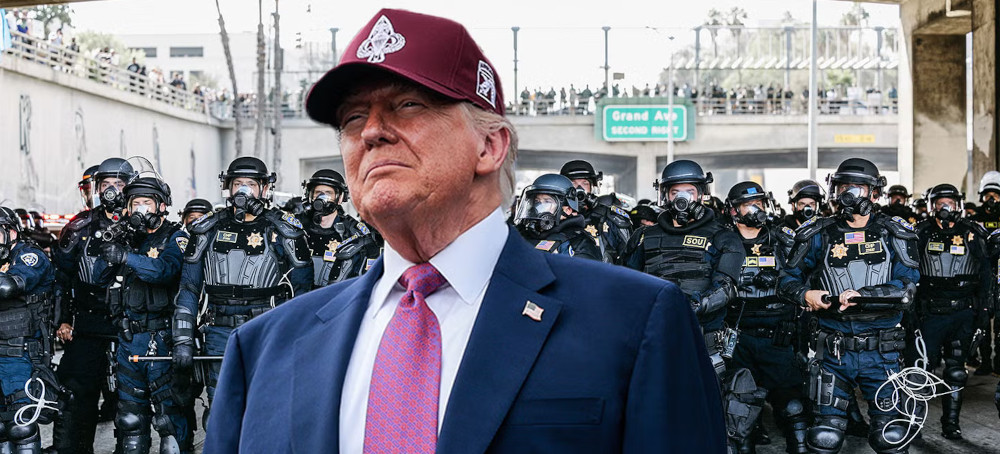 President Trump. (photo: David Pashaee/Getty)
It’s necessary to understand some immigration basics to see why Trump’s stated plans are almost comically doomed to failure. The Department of Homeland Security executes numerous different types of deportations, but those boil down to two main methods: “removals” and “returns.” Removals are deportations in the most common understanding of the term; an immigration judge or officer issues a formal order of removal against someone who is considered unlawfully present in the United States and returns them to a country of origin. Typically these are people who enter the country illegally, have certain criminal convictions, or overstayed their visa.
Returns, meanwhile, typically involve immigrants who are apprehended at the U.S.–Mexico border, turned away at an airport, or fall under expedited removal. Returns at one point in time were the highest portion of deportations because they involved people who tried entering U.S. land borders, which have historically had a much higher volume of activity than interior enforcement. It’s not exactly clear how Trump is defining his 1 million deportations goal—specifically whether it includes returns—but it may not matter. Experts I spoke to believe the president is unlikely to achieve that number in one year’s time even if the heavier volume of returns are included and if there’s a significant increase in removals.
“The idea that Trump is going to hit a million removals strains credulity,” Aaron Reichlin-Melnick, senior fellow at the American Immigration Council, told me. “I do not think that is possible. The record for interior deportations was 238,000 under President Obama in fiscal year 2009, and that’s a quarter of a million in one year. Getting up to a million removals even in the next four years seems, to me, virtually impossible.”
That doesn’t mean Trump isn’t trying with everything in his tool kit. On the very same day Trump took his oath of office, he made it clear that his administration would be taking a hard line on immigration. Through a flurry of executive orders, Trump shut down the U.S.–Mexico land border and suspended the refugee resettlement program.
But Trump did not stop at those historically lawful actions. He signed an executive order seeking to limit birthright citizenship, a blatant overreach of executive power that flew in the face of the 14th Amendment and instantly drew lawsuits. But by the time he hit his first 100 days in office, deportations did not drastically increase. Even now, with the high-profile enforcement efforts in Los Angeles, the numbers aren’t high enough to top “Deporter-in-Chief” Barack Obama. Obama’s administration deported over 3 million people over the course of his first four-year term, largely driven by administrative returns at the U.S. southern border. Ironically, those returns have plummeted under Trump because of his executive order closing the border for refugees.
NBC News calculated that from February through April, Immigration and Customs Enforcement deported about 40,500 people. At that pace, the Migration Policy Institute estimated Trump would only end up deporting roughly half a million people this year—that’s less than former president Joe Biden’s top number in 2024.
This is all expected—the Trump administration essentially set itself up for failure. But we know the president is not one to take a loss graciously, so if he can’t find enough immigrants to deport legally, it seems he’ll just ignore the Constitution to try to hit the 1 million mark. We’re seeing the natural outcome of those policies: utter chaos followed by pushback from the judiciary.
Over the past several months, we’ve witnessed the Trump administration mistakenly deport at least four immigrants: Kilmar Abrego Garcia, Jordin Melgar-Salmeron, Daniel Lozano-Camargo, and at least one other Guatemalan man. And despite admitting its errors and judges ordering these men be brought back to the U.S. to receive their due process rights, the federal government has often simply refused.
“We just have to look at the front pages of the newspapers today to understand how the administration plans to accomplish its goal,” Heidi Altman, vice president of policy at the National Immigration Law Center, told me. “They intend to violate the law and the Constitution, terrorize communities, and mislead the public about instigators of violence. These are all really concerning tactics that obviously are correlated to warning signs of a government that is increasingly authoritarian in nature.”
Characteristic of this situation was the report that deputy chief of staff Stephen Miller pressured ICE agents to arrest at least 3,000 immigrants a day, to hell with a warrant or honoring due process.
Meanwhile, the Trump administration has shown it is unfazed by cruelty. Despite their stances on immigration, nearly every U.S. president has allowed in a certain number of refugees. Trump, on the other hand, completely gutted the refugee resettlement program so not a single refugee would be legally authorized to enter the country—minus a group of white Afrikaners. That decision left thousands of refugees stranded after going through a rigorous vetting process that often takes years to complete. Then there’s the termination of temporary protected status for hundreds of thousands of immigrants, a program that the federal government has the legal authority to oversee. Trump directed Homeland Security Secretary Kristin Noem to revoke TPS from migrants by removing their home countries from the program despite ongoing civil wars, political persecution, and other atrocities.
These actions, though technically legal, have not been done by previous administrations because they are inexplicably cruel. Families get torn apart, U.S. communities lose integral members, and critical labor is lost.
The chaos unfolding in Los Angeles is another predictable result of Trump’s delusional deportation goal. As immigration agents raided workplaces, residents of California took to the streets to protest. The Trump administration, unable to withstand any criticism of its agenda, forced National Guard members onto Los Angeles, going against the authority of the city’s mayor and governor. “This is intentional chaos,” Karen Bass, mayor of Los Angeles, said. A district judge recently ruled that it was also an unconstitutional commandeering of forces meant to be under the control of the state’s governor, Gavin Newsom.
The reality underlying this chaos is that immigration has no correlation with public safety threats. Crime data from 1980 to 2022 found immigrants—including people in the country without legal permission—are less likely to commit crimes than U.S.-born people, according to a report by the American Immigration Council. Even as the share of immigrants has increased within the U.S. population over the years, national crime rates have trended downwards. And the AIC concluded that “there’s no evidence to suggest that more aggressive immigration enforcement policies lead to less crime.”
The Marshall Project came to a similar conclusion after analyzing crime rates between 2007 and 2016, finding that most types of crime, including robberies, murders, burglaries, and larcenies, had a nearly flat trend line even as the population of people without permanent legal status fluctuated.
We know that the president rode a wave of xenophobia back into the White House, selling voters on a vision that immigrants are rapists and killers who are causing crime and “poisoning the blood of our country.” But Trump is proving through his administration’s own futile deportation efforts that this imagined threat could never be as dire as the president claimed.
On Thursday, Trump himself told supporters in farming and the hospitality business that more “common sense” was needed in how the Department of Homeland Security approached removals of “very good workers, they have worked for [American farmers] for 20 years.” Trump further acknowledged that his administration “can’t take farmers and take all their people and send them back.” Given the escalating situation in Los Angeles and Trump’s own hostility to immigrants, it’s extremely unclear that this promise means anything. Either way, Trump’s mass deportation plans will continue to go up in smoke, whether he likes it or not.