Trump’s Stunning Order on College Students Will Reach Further Than It Seems
Emily Tamkin Slate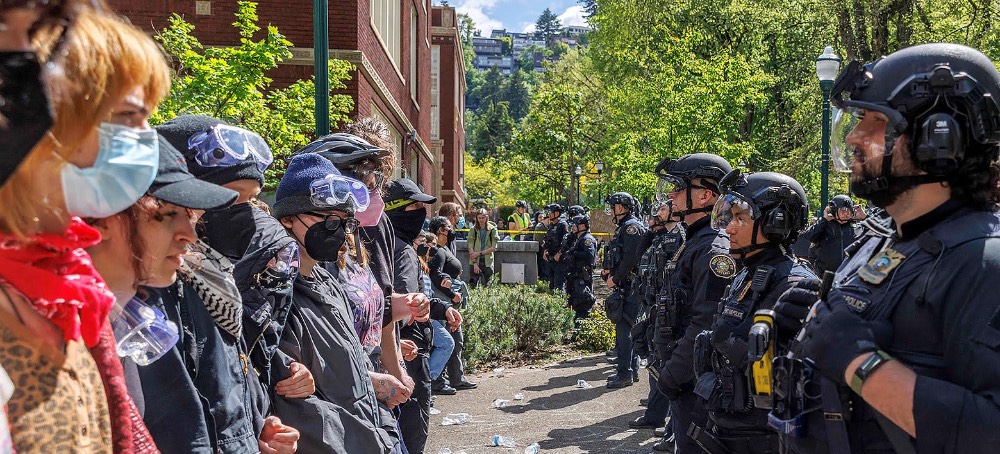 Protesters on university campuses have faced violent police crackdowns. (photo: Getty)
In other words, Trump’s plan to fight antisemitism is to use the powers of the U.S. government to go after universities, and to deport people, including students, who are here on visas if the protests in which they are participating are deemed to be sympathetic to Hamas.
Democrats who speak out against this may well be accused of antisemitism, supporting terrorism, or being soft on national security. They need to speak and act out against it anyway.
We have, unfortunately, seen that this is a tall order for many. We have seen that some Democrats were all too ready to rush to paint universities as hotbeds of antisemitism; to back legislation that would give the executive branch the power to go after nonprofits by describing them as supportive of terrorism (a term that, as we have seen in the United States and around the world, is all too open to political manipulation); and to falsely condemn peaceful protesters as violent.
That needs to change. It’s not only students who are under threat. The president is conducting an all-out assault on liberal democracy—what Perry Bacon Jr. at the Washington Post called “a full-scale war against modern liberalism,” freezing federal funding, halting foreign aid, further restricting immigration, halting initiatives to promote diversity and accessibility, and attacking transgender rights. This executive order, in its attack on institutions of higher learning and on the constitutional right to free assembly, needs to be understood in that context. You don’t support liberal democracy if you also support the Trump administration’s crackdown on universities and his planned deportation of students, and if you do support the latter, you may find that you soon no longer have the luxury of living in the former.
All of this would be true even if the administration appeared sincere in its desire to fight antisemitism. Unfortunately, it seems open to doing this only insofar as “fighting antisemitism” means “going after critics of Israel, particularly on college campuses,” and not if it involves, say, “addressing the rampant antisemitic conspiracy theories within our own building.”
During Trump’s first week in office, Elon Musk, his head of “government efficiency” who has joined the president at various meetings with foreign leaders, twice performed what looked an awful lot like a Nazi salute at a victory rally while thanking voters for saving civilization; dashed off some Nazi puns on X, his social media platform; and told supporters at a rally for Germany’s far-right AfD party that Germans should move beyond guilt about their past.
Further, while Trump did not comment this week on International Holocaust Remembrance Day, his Defense Intelligence Agency did reportedly circulate a memo saying that observance for May’s Day of Remembrance would be paused, along with those for things like Martin Luther King Jr. Day, Black History Month, and Women’s Equality Day. Wednesday and Thursday saw hearings for his health secretary nominee, Robert F. Kennedy Jr., who, in 2023, suggested that COVID was engineered to spare Ashkenazi Jews (along with Chinese people). This is before we get to the president himself, who has repeatedly pushed conspiracies about George Soros, the Jewish Hungarian-born billionaire philanthropist, and has said that there is something wrong with Jews who do not support him politically. In his first week in office, Trump also pardoned accused white supremacists and antisemites, including members of the neofascist Proud Boys, who were involved in storming the Capitol in Washington on Jan. 6, 2021.
All this is to say that the president is not threatening college students to actually fight the very real problem of antisemitism or to protect Jews. He is using Jewish fear and the threat of antisemitism to attack civil rights, minorities, and democracy itself while allowing antisemitism in his own administration to fester. Jewish groups have spoken out against the executive order, including the anti-occupation group IfNotNow, progressive Jewish group Bend the Arc, the Jewish Council for Public Affairs, and Nexus, which works to combat antisemitism and protect free speech (and with which, disclosure, I work as a fellow; it had no oversight on this piece). These groups have, accurately, called the order not only counterproductive to the fight against antisemitism—which will be won through education and working across difference and not by deporting students—but also antidemocratic. It’s good that they have said something.
But everyone should. Everyone, and particularly every elected Democrat, should work and speak out against Trump’s plans even if they don’t agree with everything, or even anything, that Jewish Voice for Peace or Students for Justice in Palestine says. They should speak out even if they don’t think it’s fair that students protest against Israel and not, say, Russia and China, or if they think it’s wrong to encourage boycotts of Israeli goods or cultural products, or if they don’t believe that there are interpretations of “from the river to the sea” that are not antisemitic.
They should do so—they need to do so—because the point of having free speech and assembly as constitutional guarantees isn’t to ensure that only people who agree with you can speak out and assemble. Nor is the point of higher education to learn only what you want to know. Politicians and ordinary Americans must oppose this action because if the people with whom you disagree don’t have the right to speak out against government policy without fear of retribution from the most powerful people in the country, that right no longer exists.
And so I hope that every Democrat speaks out for these universities, these professors, these students. They should do so even when it gets hard and politically uncomfortable. And they should remember that when you speak out for someone else’s right to protest without fear of political persecution in a democracy, you’re not only doing it for them. You’re doing it for yourself.