Drilling Could Resume Where a 1969 Oil Spill Inspired Earth Day
Joshua Partlow The Washington Post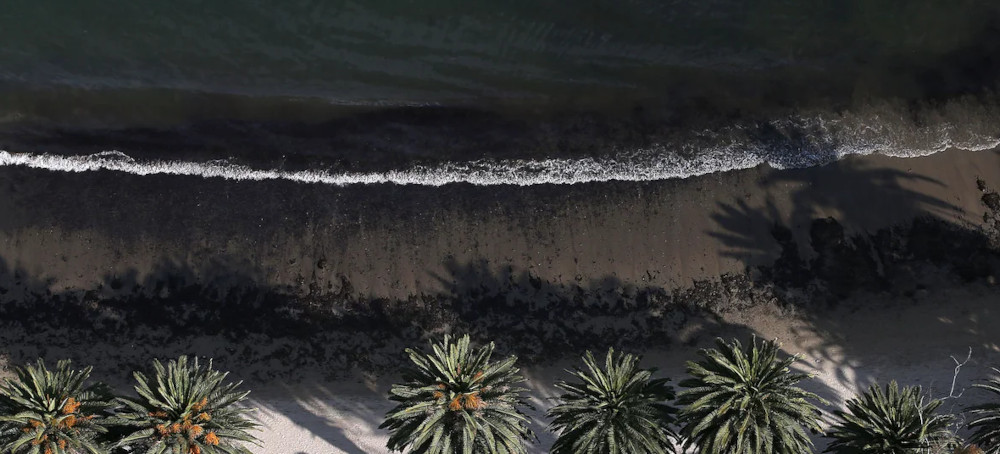 Oil is visible on the beach at Refugio State Beach on May 21, 2015, in Goleta, California. Over 100,000 gallons of oil may have spilled from an abandoned pipeline on the land near Refugio State Beach, spreading over about nine miles of beach within hours. (photo: Getty)
A plan by Sable Offshore to restart an oil pipeline that burst in 2015 has outraged Santa Barbara environmentalists.
He would learn later about the oil-covered birds, the dead dolphins and sea lions — casualties of a pipeline that ruptured and spilled more than 120,000 gallons of crude oil along the Gaviota Coast, one of the last undeveloped stretches of Southern California oceanfront.
“The full extent will never really be known,” Frankel said as he walked amid those same palms, many of them now teetering and washing away from winter storms and rising seas. He has become a lawyer for the Environmental Defense Center, a Santa Barbara-based nonprofit, and one of the people trying to block an effort to restart that defunct pipeline and boost an offshore oil industry that for years has been fading into the California sunset.
The company behind that effort, Sable Offshore Corp., an independent Houston-based oil and gas company formed in 2020 and whose management team has experience in the California oil industry, said in an SEC filing on Dec. 19 that it had received a waiver from California’s Office of the State Fire Marshal that puts it on a path to restarting early in January.
“We’ve had decades of safe oil and gas operations,” Steve Rusch, the company’s vice president of regulatory and environmental affairs, told a Santa Barbara county public hearing in October. “Sable’s committed to running the pipeline with state-of-the-art improvements.”
Sable’s plan — to resume drilling at three offshore platforms and pump oil through a buried pipeline running for miles up the coast — is reopening old wounds in this winsome seaside city. Many places are pro-environment and wary of pipelines. Santa Barbara was the first, with oil spills spawning an environmental ethic that is central to the city’s identity.
In 1969, another major spill at an offshore oil platform disgorged 100,000 barrels of crude into the Santa Barbara channel — a catastrophe that helped launch an environmental movement in the United States. It prompted the first Earth Day, led to the creation of the U.S. Environmental Protection Agency and helped spawn bedrock laws such as the Clean Air Act and the Endangered Species Act.
The pipeline plan looms at a time when many Californians fear backsliding on climate and environmental issues, as President-elect Donald Trump returns to office with promises to “drill baby drill.” During his first term, Trump pushed to expand offshore drilling in California, even as many platforms have stopped producing and the federal government hasn’t issued an offshore oil lease in the state since 1981.
Trump’s return makes stopping the Sable proposal “more critical for California,” said Alex Katz, executive director of the Environmental Defense Center, which was created in response to the 1969 spill. “You’ve got a federal administration that wants to drill everywhere. This is an opportunity for California to show we’re still going to lead on the climate crisis in spite of this administration.”
“If California allows this to happen,” he added. “I think it would send a really bad message.”
Sable says it plans to produce 1 million barrels of crude oil per month from the platforms that have been idled since the 2015 spill. Supporters of the project say restarting operations would boost the local economy — Sable expects to employ some 200 people at the associated facilities — and provide domestic oil produced under strict environmental standards.
“We lost a lot of good people when Exxon Mobil left,” Ryan McLeod, an offshore field foreman for Sable, said during the October hearing. “Families that were forced to find a lower-paying jobs or simply leave this beautiful area, and now we have an opportunity to bring them back, and Sable is providing us that opportunity.”
While environmentalists have firmly staked their claim in Santa Barbara, oil’s claim was staked even earlier. The country’s first offshore oil drilling rig was built in the Santa Barbara channel in the late 19th century. By the 1920s, wooden piers and oil derricks filled the nearshore waters of Summerland, just to the south of Santa Barbara. And Big Oil platforms were built further out in state and federal waters that pumped crude to shore in a network of pipelines.
But the industry, once so central to the state, has been on a long decline in recent years. Of the 23 remaining offshore oil platforms, eight are no longer functioning, and six are in the process of being decommissioned.
They include Platform Holly, which shut down after the 2015 oil spill at Refugio beach that poured crude into a culvert under Highway 101 and out into the ocean. The spill killed about 550 birds, more than half of them brown pelicans, 150 pinnipeds, mostly California sea lions, and some 75 dolphins, according to a state and federal damage assessment. It also closed beaches and fisheries, and spread oil out to sea and as far south as Los Angeles County, more than 100 miles away.
The 2015 spill “just really was unbelievably traumatic once again,” said Joan Hartmann, a Santa Barbara county supervisor and former environmental lawyer. “You feel such shame, such anguish on the part of our species and what we’ve done to the natural world.”
Hartmann was a college student, on a premed track, at the time of the 1969 spill. She changed her focus to environmental policy and law. With the Interior Department, she worked on the first regulatory negotiations to set air quality standards for offshore oil equipment; with the EPA, she focused on acid leaching from coal mines.
The 2015 spill, and the hurt it brought back, prompted her to run for a seat on the county board of supervisors and pursue a vision of making Santa Barbara an exemplar of the transition to renewable energy. The Sable pipeline happens to pass along her property line, however, so she is recused from voting on the issue.
“But they can’t take away my voice,” she said.
After the 2015 spill, Exxon Mobil halted its operations at three offshore platforms in federal waters — Hondo, Harmony, and Heritage that make up the Santa Ynez Unit — and the pipeline operator, Plains All American Pipeline, was found guilty of multiple criminal counts by a jury in Santa Barbara County.
Exxon eventually proposed delivering the oil by truck — a plan that Santa Barbara county rejected. In February, Sable acquired the Santa Ynez unit and pipeline system from Exxon, which loaned the company more than $600 million for the purchase.
Sable says it has authority to restart under the federal consent decree that came out of litigation following the latest spill.
The waiver by the fire marshal’s office, which pertains to pipeline safety measures, must still be approved by the U.S. Pipeline and Hazardous Materials Safety Administration. Additionally, “Sable must still complete numerous other actions” before it can restart the pipeline, according to Christine McMorrow, a Cal Fire spokesperson.
“We appreciate the state Fire Marshal’s approval, recognizing our robust safety measures, which go above and beyond state and federal requirements, including the federal court’s Consent Decree. By the time of restart, this pipeline will meet more stringent safety requirements than any other pipeline in the state,” Sable said in a statement.
Rather than replace the corroded pipeline that burst, as Exxon had initially considered, Sable decided to repair it. The company says it is installing enhanced safety measures, including 27 new emergency shutoff devices, and will conduct inspections more often than required. Before the pipeline restarts, the company says it will conduct pressure tests to ensure it is in “as new” condition.
Moving forward with those repairs — digging up sections of the pipeline to fix about 100 “anomalies” both in the coastal zone and further inland — involved making a deal with landowners along the route. A settlement was reached for Sable to pay $70 million to about 100 landowners, said Barry Cappello, a lawyer representing the landowners.
“The landowners are very happy with the settlement,” Cappello said. “If you own an acre or an acre and a half, you may see a check for 250 grand.”
That repair work has generated controversy.
In the fall, drivers started seeing heavy machinery digging up mounds of earth along Highway 101 within view of the Pacific. Brian Trautwein, director of the watershed program for the Environmental Defense Center, documented about 20 sites, most of them in drainages or near streams.
The California Coastal Commission issued Sable a cease-and-desist order in November, as the company did not have a permit for the work and ordered it to fill open pits and control erosion.
Rusch, the Sable official, said during the October public hearing that the company believed it was conducting permitted repairs under existing approvals, and did so with biologists and archaeologists present. Sable was working with the coastal commission to address their concerns, he said.
Sable said in December that the “matter is ongoing, and we look forward to having it resolved.”
Kevin Loughran lives downslope from one of these sites in a rustic cluster of homes overlooking the ocean. The 76-year-old artist and metalworker resides amid an exuberance of vegetation, lime and macadamia trees, cherimoya and dragonfruit. The four dwellings on his property rely on a well fed by spring water.
The mound of earth excavated at the repair site behind his house has since been filled in and ringed by orange netting, along with a sign: “Warning: Crude Oil Pipeline.” But there is still a swath of loose dirt and rocks that he fears could wash down into his yard and contaminate his well during the winter rains. He does not want to see the pipeline restart.
“I really hope they find it unworkable,” he said. “I don’t know why they’re even trying it.”
In 2024, Santa Barbara County passed an ambitious goal to cut greenhouse gas emissions by 2030. Hartmann, the county supervisor, said Sable’s operations, if they restart, would account for a big chunk of the county’s total emissions. As for the 2030 goal, she said, it would “blow that to hell.”
“If this operation starts up, it would be the largest emitter in the county,” she said.
But more than anything, opponents in Santa Barbara fear another spill.
A draft environmental analysis prepared for Santa Barbara County in 2024 found that restarting the pipeline could result in a spill once a year and a major rupture every four years, potentially releasing about twice as much oil than during the 2015 spill, even with safety valves to contain it.
Sable described the document as “an uncertified, incomplete and non-peer reviewed draft” that “does not accurately capture the impact of restarting a completely refurbished pipeline to as-new condition.”
For Frankel and other environmentalists in Santa Barbara, it’s another reminder of the dangers of dredging up more oil in this place where so much has already spilled.
“No one thought anyone would actually try to restart this pipeline,” Frankel said.