Don’t Mistake a Pause For Peace
Bobby Ghosh Substack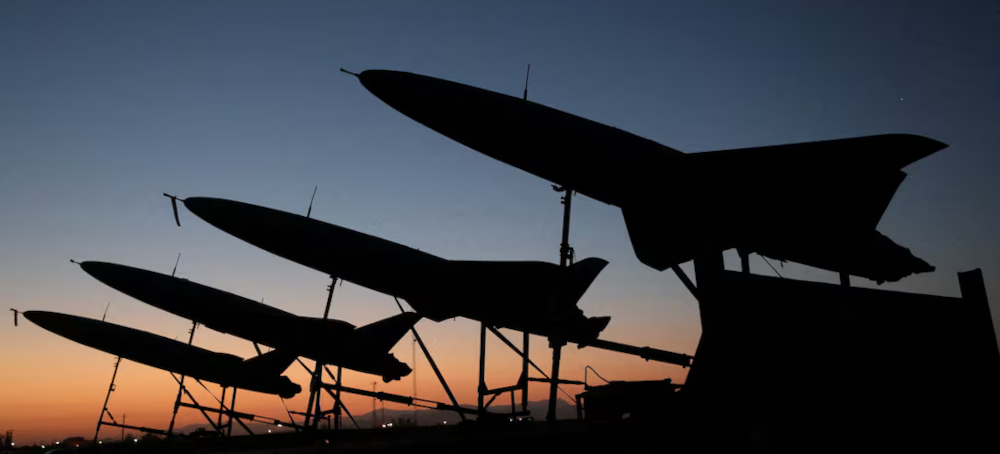 Iran's attack drones ready for launch. (photo: Reuters)
ALSO SEE: Ghoshworld, Bobby Ghosh on Substack
The US got a ceasefire, but Iran kept its leverage. The negotiations will require expertise and patience, scarce commodities in the Trump administration
As I write this, Donald Trump is declaring victory, and the regime in Tehran is doing the same. One of the lessons I learned as a conflict journalist is that when both sides claim to have won a war, it usually means the reckoning has been deferred, not resolved.
The two-week ceasefire, extracted from the wreckage of Trump’s own deadline with some assistance from Pakistan’s Prime Minister Shehbaz Sharif, is to be welcomed. It is better than the alternative the American president was threatening just hours before the announcement — the death of Iran’s civilization, accompanied by the systematic demolition of power plants, bridges, and civilian infrastructure on a scale that legal scholars were already characterizing as a potential war crime.
But relief, however genuine, should not be allowed to harden into complacency. There are things we know about this deal, and things we don’t — and what we don’t know may matter more.
Start with the ten-point Iranian proposal that Trump called “a workable basis on which to negotiate” in his post on Truth Social. He did not tell us what was in it. Iran’s state media rushed, predictably, to fill that vacuum. According to IRNA, Tehran’s official news agency, the proposal includes a permanent end to the war, security guarantees against future strikes, full sanctions relief, an end to Israeli operations in Lebanon, and — most immediately consequential — a formalized protocol for managing passage through the Strait of Hormuz, complete with a $2 million transit fee per vessel, revenues earmarked for reconstruction.
Whether any of that reflects what Washington actually agreed to remains to be seen — Iran’s account of its own proposal is not a neutral document. But what we do know is that when a U.S. official first reviewed the Iranian submission on Monday, Axios reported that the official described it as “maximalist.” By Tuesday evening, with Pakistan pressing hard and Trump’s self-imposed deadline expiring, the president had called it workable.
The Iranians had not moved. But the clock had. With his deadline looming and his ultimatum leaving him with no good options, as I explained yesterday, Trump backed down.
The questions raised by Tuesday’s announcements will presumably be discussed when proper negotiations commence in Islamabad on Friday.
The big one: What about the uranium? Tehran has approached this conflict as a form of strategic insurance — raising the cost of future American military action to a level that concentrates the mind. That strategy has always run alongside a parallel track: an enriched uranium stockpile whose existence gives Iran leverage that no amount of bombing has fully eliminated.
Before the war, the IAEA had documented that Iran held roughly 440 kilograms of uranium enriched to 60% purity — a level that the Center for Arms Control and Non-Proliferation has noted represents 99% of the technical work needed to reach weapons-grade material. The June 2025 Israeli and American strikes targeted enrichment facilities at Natanz and Fordow. But the Arms Control Association has reported that the stockpile itself almost certainly survived, and the IAEA — denied full access since the strikes — cannot confirm its current location or condition.
That uranium exists somewhere. The CSIS noted this week that the stockpile is now believed to be split between two underground locations — the tunnel complex at Isfahan and Natanz — and that seizing or destroying it would constitute, in the words of military experts, “the most complicated special operation in history.”
Trump, for his part, told Reuters the uranium was “so far underground, I don’t care about that.” But since eliminating Iran’s nuclear program has been one of the most often cited explanations for going to war, he can hardly afford not to care. He insisted as recently as Sunday that he would accept nothing short of Iran handing it all over. The ceasefire he announced does not appear to include that condition.
The gap between those two positions is not a detail. It is the entire ballgame.
And then there is the Strait of Hormuz — which is where the strategic accounting gets uncomfortable for the architects of this campaign. The waterway was open on the night the war began. According to documented shipping data, tanker traffic on the evening of February 28 was heavy; Iran’s IRGC did not formally declare the strait closed until March 4. When the closure came, it required no naval blockade, no mines, no anti-ship missiles fired in anger. As NPR reported, a handful of drone strikes near the waterway was enough to cause the insurance market to do Iran’s work for it — rendering the route economically unnavigable for most of the world’s shipping. S…P Global Market Intelligence documented the result: traffic collapsed from more than 100 ships a day to 21 transits in the first two weeks of the war.
What we know about the terms of this ceasefire suggests that reopening Hormuz open has become a key objective of the entire negotiation — the prize that has to be bargained for after weeks of economic disruption and a global energy crisis that one analyst compared to the 1970s oil embargo.
Which brings us to the meta-question, upon which hingers all the others: who, exactly, is going to negotiate for America?
The pre-war diplomatic record offers little comfort. The nuclear talks that collapsed five weeks ago, setting the stage for Operation Epic Fury, were led on the American side by Steve Witkoff, Trump’s special envoy, and Jared Kushner, his son-in-law. Neither man brought technical expertise in nuclear nonproliferation to the table, and it showed. CNN’s examination of their public statements found that Trump kept referring to “nuclear dust” — not a recognized term in the industry — while Witkoff’s comments after the Geneva talks suggested, in the words of one arms-control analyst, that there was “a gap” between what the negotiators understood and what they were actually negotiating. The Arms Control Association’s detailed post-mortem of those talks found a pattern of basic factual errors: Witkoff wrongly claimed there was enrichment activity at Iran’s Tehran Research Reactor, incorrectly stated that the IAEA had been denied all access to Iran since the June 2025 strikes, and asserted that Iran had been “testing for weaponization since 2003” — a claim directly contradicted by both the IAEA and the U.S. intelligence community’s own assessments. PolitiFact found his claim that Iran was “a week away” from bomb-making material was similarly disputed by independent weapons experts.
The Iranians, for their part, offered their own contested account of events. Foreign Minister Araghchi told MS NOW that Iran had in fact offered to relinquish its enriched uranium stockpile in those talks — a claim Witkoff disputed — and that his delegation left Geneva convinced it had been negotiating in bad faith, used as a diplomatic feint to buy time before the strikes. A Persian Gulf diplomat with direct knowledge of the talks told the same outlet that Witkoff “conducted himself in a manner not befitting the office he represented.” A former senior U.S. official with Middle East negotiating experience told NBC News that Witkoff had failed to bring technical experts to a negotiation that was, at its core, a technical problem.
Whatever the truth of those competing accounts, the outcome was unambiguous: the talks failed, the bombs fell, and the Strait of Hormuz closed.
There is no reason to expect a different result from the same team negotiating the same issues under greater pressure and with less time. The nuclear question — where Iran’s enriched stockpile is, who controls it, what verifiable constraints can be placed on Iran’s enrichment capacity — is among the most technically demanding in the history of arms control. It is not a real estate negotiation. It requires people who have spent careers understanding safeguards agreements, centrifuge cascades, and the difference between a research reactor’s fuel assemblies and a weapons program’s feedstock.
If Trump sends Witkoff and Kushner back to Islamabad, he is not negotiating. He is merely performing negotiation.
Serious negotiations require patience, not performance. Nuclear negotiations are, by their nature, a prolonged exercise in managed ambiguity. They move slowly, they stall, they produce proposals that look inadequate and counterproposals that look worse. Competent negotiators understand that this is the process, not a sign of bad faith. Trump, by every available measure, does not.
The danger now is that he draws the wrong lesson from Tuesday night entirely. If he has persuaded himself that it was the threat of annihilation — “a whole civilization will die” — that brought Iran to the table, then the moment the Islamabad talks stall, as they surely will, he will reach for the same lever. That reflex ended the last round of diplomacy with a war. There is no guarantee the next round ends differently.
The enriched uranium is still there. The strategic questions that produced this war are still unanswered. The mistrust between the parties — structural, decades-old, baked into the institutions of both governments — has not been dissolved by a phone call and a Truth Social post. What exists, as I write this late on Tuesday night, is a pause. Whether it becomes anything more depends on negotiations that haven’t properly started yet, between parties who don’t trust each other, over terms that haven’t been made public, conducted by envoys who do not fully understand what they are negotiating, and overseen by a president whose attention span is calibrated in news cycles, not diplomatic timelines.
The world may have exhaled this evening. On Friday, we will go back to holding our collective breath. For how long, who can tell?