Do US Presidents Have the Power to Declare War?
Jill Lepore The New Yorker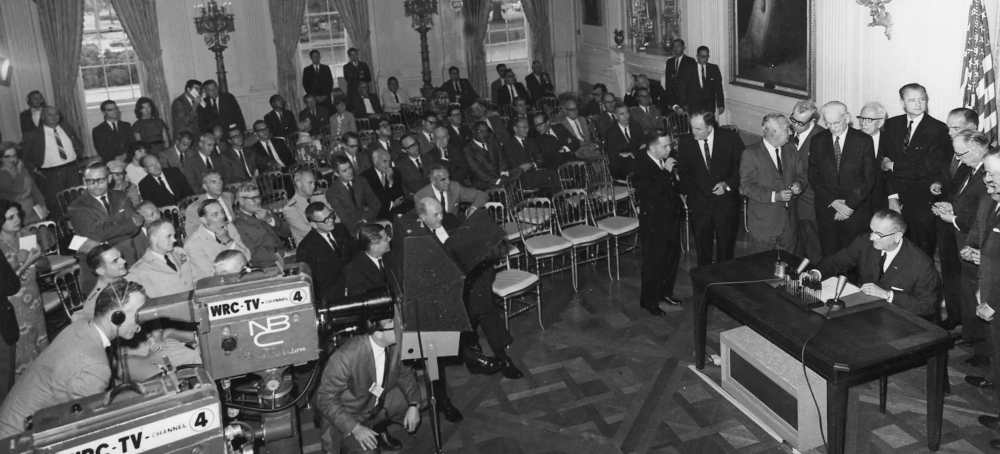 President Lyndon B. Johnson signs the Tonkin Gulf Resolution, in August, 1964. (photo: Alamy)
On paper, declaring war is reserved for Congress. The Tonkin Gulf Resolution turned a constitutional requirement into a legislative habit of looking away.
On August 2nd of that year, North Vietnamese torpedo boats attacked the U.S.S. Maddox in the Gulf of Tonkin. Following a much-disputed report of a second attack, President Lyndon B. Johnson ordered a bombing raid and asked Congress to pass a joint resolution of support. Johnson had been angling for such a resolution since the last weeks of 1963 and had begun discussing it in earnest the following February. “Being sprung from the loins of the Congress,” Johnson’s adviser Jack Valenti later said, “he was very, very disgruntled and discontented with the fact that we were messing around in Southeast Asia without congressional approval.” As a senator, Johnson had particularly objected to Harry Truman having sent troops to Korea without seeking support from Congress. If any President tried to get away with that while Johnson was Senate Majority Leader, Valenti said, “Lyndon Johnson would have torn his balls off.”
Pressed by Johnson to prop up the Administration’s actions in Vietnam, Senator J. William Fulbright of Arkansas, the chair of the Senate Foreign Relations Committee, set to work wrangling his colleagues immediately following the attack on the Maddox. On the Senate floor, he offered reassurance that the measure was exceedingly narrow, but it was also clear that at least some members of the Senate understood the breadth of the resolution.
Mr. Brewster: My question is whether there is anything in the resolution which would authorize or recommend or approve the landing of large American armies in Vietnam or in China.
Mr. Fulbright: There is nothing in the resolution, as I read it, that contemplates it. I agree with the senator that that is the last thing we would want to do. However, the language of the resolution would not prevent it. It would authorize whatever the Commander-in-Chief feels is necessary.
On August 7th, Congress issued a joint resolution declaring its support for “the determination of the President, as Commander in Chief, to take all necessary measures to repel any armed attack against the forces of the United States and to prevent any further aggression.” Johnson was delighted, remarking that the Tonkin Gulf Resolution, “like grandma’s nightshirt . . . covered everything.”
Fulbright came to regret both the vote and the war whose conduct it authorized. In 1967, he presided over hearings investigating American military operations in Vietnam. As the historian Bruce Schulman reported in his book “Lyndon Johnson and American Liberalism,” Johnson, furious at what he considered a betrayal, said, “You know when you’re milking a cow and you have all that foamy white milk in the bucket and you’re just about through, when all of a sudden the cow switches her tail through a pile of manure and slaps it into that foamy white milk. That’s Bill Fulbright.” In 1971, weary of the war in Vietnam, Congress repealed the Tonkin Gulf Resolution. Two years later, determined to prevent “another Vietnam,” Congress jointly passed the War Powers Resolution; that measure aimed to claw back for the legislature its exclusive constitutional power to declare war, narrowing the circumstances under which a President could do so to “a national emergency created by attack upon the United States, its territories or possessions, or its armed forces.” This week, Congress is expected to vote on another War Powers Resolution, which would say about the same thing and would be about as effective, which is to say, not at all. “The Constitution says we’re not supposed to be at war without a vote of Congress,” the Democratic senator Tim Kaine told NPR. This resolution is not expected to pass, and if it did pass, it would be ignored.
In 1964, the House voted unanimously in favor of the Tonkin Gulf Resolution, and only two senators voted against: Ernest Gruening, a Democrat and former governor of Alaska, and Wayne L. Morse, a Democrat from Oregon and a former dean of the Oregon Law School. (They often voted together, in dissent. “Morse and Gruening may be right, but they have been written off,” another senator remarked.) Gruening, who trained as a doctor, spent his early career as a foreign-policy journalist, and was an editor at The Nation. His position regarding U.S. involvement in Vietnam dates to his opposition to the U.S. occupation of Haiti. A so-called peace progressive of the Wilsonian era, the anti-imperialist, pro-democracy Gruening had objected to American involvement in foreign wars since the nineteen-twenties. Elected to the Senate in 1958, he had consistently warned against U.S. entry into the war in Vietnam, questioning American intelligence (“the repeated optimistic statements of our officials . . . have been promptly refuted by events”) and calling it, in March of 1964, an “impossible war.” During the debate over the Tonkin Gulf Resolution, Gruening accused his colleagues of having propped up “corrupt and unpopular dictatorships which owe their temporary sojourn in power to massive American support,” leaving him convinced that the “allegation that we are supporting freedom in South Vietnam has a hollow sound.”
Morse’s dissent is the more interesting case. Morse, a progressive Republican from Wisconsin and an avid Cold Warrior, had been elected to the Senate from Oregon but left the Republican Party in part because of its failure to denounce Joseph McCarthy and, in 1955, became a Democrat. In 1957, he objected, unsuccessfully, to a resolution that Dwight Eisenhower presented to Congress, seeking pre-authorization for military action in the Middle East, calling it “constitutionally dangerous.” After the Bay of Pigs fiasco, in 1962, Morse described the C.I.A. as “an unchecked executive power that ought to be brought to an end,” and warned of the executive’s increasing recourse to unauthorized military action, predicting that “we are in a situation in which we shall probably never again see Congress pass a declaration of war prior to the beginning of a war.” History proved him right.
Morse so frequently opposed unauthorized military action, and so often spoke at the end of the day, before an empty chamber, that he earned the nickname the Five O’Clock Shadow. In 1963, the week before John F. Kennedy was assassinated, he told Morse, “Wayne, I want you to know you’re absolutely right in your criticism of my Vietnam policy.” In the spring, when Johnson sought a military appropriation, Morse accused him of “trying by indirection to obtain congressional approval of our illegal, unilateral military action in South Vietnam without coming forward with a request for a declaration of war.”
In August, Morse objected to the Tonkin Gulf Resolution on constitutional grounds, calling the resolution a “predated declaration of war” and an “evasion of congressional responsibility,” and a de-facto amendment of the U.S. Constitution. He warned his colleagues that “the American people will quickly lose their liberty if you do not stop feeding the trend toward Government by executive supremacy.” In 1965, when Johnson ordered the bombing of North Vietnam and sent fifty thousand troops to South Vietnam—“This is really war,” the President said that summer—Morse became a leading speaker at rallies in the growing antiwar movement.
Article I, Section 8, of the U.S. Constitution gives Congress the power to “declare war.” When, at the Constitutional Convention, in Philadelphia, in 1787, Pierce Butler of South Carolina raised the possibility that the President should wield this power, Elbridge Gerry of Massachusetts responded that he “never expected to hear in a republic, a motion to empower the Executive alone to declare war.” The general view of the delegates was reflected by Alexander Hamilton, in Federalist No. 75: “The history of human conduct does not warrant that exalted opinion of human virtue which would make it wise in a nation to commit interests of so delicate and momentous a kind, as those which concern its intercourse with the rest of the world, to the sole disposal of a magistrate created and circumstanced as would be a President of the United States.”
Abraham Lincoln, while serving in Congress, summarized the Convention’s thinking this way:
Kings had always been involving and impoverishing their people in wars, pretending generally, if not always, that the good of the people was the object. This, our Convention understood to be the most oppressive of all Kingly oppressions; and they resolved to so frame the Constitution that no one man should hold the power of bringing this oppression upon us.
If a President were to be granted this kingly power, Lincoln warned, there would be no turning back:
Allow the President to invade a neighboring nation, whenever he shall deem it necessary to repel an invasion, and you allow him to do so, whenever he may choose to say he deems it necessary for such purpose—and you allow him to make war at pleasure.
That later Presidents did indeed engage in military action without consulting Congress, creeping on to a power reserved for the legislature, is a fact of the past century and a half of American history but especially since the rise of the national-security state during the Cold War. Does the fact of that frequent practice alter the Constitution? This question has been a subject of heated legal dispute since the late nineteen-sixties.
Reviewing the state of the debate in 1971, the Yale legal scholar Alexander M. Bickel addressed the contention that the provision of the Constitution that grants only Congress the power to declare war had been informally amended by the executive’s regular exercise of this authority. After all, as Louis Brandeis had written, the Constitution “is capable of growth.” Bickel was unpersuaded by this argument. Growth there might be, but you can’t extend the length of a Presidential term, or abolish the Electoral College, by “growth,” and neither can you grant the executive the power to declare war by force of habit. To be clear, Bickel opposed the U.S. war in Vietnam. “I formed the opinion some years ago that the war has been a moral and political disaster,” he wrote, “and I believe further that we might have avoided it, or might at least avoid its repetition, if our institutional arrangements were such as to foreclose presidential wars.” But his argument, here, was merely the constitutional one: “No one should ever reasonably have assumed that the United States could go to war by presidential say-so.”
Ink and blood have been spilled on this question abundantly since Vietnam, especially with regard to U.S. military action in the Middle East, in Iraq, in Afghanistan, and, this week, in Iran. The debate, as a legal scholar once explained, tends to fall into two camps. One camp sticks strictly to the claim that Congress alone has the power to declare war. The other camp argues that the President has the power, as Commander-in-Chief, to engage in military action to defend Americans in case of emergency. Both of those statements can be true and yet this can scarcely be said to be a stalemate, or even a proper separation of powers. Congress, having repeatedly failed to exercise its war power, no longer really can. And, as to what constitutes an emergency, the President gets to decide, allowing him, as Lincoln put it, to make war at pleasure.