Dire Straits
Sudarsan Raghavan The New Yorker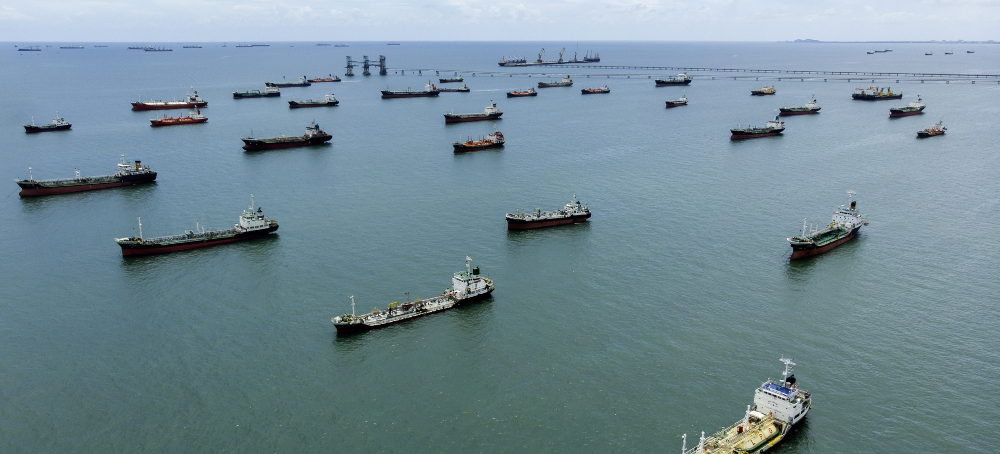 Iran has enacted a de facto blockade of the Straight of Hormuz. (photo: Getty)
The country is in survival mode, and effectively fighting back by shutting down the Strait of Hormuz and blocking the transport of much of the world’s oil supply.
When the U.S. and Israel attacked Iran four weeks ago, the goals were to topple the Iranian government, destroy the country’s military, security, and nuclear capabilities, and diminish its influence in the region by cutting off its support for proxy forces. After a U.S.-Israeli strike killed Iran’s Supreme Leader, Ayatollah Ali Khamenei, President Trump demanded the regime’s “unconditional surrender.” He urged its forces, especially members of the Islamic Revolutionary Guard Corps, to defect, and encouraged Iranians to rise up against the regime. On March 9th, he said that the war would be over “pretty quickly.” None of that happened. The Trump Administration underestimated Iran’s ability and determination to fight back, wreak chaos outside its borders, and unleash economic pain worldwide. Now the war has turned into a race to stabilize the rapidly deteriorating global economic order, central to which is reopening the Strait of Hormuz. Waging drone strikes on tankers and issuing threats of laying sea mines, Iran has effectively shut down the narrow body of water through which a fifth of the world’s supply of oil and natural gas flows. It wasn’t a surprise: U.S. military planners have, for decades, mapped this out as a likely scenario in the event of war with Iran.
For the country’s leadership, weakened militarily and more isolated than ever, inflicting economic suffering has become the most powerful weapon available. Proving that Iran can effectively close the strait is now a critical strategy to deter future strikes by the U.S. and Israel, and a potent point of leverage in any future talks about the war and Iran’s nuclear program. For Trump, the Strait of Hormuz has become a geopolitical albatross. The longer the strait remains blocked, the greater the chance of lasting harm to the global economy, and the greater the risks for Trump politically; an extended standoff could diminish his popularity at home, as midterm elections approach and voters grapple with high gas prices and airline fares. It could sap his authority internationally and weaken American influence in the region. But fully reopening the strait could take weeks, even months, and could require sending in U.S. ground troops and a naval convoy to protect ships. These possibilities are also fraught with risks. And it may be too late for Trump to negotiate from a position of strength with Iran, or simply declare victory and stop the war, as that would leave Iran in control of the strait. “Trump needed to cut a deal, and he could still try to cut a deal, but the price, the political price, of the deal keeps going up, and so the problem he’s facing is, there’s no golden off-ramp,” Robert Pape, a political scientist at the University of Chicago specializing in international-security affairs, told me.
The pressure on Trump to reopen the strait was made evident on Saturday, when, on Truth Social, he delivered an ultimatum: if the Iran does not “FULLY OPEN, WITHOUT THREAT, the Strait of Hormuz, within 48 HOURS,” he said, the U.S. will “obliterate” Iran’s power plants. It was his first attempt to apply pressure by threatening Iran’s civilian energy infrastructure.
The next day, Lieutenant Colonel Ebrahim Zolfaghari, an Iranian military spokesman, according to state media, warned that, if its power plants are targeted, Iran will not only strike “fuel and energy” targets but expand its attacks to civilian “information-technology and desalination infrastructures” used by Israel, the United States, and its regional allies. (Desalination plants are the main source of freshwater in the Middle East, critical to millions of lives.) Iranian officials also warned that they would fully shut down the strait, as opposed to just blocking it for ships from the U.S., Israel, and their allies, a move that would introduce more chaos and uncertainty into the global economy. “The Iranian regime is in survival mode, and so they’ll fight to the end, and they’ll throw everything they have at it,” Daniel Shapiro, a former U.S. Ambassador to Israel during the Obama Administration, told me. “They will obstruct the strait. They will be willing to sacrifice some of their own oil infrastructure—or, if they have to, they will impose an identical cost on their neighbors across the Gulf. All they really have to do to claim victory is to survive.”
On Monday, shortly before the deadline he’d set, Trump wrote that he had just had “VERY GOOD AND PRODUCTIVE CONVERSATIONS” with Iran “REGARDING A COMPLETE AND TOTAL RESOLUTION OF OUR HOSTILITIES.” All military strikes against Iranian power plants and energy infrastructure had been postponed for a five-day period, Trump added, depending on the success of the talks. Oil prices fell, and global stock markets rebounded. But Mohammad Bagher Ghalibaf, the speaker of Iran’s parliament and a top official, contradicted Trump, saying in a post on X that no negotiations were held and that Trump’s statement was meant “to manipulate the financial and oil markets and escape the quagmire in which the US and Israel are trapped.”
What has happened since the attack on South Pars exemplifies Trump’s conundrum. Instead of cowing Iran, the Israeli strike escalated the war. As South Pars burned, spewing thick clouds of dark smoke, Iran struck back, firing missiles into Ras Laffan, Qatar’s massive liquefied-natural-gas hub, and targeting oil-and-gas facilities in Saudi Arabia, Kuwait, and the United Arab Emirates. Nearly every day, Trump Administration officials have made declarations that the U.S. and Israel are winning the war. Thousands of American and Israeli strikes have decimated Iran’s senior leadership and degraded its military and naval capabilities. Yet the air campaign, costing billions of dollars, has not forced Iran to capitulate and loosen its grip on the strait. If anything, the regime is more defiant, belligerent, and brazen, determined to prevail at any cost. New, more hard-line leaders have replaced those who were assassinated, while, as South Pars and its aftermath reveal, Iran is still able to fire cheaply made missiles and drones daily at Israel and U.S. allies, hitting targets with increasing accuracy. And, even as the International Energy Agency, last week, said that the war “is creating the largest supply disruption in the history of the global oil market,” Iran has still been able to ship millions of barrels through the strait, earning foreign currency, as the regime selectively allows some ships to pass through that are linked to allies such as China. In a desperate effort to contain soaring energy prices, the U.S. Treasury Department has temporarily lifted sanctions on some Iranian oil to allow the sale of more than a hundred and forty million barrels of crude stranded on ships at sea. Paradoxically, this could help fund the war against the United States and its allies.
The repercussions of Iran’s choke hold on the strait are not limited to the gas pump and jet fuel. Hundreds of millions of people, and entire industries, from the Persian Gulf to Asia, have been affected by industry shutdowns, rising food and heating costs stemming from higher energy prices, and fuel shortages. Companies that export goods to, or import them from, the Middle East are crippled, as global supply chains are interrupted. The strait is also a crucial gateway for nitrogen-based fertilizer components, such as urea and ammonia. As a result of the disruption, their prices have spiked, deepening food insecurity in vulnerable countries and influencing spring-planting decisions by farmers in the U.S. Even the U.S. defense industry may be affected: roughly half the global trade of sulfur—a mineral that’s key not only to sustaining America’s electrical grid but to building semiconductors in precision-guided munitions, and to repairing military equipment—flows through the strait.
“The main question still lying in front of us is, will President Trump use boots on the ground and prolong the war to try to open the strait?” Danny Citrinowicz, a Middle East expert at the Institute for National Security Studies, in Tel Aviv, told me. “Or will he stop, declare victory, and return to dealing with Cuba or China, or whatever else?” When I asked what Trump could do to bring down climbing gas and energy costs, Citrinowicz replied, “There are no good options whatsoever, unfortunately.” The South Pars strikes showed that “you cannot attack infrastructure in Iran to force them to open the strait. This is not going to happen.” Trump, he added, “doesn’t understand anything about Iranians. It is what it is.”
Despite Trump’s noise about negotiations, his objectives are far from clear, whether he’s leaning toward escalating the war, exiting by declaring victory, negotiating with Iran, or staying the course with aerial strikes. His messaging has been inconsistent; his goals shift nearly every day. Only three days before his ultimatum to Iran, after Israel’s assault on South Pars, Trump said that the U.S. “knew nothing about this particular attack,” and warned Israel not to target the area again if it wanted to avoid another escalation. Yet Shapiro and other analysts told me that the U.S. and Israel have been closely coördinated on military targeting, and Trump likely knew about, and even approved, the South Pars strikes, but didn’t expect Iran’s strong response, or the harm to the global economy. Even as Trump sought, at least publicly, to de-escalate the war, Israel and Iran weren’t listening. On Tuesday, after dozens of tit-for-tat strikes between the two countries, oil prices climbed again. And Trump’s recent actions suggest that the U.S. is preparing for a longer war. The Pentagon has asked for two hundred billion dollars in additional funds, and the U.S. military has announced plans to move roughly twenty-five hundred combat soldiers from the Indo-Pacific region to the Middle East. Another twenty-five hundred marines are expected to be deployed next month. Military analysts predict that the marines could be used to open a new phase in the conflict, launching raids and seizing control of several strategic Iranian islands in the Persian Gulf that are vital to Iran’s oil production. The biggest target is Kharg Island, the main export hub through which Iran moves ninety per cent of its oil. In 1988, during the Iran-Iraq War, Trump, then a New York real-estate mogul, told the Guardian, “I’d be harsh on Iran. They’ve been beating us psychologically, making us look like a bunch of fools. One bullet shot at one of our men or ships, and I’d do a number on Kharg Island. I’d go in and take it.” Now several of Trump’s closest advisers have said that Kharg is the key to shortening the war and breaking Iran’s stranglehold on the strait. “If Iran loses control or the ability to operate its oil infrastructure from Kharg Island, its economy is annihilated,” the Republican senator Lindsey Graham, of South Carolina, wrote on X. “He who controls Kharg Island, controls the destiny of this war.”
A ground invasion of Kharg and the surrounding islands is certain to escalate the conflict, further driving up oil prices and, most likely, increasing the number of U.S. casualties, in a war that is already unpopular with many Americans. The first obstacle for the marines would be getting their ships—which would be carrying combat troops, helicopters, fighter jets, and amphibious assault vehicles—to successfully land on the islands. Geography works against them: Iran’s side of the strait is rugged and mountainous. Iranian forces could rain missiles and drones on U.S. ships from high, hard-to-detect vantage points, allowing only a few seconds to respond. Then, if the marines managed to seize Kharg, holding it would pose various challenges. They could face daily barrages of missiles fired from the mainland, in addition to drone strikes and attacks from Revolutionary Guard troops on the island. “There’s just a lot of threats here,” Pape, the University of Chicago professor, said. “You’re going to have multiple clusters of hornets’ nests.” And although the Iranians will have varying levels of success, Pape added, “they only need a few per cent of their attacks to actually hit, and that will be painful. We’ll basically have to be sitting ducks.”
The Trump Administration has considered sending naval convoys to protect oil tankers through the Strait of Hormuz, and has even demanded that NATO allies, along with China, Japan, and South Korea, contribute ships. (None has yet agreed to do so.) The last time U.S. warships escorted oil tankers through the strait was in the late nineteen-eighties, during the Iran-Iraq War. That was the largest naval-convoy endeavor since the Second World War, and included aircraft carriers and reconnaissance planes. During the operation, an Iranian mine damaged a massive tanker, the S.S. Bridgeton. It was a propaganda victory for Iran and embarrassing for the U.S. Navy. Steven Wills, a former U.S. Navy officer and a researcher at the Center for Maritime Strategy, a nonpartisan think tank, told me that the Navy has become more adept at shooting down drones and missiles, owing to the American campaign in the Red Sea against Yemen’s Houthi militia, and mines remain the biggest threat today. But, Wills told me, “There’s always going to be danger.” U.S. warships must pass through the strait’s bottleneck opening, sailing roughly ten nautical miles from the Iranian mainland. They have mere seconds to react to drones and missile attacks, he explained. “Naval warfare is ugly and messy, and, if a U.S. ship takes a hit, then hundreds of crew could die.”
If America and Israel destroy Iran’s oil infrastructure, power plants, and other energy facilities, as Trump has threatened, most experts predict a doomsday scenario. The Iranian regime has already declared that any such acts won’t bring them to the negotiating table and will only prompt more retaliation. And a total shutdown of the strait, combined with a bottleneck in exports from Iran, OPEC’s third-biggest producer, could anger China, the largest recipient of Iranian oil, leading to tensions with the United States at a time when the U.S. military, with its focus on the Middle East, is stretched thin in Asia.
There will also be hard consequences if Trump opts to declare victory and end America’s involvement in a war that could become long and costly. Iran’s government, now more hard-line and militarized than ever, will remain in power. Its nuclear program will be intact, including its stockpiles of enriched uranium. Having outmaneuvered the U.S. and Israel, Iran will be emboldened; at any time, it could threaten global economic chaos by shutting down the strait again. “The Strait of Hormuz situation won’t return to its pre-war status,” Ghalibaf, the speaker of Iran’s parliament, posted on X last week.
Israel and most of the Gulf countries want the United States to press on until the Iranian regime is dismantled or too weak to pose harm, according to analysts I spoke with. They fear that even a damaged but intact Iran will remain a long-term existential threat and wield more power over their economies and daily lives. Saudi Arabia, in particular, appears to be losing patience. In the aftermath of the South Pars strikes, its foreign minister, Prince Faisal bin Farhan, sternly warned that the kingdom has “the right to take military action if deemed necessary.” On Tuesday, the Times reported that Saudi Arabia’s de-facto ruler, Crown Prince Mohammed bin Salman, is pushing Trump not to wind down the conflict. “The U.S. cannot afford to stop the war now. There are no off-ramps at this point,” Muhanad Seloom, a professor of international politics and security at the Doha Institute for Graduate Studies, in Qatar, told me. “If the war stops now, Iran would understand that, in the future, if they come under pressure, they don’t have to hit the U.S. They don’t have to hit Israel. They would just have to hit the Gulf countries.” This could lead the Arab countries to try to reduce their dependence on the U.S. as a security partner, possibly turning to Russia or China, or creating their own military alliance, often called an Arab NATO, weakening U.S. influence in the Middle East. Iran is already goading the Arab states to rethink their security ties with the U.S. In another post on X, Ghalibaf wrote, “This war proved one thing quite clearly: American bases in our region does not protect anyone—they are a threat. America sacrifices everyone for Israel and does not care about anyone but Israel. Anyone clothed by the US is literally NAKED!”
After Trump reversed course again, postponing strikes on Iran’s power plants, it became clear that Iran was in a stronger negotiating position now that it had handcuffed the world’s economy. “Trump blinked first—out of a clear understanding that striking Iran’s energy infrastructure would trigger a direct and significant retaliation,” Citrinowicz, of the Institute for National Security Studies, wrote in a post on X. “This regime is unlikely to reopen the Strait without meaningful concessions from the U.S.” Trump may not have wanted a long war, but he’s got one now.