DHS Seeking to Deport Two Men Who Said Fellow ICE Detainee Was Killed
Douglas MacMillan The Washington Post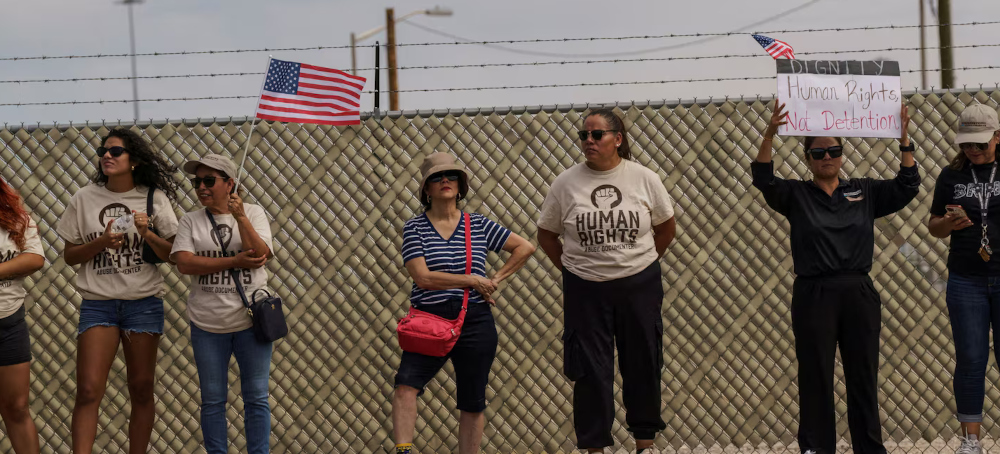 People protest mass deportations by Immigration and Customs Enforcement at the Cassidy Gate at Fort Bliss in El Paso on Aug. 17. (photo: Paul Ratje/Reuters)
The two men’s accounts of the Jan. 3 death of Geraldo Lunas Campos at a Texas detention camp differ from the Department of Homeland Security’s account of the incident.
Santos Jesus Flores and Antonio Ascon Frometa, two detainees at Camp East Montana who both have criminal convictions, said in phone interviews with The Washington Post this week that they witnessed Lunas Campos engaged in a struggle with guards before his death. Flores claimed he saw guards choking Lunas Campos to death.
In a statement Thursday, DHS Assistant Secretary Tricia McLaughlin said Lunas Campos had tried to take his own life and guards were trying to save him. “Campos violently resisted the security staff and continued to attempt to take his life,” McLaughlin said. “During the ensuing struggle, Campos stopped breathing and lost consciousness.”
Flores, a Salvadoran immigrant, was ordered to be removed by an immigration judge on Jan. 8, according to internal Immigration and Customs Enforcement records reviewed by The Post — five days after Lunas Campos’s death. He shared his account with The Post on Jan. 13, and on the same day was “offered” removal to Mexico but declined, citing fear of being deported there, the records show. He was named in The Post’s story about the incident two days later.
Frometa, a Cuban, was served notice of removal to Mexico on Jan. 16, records show — three days after The Post interviewed him. After he refused deportation, the records show, ICE began preparations to transfer him to a detention center in the southeast U.S. He was not named in The Post’s initial story.
McLaughlin declined to comment on the attempted deportations or whether those moves had anything to do with the government’s response to Lunas Campos’s death.
As of Friday afternoon, when Frometa last spoke to The Post, both men were still at Camp East Montana. In some cases, ICE does not deport people who can demonstrate they will probably be persecuted or tortured if sent to a country where they are not a citizen, immigration attorneys said. It is not clear whether that has been assessed in these cases.
Detention is often a last stop for immigrants fighting removal proceedings, and the government has long targeted both Flores and Frometa for deportation. Flores was convicted in 2023 of sexual offenses involving minors, according to New York’s sex offender registry, and DHS placed him on its “worst of the worst” list of migrants it has arrested with criminal records.
Still, both men have claimed to witness events that DHS says are under active investigation, and legal experts say deporting them could make it more difficult for investigators to obtain and verify their accounts. DHS has the power to temporarily halt the deportation of immigrants who have made claims of wrongdoing while those claims are being investigated, said Ann Garcia, a senior staff attorney at the National Immigration Project, a Washington-based nonprofit group that advocates for immigrants.
Neither Flores nor Frometa could be reached to comment about their criminal records or their pending removals because they are still being detained at the El Paso facility with limited phone access. For each of their previous interviews, they had contacted a family member of Lunas Campos, who in turn connected them with a reporter at The Post.
Representatives from Acquisition Logistics, the Virginia contractor that oversees Camp East Montana, and Akima Global Services, a company that employs guards there, did not respond to requests for comment.
On Thursday, The Post reported that an employee of El Paso County’s Office of the Medical Examiner had said in a recorded phone call that the office is likely to classify Lunas Campos’s death as a homicide, subject to the results of a toxicology report. The employee said a doctor there “is listing the preliminary cause of death as asphyxia due to neck and chest compression,” which means Lunas Campos did not get enough oxygen because of pressure on his neck and chest.
In response to the story, the American Civil Liberties Union reiterated its call for the administration to close Camp East Montana, saying the death follows a “disturbing pattern” of abuse against immigrants detained at the hastily opened facility. In an emailed statement, Rep. Veronica Escobar (D-Texas), who represents El Paso, said DHS is operating the facility “with absolutely no regard for transparency, truthfulness or regard for human life.”
DHS said Lunas Campos’s death “is still an active investigation” but did not say who is probing the matter or whether it is being treated as a potential homicide. Jeanette Pagan Lopez, the mother of two of Lunas Campos’s children, said she has been contacted by agents from the FBI, who told her they are conducting an investigation into the death. The FBI declined to comment when asked about it this week.
Frometa emigrated from Cuba in the mid-1990s, around the same time as Lunas Campos. When Frometa spoke with The Post on Friday, he said the two men were previously detained together for more than a year in Guantánamo Bay, among the thousands of Cuban migrants who were held at the U.S. naval base during that period after attempting to reach the United States by sea. The Post could not verify this account.
When they were paroled into the U.S., Frometa went to California and Lunas Campos went to New York. By coincidence, they were reunited decades later in the same housing unit at Camp East Montana, among other detainees who had criminal convictions.
Frometa has twice been convicted of assault, according to internal ICE records. An immigration judge had ordered him to be removed from the country in 2008, government records show, but Cuba would not accept him. He was served notice of removal to Mexico last December and refused to sign, records show.
According to Frometa, the conflict that led to Lunas Campos’s death began around 4 p.m. on the first Saturday of this month, after he said he saw detention staff repeatedly refuse Lunas Campos’s requests for medication. Becoming frustrated and vocal, Lunas Campos volunteered to be taken to “the hole,” or the segregated housing unit, if that would ensure he got access to his medication, Frometa said.
Frometa believes Lunas Campos needed medication for his asthma. The Post could not verify this, and Lopez, Lunas Campos’s former significant other, did not know what medication he needed and had no recollection of him ever having asthma.
According to Flores, guards then brought Lunas Campos, wearing handcuffs and shackles around his ankles, to the segregated housing area and tried to place him in a cell. Flores said he could see the men through his window only a few cells away. Lunas Campos stood in the hallway and resisted going into the cell, telling guards he needed his medication, Flores said.
“He said: ’I need my medicine. I need my medicine. I’m not going inside my cell without my medicine,’” Flores said.
Minutes later, the guards grabbed Lunas Campos “and choked him,” Flores said, as dozens of detainees looked on from their cells.
Lopez, who lives in Rochester, New York, recently hired a lawyer to explore potential civil litigation around Lunas Campos’s death. She said DHS’s claim that he attempted to harm himself is “a complete lie.”
The agency’s statement did not provide details about how Lunas Campos had allegedly tried to kill himself.
“How is he going to take his own life if he’s handcuffed?” Lopez asked.