Democrats Warn Trump’s Plan to Claw Back More Funds May Spark a Shutdown
Theodoric Meyer The Washington Post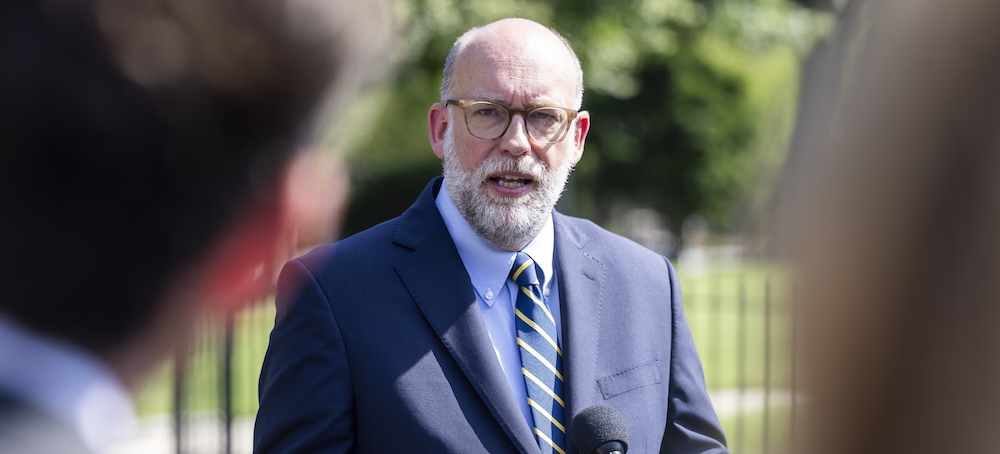 Russell Vought, the acting director of the Office of Management and Budget. (photo: WP)
ALSO SEE: Democrats Pressure Schumer, Senate to Hold Line on GOP Spending Bills
The administration is considering including Education Department cuts in the next rescissions package.
Republicans in Congress last week approved President Donald Trump’s request to cancel $9 billion in foreign aid and funding for public broadcasting, giving the administration a victory in its ongoing battle with lawmakers over the power of the purse. The White House has signaled that it plans to ask Congress to rescind more money soon.
That prospect is causing anxiety for lawmakers attempting to hammer out a spending deal for the next fiscal year and avoid a government shutdown starting Oct. 1. The White House needs Democrats to sign on to a deal in a closely pided Senate.
“They are going to stab us in the back again,” said Sen. Chris Murphy (D-Connecticut), a member of the Senate Appropriations Committee. “They are asking for our bipartisan imprimatur on a bill that they don’t believe is worth the paper it’s written on.”
Even some Republicans are concerned that the White House will ask Congress to slash more spending it already approved — known as a “rescissions” request — while lawmakers are trying to reach agreement on new funding. The White House’s budget director, Russell Vought, also has not ruled out attempting to withhold funding without congressional approval by taking advantage of ambiguity in the law that governs rescissions, which could destabilize spending negotiations.
The administration is considering including Education Department cuts in the next rescissions package, according to Sen. Lindsey Graham (R-South Carolina) and another person familiar with the discussions, who spoke on the condition of anonymity to discuss private conversations.
Trump signed an executive order in March aimed at shutting down the department and has withheld billions of dollars in already approved funds from schools.
Sen. Susan Collins (R-Maine), who chairs the Appropriations Committee, said in an interview that she had encouraged Vought over the weekend to seek more spending cuts though the bipartisan appropriations process, rather than another rescissions package that Democrats would never support.
“I don’t see the need for additional rescissions to be sent up by the White House,” Collins said.
Sen. Patty Murray (Washington), the top Democrat on the Appropriations Committee, said she was urging Republicans to ignore Trump’s request if he asks Congress to sign off on more cuts.
“A number of them do not like this process, they were unhappy with having to go through it the first time, and I urge them to reject it if it comes at them again,” Murray said in an interview.
Murray and other Democrats are wary because Republicans will need their support to keep the government funded and avoid a filibuster by garnering 60 votes. Such bipartisan support isn’t necessary for a rescissions package, which only requires 50 votes if Vice President JD Vance breaks a 50-50 tie. Republicans control the Senate, 53-47.
Trump’s push to claw back money is part of a broader effort to slash the size of the federal government with or without Congress. The administration has fired thousands of federal workers and dismantled the U.S. Agency for International Development, but it remains far short of Elon Musk’s goal of cutting $2 trillion in federal spending.
Many of the cuts made by the U.S. DOGE Service are being contested in court, and Vought argued that they will not be permanent unless Congress approves them.
Congress cut some of the same programs last week when it passed the first rescissions in decades, although Senate Republicans restored $400 million in proposed cuts to the President’s Emergency Plan for AIDS Relief (PEPFAR).
Vought told reporters last week at a Christian Science Monitor breakfast that the administration is likely to seek more rescissions soon. He also called for Congress to take a “less bipartisan” approach to government funding bills, arguing that voters do not care whether such bills are bipartisan.
“There is no voter in the country that went to the polls and said, ’I’m voting for a bipartisan appropriations process,’” Vought said.
His words landed with a thud on Capitol Hill. Senate Minority Leader Charles E. Schumer (D-New York) called for Vought to be fired — and some Republicans pushed back, too. House Appropriations Committee Chairman Tom Cole (R-Oklahoma) debuted a plaque hours later quoting the Constitution: “No Money shall be drawn from the Treasury, but in Consequence of Appropriations made by Law.”
Sen. Lisa Murkowski (R- Alaska), a senior member of the Senate Appropriations Committee, said she thought Vought was trying to pide Democrats and Republicans on the panel.
“I don’t know what to think other than that he’s testing to see where we’re going to line up,” Murkowski said. “Are we going to line up following our own Article I authorities or are we going to line up and just follow the president?”
Republicans forced Senate Democrats to swallow a government funding bill written without Democratic input in March, and they could try to do it again. But so far, Senate Republicans are taking a more — not less — bipartisan approach to funding this government this time.
The Senate voted overwhelmingly Wednesday to take up a bill to fund the Department of Veterans Affairs and military construction. “We’re trying to give [Democrats] what they’ve been asking for, which is a bipartisan appropriations process,” Senate Majority Leader John Thune (R-South Dakota) said Tuesday.
Some Republicans are concerned another rescissions request would disrupt those efforts — including several who voted for last week’s rescissions, which Collins and Murkowski opposed.
“I’d like to see us get this appropriations process moving and a little bit of bipartisanship here on this before we considered another rescission package,” said Sen. Shelley Moore Capito (R-West Virginia), an Appropriations Committee member. “I just think that would be healthier for the appropriations process.”
Graham, a close Trump ally, said he had encouraged the White House to consider Pentagon funding cuts in its next rescissions request. But he said he would prefer Trump to hold off while government funding negotiations are ongoing.
Other Republicans see no reason for the White House to delay. Sen. John Neely Kennedy (R-Louisiana), a member of the Appropriations Committee, said he did not think a bipartisan deal would cut spending.
“The only time I have seen us reduce spending is through a rescission package,” Kennedy said. “I’ll take a dozen of them.”
The stakes are high for Schumer, who endured heavy criticism from Democrats for voting to keep the government open in the midst of DOGE’s onslaught — the only real leverage Democrats had to protest the Trump agenda. Schumer huddled with House Minority Leader Hakeem Jeffries (D-New York) and other top Democrats on Tuesday to discuss a strategy for the next funding battle.
But the administration might not need to sign off on its next rescissions request if it sends one to the Hill in coming weeks.
The Impoundment Control Act, the 1974 law that governs rescissions, allows the administration to withhold funding for 45 days after it proposes them — after which it must release the money if Congress has not approved the request. The administration has argued that any rescissions request sent within 45 days of the end of the fiscal year — after mid-August — would take effect even if Congress does not approve it.
Collins has said she believes this strategy — known as a “pocket rescission” — is illegal. So have Democrats, who point to a 2018 letter from the Government Accountability Office. “Without affirmative congressional action, the President’s proposal remains just that: a proposal,” Thomas H. Armstrong, GAO’s general counsel, wrote in the letter.
Vought has relied on an older GAO letter to argue that the strategy is legitimate. “We haven’t made a determination to use it, in part because we’re making progress during the normal course of business with Congress,” he told reporters.
Democrats warn that such a move could torpedo efforts to avert a shutdown.
“If the administration is determined to blow up appropriations and force us into a government shutdown, they ought to just tell us,” said Sen. Chris Coons (D-Delaware), a member of the Appropriations Committee.
“I remain optimistic we can actually appropriate this year,” Coons added. “But another rescission package is a shot right at the very heart of appropriating.”