Democratic Odds of Taking the Senate Increase as Four Ratings Shift in Their Favor
Jessica Taylor The Cook Political Report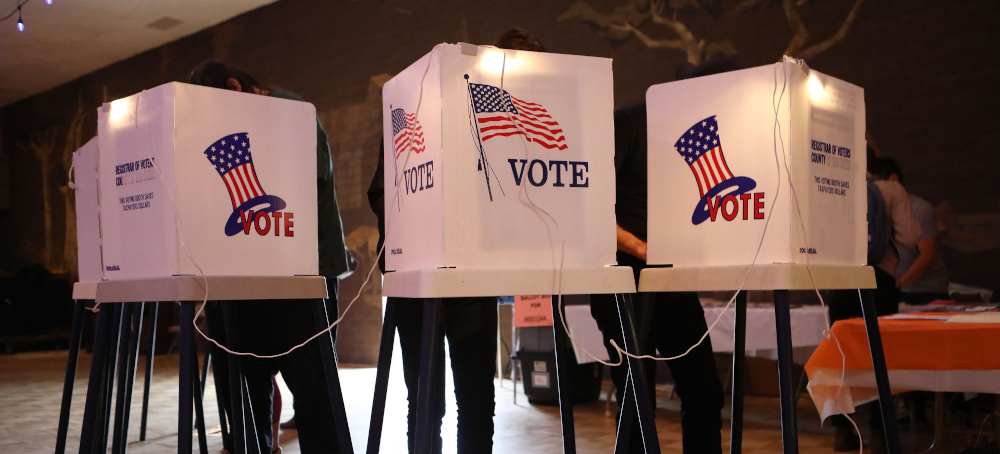 Voters fill out their ballots. (photo: Mario Tama/Getty )
We are shifting four ratings, all in Democrats’ favor. Two seats move out of the Toss Up column to Lean Democrat — the open Republican seat in North Carolina, which represents a net pickup for Democrats, and Sen. Jon Ossoff’s seat in Georgia, where a messy GOP primary still reigns as the incumbent continues to stockpile cash.
Ohio, where even recent GOP polling has shown former Sen. Sherrod Brown in a statistical tie with appointed GOP Sen. Jon Husted, shifts from Lean Republican into the Toss Up column.
One seat moves from Solid Republican to the periphery of the battleground map into the Likely Republican column: Nebraska, where independent Dan Osborn is back again, this time challenging wealthy Sen. Pete Ricketts.
North Carolina: Moves From Toss Up to Lean Democrat
We’ve long believed the North Carolina Senate race is the GOP seat Democrats are most likely to flip. Former Democratic Gov. Roy Cooper is the strongest candidate Democrats could have fielded in the state. He and former Republican National Committee Chairman Michael Whatley could break spending records, but it’s Cooper who begins the general election with a noteworthy advantage that merits a move to the Lean Democrat column.
Early polling has shown Cooper — who left office with an approval rating of +20 — opening up a consistent lead over the still-unknown Whatley. While the margins vary across polls, the trendline is consistent: a March 31-April 1 Quantus Insights poll showed Cooper up 49%-44%, a March 9-18 Catawba College/YouGov poll put him up 48%-34% and a March 22-23 poll from GOP firm Harper Polling for the conservative Carolina Journal showed Cooper up 49%-41%. According to CNN, Trump’s average approval rating in the Tar Heel State is 15 points underwater.
Privately, we’ve been told of even more pessimistic trends for Republicans statewide among independent voters, particularly independent women. Many of those voters — and even some Republicans — are already used to splitting their ballot for both Trump and Cooper, who won two elections for governor at the same time the president carried the state. Democrats also saw higher turnout in last month’s primary than Republicans by a margin of some 200,000 votes — an early harbinger of where enthusiasm is and which party’s ballots independents are pulling.
Whatley has the burden of introducing himself to voters in his very first race ever as a candidate, and so far he’s not deviating from the company-approved jargon. Meanwhile, Cooper brings a well-honed brand. One source we talked to likened the former governor to a well-worn coat, while Whatley is more of a new pair of shoes that require breaking in — from a brand voters already don’t like.
Georgia: Moves From Toss Up to Lean Democrat
Georgia is playing host to one of the GOP’s most muddled primaries, which isn’t helping in their quest to oust Sen. Jon Ossoff as the first-term Democrat continues to stockpile eye-popping amounts of cash. Given those dynamics, Georgia Republicans we’ve talked to have been souring on their chances in the Peach State. One national GOP strategist described the current scenario as a “disaster” and expressed skepticism they can flip this seat given the current political environment.
Akin to North Carolina, Georgia is likely to be a narrow contest given the partisan makeup of the state, but there’s little doubt that Ossoff currently has the advantage. Ossoff is expected to have another monster fundraising quarter when reports are due later this week, and at the end of the year he had $25 million in the bank; one Republican we talked to estimated that could double by the time the general election kicks into gear in the fall. Senate Leadership Fund reserved $44 million here in the fall.
Add to that results in last Tuesday’s special election to succeed former Rep. Marjorie Taylor Green — where the Democratic candidate lost but nonetheless overperformed Kamala Harris’ margin by 25 points, the largest of any congressional special election this cycle — and it’s clear there is a problem with Trump turning out his base here when he isn’t on the ballot. Republicans are still smarting from 2021, when GOP voters similarly sat out the runoff races that elected Ossoff and Sen. Raphael Warnock and secured the Senate majority for Democrats.
Ohio: Moves From Lean Republican to Toss Up
GOP sources we’ve talked to are increasingly worried about this race— and Democrats are increasingly bullish. Former Sen. Sherrod Brown’s notched a $12.5 million fundraising haul in the first quarter across his fundraising committees. Add to that a March 3-8 survey from GOP pollster OnMessage Inc. that gave Brown a two-point edge, 47%-45%, over appointed Sen. Jon Husted. A March 13-14 Quantus Insights poll showed Husted with a one-point edge.
Brown […] decided to run for Senate again in what was another recruiting coup for Senate Minority Leader Chuck Schumer. Brown’s long record of economic populism may be uniquely suited to this moment when affordability concerns are paramount.
Additionally, we’ve talked to several Republicans who worry Husted may face headwinds with Vivek Ramaswamy at the top of the ticket in the governor’s race — which we recently moved from Likely to Lean Republican.
Husted, who initially eyed a bid for governor instead of accepting an appointment to Washington, has also given Democrats ready-made attack ad material recently when it comes to affordability, saying last month on a conservative podcast, “People living in poverty are just not very, um, experienced at navigating the real world, right?” and that “you literally have to teach people how to budget.” He was also a defense witness in the First Energy bribery trial last month, which Democrats believe gives them even more fodder.