Could a Democratic Triumph in Florida Be a Bellwether of a Blue Wave in Red State Midterm Elections?
Joseph Contreras Guardian UK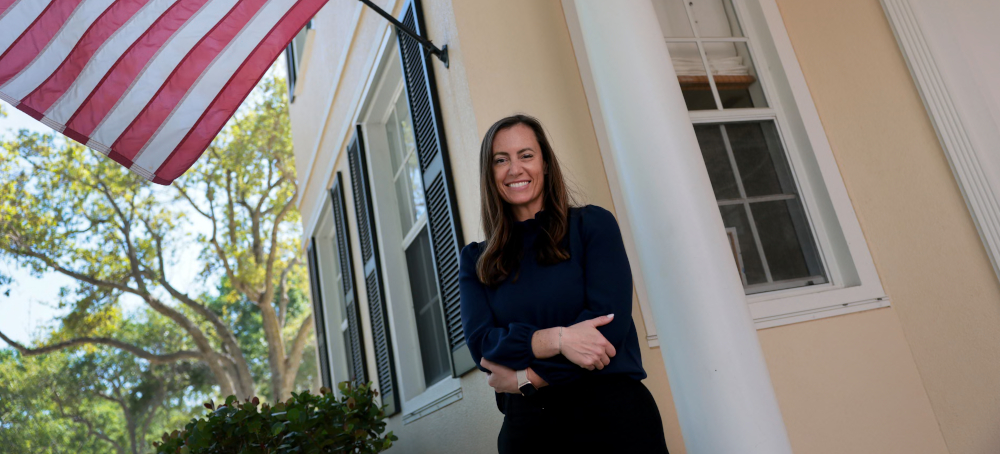 Emily Gregory outside her home the day after she beat her Republican challenger for a Florida state house seat, on 25 March 2026 in Jupiter, Florida. (photo: Joe Raedle/Getty)
Emily Gregory’s victory in district that includes Mar-a-Lago has revitalized the party before the crucial November vote
Since Trump returned to the White House in January 2025, Democrats have flipped more than two dozen legislative districts held by Republican lawmakers nationwide. Amid mounting discontent with the high cost of living, the violent tactics used to enforce the administration’s mass deportation agenda and bewilderment over the erratic imposition of tariffs, Democratic candidates have captured a series of traditionally Republican seats in states spanning deep-red Mississippi to purple Virginia.
But no recent Democratic victory may have stung the president more than the triumph of political newcomer Emily Gregory in Florida’s 87th house district. The 40-year-old owner of a fitness center for women eked out a narrow win over Trump-endorsed candidate Jon Maples. The district encompasses Trump’s Mar-a-Lago estate in Palm Beach county, and in 2024 the Republican incumbent handily won re-election by a margin of 19 percentage points.
“We’re seeing a return to the [political] center,” said Gregory, who focused her campaign on affordability issues such as the skyrocketing cost of property insurance and healthcare. “I’ve never seen Florida as this fixed, ruby-red state, and we’ve seen a state legislature that doesn’t even attempt to tackle the kitchen table issues facing Floridians. They talk about how expensive Florida has become, how hard it is to make your bills, how people aren’t able to save. I attribute our victory to having responded to their real priorities and needs.”
The Sunshine state has been a recurring source of stormy weather for Democrats for many years. No Democrat has won a statewide office since 2018. Twenty of Florida’s 28 congressional seats are held by Republicans. The lame-duck Republican governor, Ron DeSantis, has enjoyed supermajorities of 60% or more in both chambers of the state legislature throughout most of his term in office. Once regarded as a swing state that voted for Barack Obama, Florida has delivered for Trump in three consecutive presidential elections, with an expanding margin of victory.
But the victories of Gregory and fellow Democrat Brian Nathan in the 14th state senate district byelection, coupled with the election of Miami’s first Democratic mayor in 28 years last December, point to a change in the party’s fortunes.
“Florida is a red state, but there couldn’t be a better year for Democratic candidates who talk about affordability to run for office and win,” says Rick Wilson, a former Republican strategist and outspoken critic of Trump in Florida who co-founded the Lincoln Project in 2019 with other moderate conservatives and disaffected Republicans. “Trump is profoundly unpopular in an area that he should be strong on, which is the economy.”
A new Reuters/Ipsos poll released last Tuesday found the president’s approval rating hitting a new low of 36%, with a mere 29% of respondents voicing support for his handling of the economy. Buoyed up by such opinion surveys and the impressive winning streak that Democratic nominees have compiled during the past 12 months, the Democratic Legislative Campaign Committee (DLCC) is targeting hundreds of legislative seats at the state level in 42 senate and house chambers this fall. The committee plans to raise $50m to fund the campaigns of Democratic candidates, and it recently added the legislatures of Arizona and New Hampshire as lawmaking bodies that are ripe for wresting away from the GOP’s control.
Should Florida be added to that list? An internal DLCC strategy memo issued late last year limited the party’s ambitions in 2026 to the reduction of the Republican supermajorities in both houses of the Florida legislature.
The Democratic Congressional Campaign Committee’s target list for this year’s US House of Representatives contests, meanwhile, prominently features two Latina lawmakers, Maria Elvira Salazar and Anna Paulina Luna, whose support among Hispanic voters may be eroding in the face of the Trump administration’s failure to lower inflation and its relentless deportation of undocumented Latin American immigrants.
Another Republican in the committee’s crosshairs is Cory Mills, a 45-year-old army veteran whose suburban Orlando district has seen an influx of registered Democratic voters since he was first elected to Congress in 2022.
But registered Republican voters still outnumber registered Democrats by nearly 1.5 million, and outside the major urban centers of Miami/Fort Lauderdale, Orlando and Tampa/St Petersburg, the state remains a largely GOP bastion.
“You have to be very careful about reading too much into a special election result,” cautioned Kevin Wagner, a professor of political science at Florida Atlantic University and director of its Political Communication Lab. “The Democrats will say this is more evidence of a giant blue wave that will swamp Florida. But the state has trended Republican for the last 20 years, and that isn’t likely to be reversed in a single year.”
Republicans also downplay the significance of the Democratic triumphs. “A low-turnout state house special election is a snapshot of local quirks, candidate dynamics and turnout math,” said Danielle Alvarez, a senior adviser at the Republican National Committee, in a statement. “[It is] not some grand verdict.”
The wild card in any Florida election, however, is the state’s large number of independent voters who now exceed 3.3 million. If a sizable majority of those voters back Democratic nominees and the absence of Trump’s name on the November ballot lowers turnout among registered Republicans as it did in the 2018 and 2022 midterms, Democrats could flip one or two congressional districts and pick up more seats in the state legislature.
One of those hopefuls is Pia Dandiya, 38, a former high school principal who is seeking her party’s nomination to unseat Republican incumbent Brian Mast in Florida’s 21st congressional district.
“The tide is turning,” says the Harvard-educated daughter of Indian immigrants. “There is an appetite for a pragmatic, commonsense Democrat who is committed to delivering results quickly, and our party has an opportunity to write a new chapter for what it means to be a Democrat in Florida.”