Congress Faces War Powers Votes in Wake of Iran Strikes
Robert Jimison and Megan Mineiro The New York Times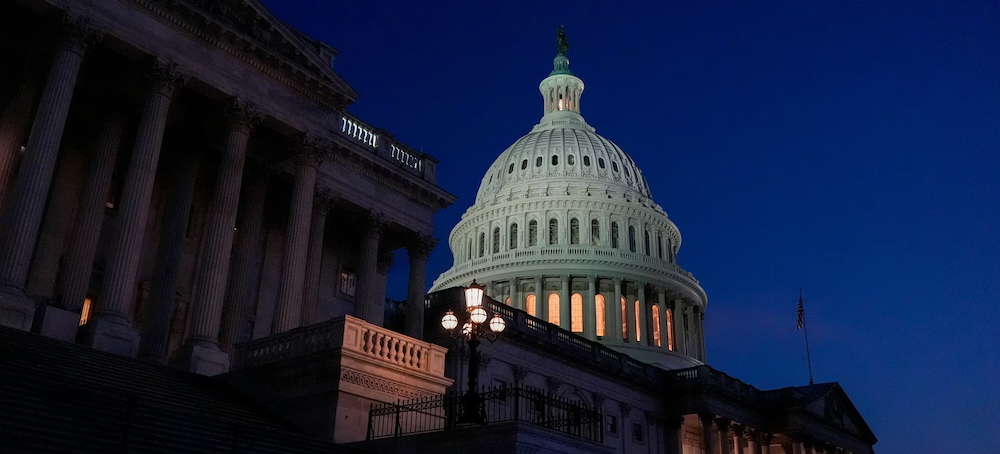 The United States Capitol building. (photo: Kent Nishimura/Bloomberg/Getty Images)
Following the attack, Democrats and a few Republicans escalated their calls for swift votes on whether to curb the president’s power to continue using force against Iran without explicit authorization.
Even before Mr. Trump ordered a surprise attack on Iran’s government in coordination with Israel, leaving plumes of smoke rising over Tehran, the House and Senate had been on track to debate and vote next week on resolutions to rein in the president’s war powers.
The measures — one expected to be considered in the Senate on Tuesday and the other in the House on Thursday — appear all but certain to fail, given that proponents of restraining the president’s authority lack the necessary support to override a presidential veto. But the effort took on new urgency in the aftermath of Saturday’s strikes, which set the stage for every member of Congress to take a position on Mr. Trump’s decision to abandon diplomatic talks in favor of unilateral military action.
“The administration has not provided Congress and the American people with critical details about the scope and immediacy of the threat,” Senator Chuck Schumer, Democrat of New York and the minority leader, said in a statement on Saturday. He called for Congress to “quickly return to session and reassert its constitutional duty” by passing legislation to curtail the military campaign against Iran.
Following the surprise attack on Saturday, most Republicans appeared no more willing to support such a move than they had been before the president said he was launching a “massive and ongoing” campaign against Iran. They praised Mr. Trump for attacking an enemy they said for years had sought to expand its nuclear capacity, sponsored terror groups and threatened the security of the United States and its allies.
“The Iranian regime has refused the diplomatic offramps that would peacefully resolve these national security concerns,” Senator John Thune of South Dakota, the majority leader, said in a statement. “I commend President Trump for taking action to thwart these threats.”
But Democrats expressed alarm about the attack. They said the president had presented no clear evidence of an imminent threat to warrant it. And while they said they shared the desire to end Iran’s nuclear ambitions, they said military action required deliberation and coordination with the legislative branch that Mr. Trump had refused to engage in.
“The American people and Congress deserve immediate answers,” said Senator Jeanne Shaheen of New Hampshire, the top Democrat on the Senate Foreign Relations Committee. In a statement that accused Mr. Trump of having a “disappointingly cavalier approach towards the use of force,” she called for Congress to return without delay “before this entanglement grows,” and vote on the matter.
“The Senate should immediately return to session and vote on my war powers resolution to block the use of U.S. forces in hostilities against Iran,” said Senator Tim Kaine of Virginia, who partnered with Senator Rand Paul, Republican of Kentucky, on a measure that would require that the president seek authorization from Congress before taking further military action against Iran.
“Every single senator needs to go on the record about this dangerous, unnecessary, and idiotic action,” Mr. Kaine added.
Fewer than a handful of Republicans agreed, including Mr. Paul and Representative Thomas Massie, another Kentucky Republican who has cosponsored a similar resolution on Iran.
“The Constitution conferred the power to declare or initiate war to Congress for a reason, to make war less likely,” Mr. Paul wrote on social media on Saturday, adding: “My oath of office is to the Constitution, so with studied care, I must oppose another presidential war.”
Mr. Massie said the strikes amounted to “acts of war unauthorized by Congress.”
Both measures invoke the War Powers Act, which allows for speedy consideration of any resolution to terminate military hostilities unless Congress has authorized them.
Mr. Kaine forced a similar vote last summer after Mr. Trump directed strikes on three nuclear sites in Iran. That effort failed, as did a subsequent attempt to curb military action in Venezuela. But he has argued that the scale of the buildup in the Middle East in recent weeks has changed the stakes on Iran.
Now, the question is whether an active military campaign will persuade any Republicans to think twice about allowing Mr. Trump to continue unchecked.
Only a handful of Republicans had signaled openness to supporting the resolutions.
Representative Warren Davidson of Ohio had said he would back the House measure if the administration failed to provide new information justifying military action.
“I have asked for a classified briefing defining the mission in Iran,” Mr. Davidson wrote in a social media post on Thursday that he reshared on Saturday morning, adding that “war requires Congressional authorization,” and that “no case has been made” for it.
Still, the resolutions would need near-unanimous Democratic backing and several Republican votes in each chamber to pass.
Some Democrats — including Senator John Fetterman of Pennsylvania, along with Representatives Jared Moskowitz of Florida and Josh Gottheimer of New Jersey — had broken ranks even before the bombs started falling and said they could not support any effort to rein in Mr. Trump’s war powers when it came to Iran.