Clarence Thomas' Benefactors Finally Face the Music
David Janovsky and Sarah Turberville Slate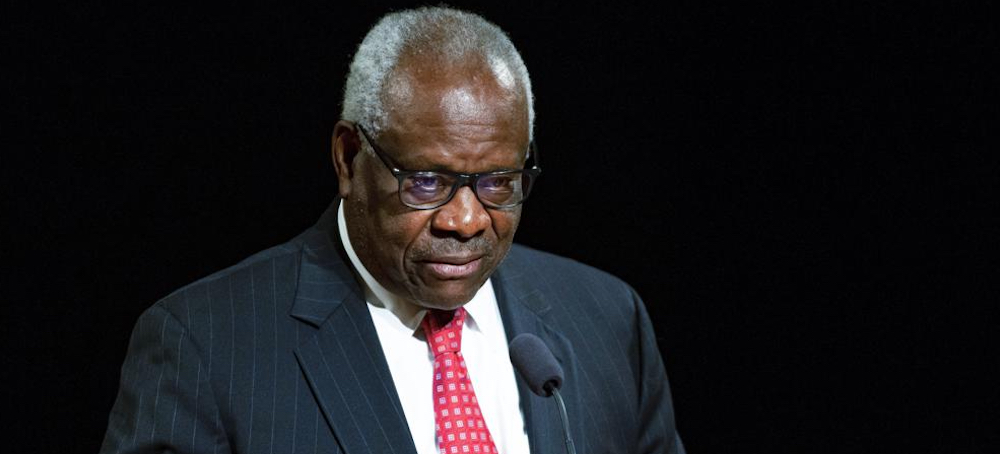 Clarence Thomas. (photo: Robert Franklin/AP)
Most people know the basic backstory. Thanks to the dogged reporting of several media outlets this year, particularly ProPublica, the curtain has been pulled back on a decadeslong influence scheme aimed at the justices on the U.S. Supreme Court. But a group of ultrawealthy benefactors at the center of the Supreme Court’s ethics crisis have thumbed their noses at the Senate Judiciary Committee’s efforts to uncover the scope of the financial entanglements.
They brazenly rebuffed Senate investigators who requested information about lavish, undisclosed travel and other gifts they have bestowed on Justices Clarence Thomas and Samuel Alito.
But now the committee is pushing back—welcome news, especially for the overwhelming majority of the public that wants a more ethical Supreme Court (and a functional Congress, for good measure).
The targets of the Senate’s investigations are not just anyone. Two of them—Harlan Crow and Robin Arkley—are billionaires who have contributed their considerable largesse to a yearslong campaign to radically alter the Supreme Court, lavishing Thomas and Alito with luxury travel in the company of conservative activists. (For his part, Arkley agreed to cooperate with the committee, which dropped its subpoena threat in his case.) At the same time, the Supreme Court has even considered cases involving businesses with direct ties to Crow and Paul Singer, another benefactor and subject of the committee’s investigation (who also was not a subpoena target at Thursday’s vote).
A common thread in a network of wealthy individuals, government officials, and advocates who have orchestrated the current right-wing supermajority on the court is another target of the investigation: the Federalist Society’s Leonard Leo. He is the driving force behind the Federalist Society’s judicial pipeline and a billion-dollar network of groups working to reshape the law in favor of corporations and the über-wealthy. Arkley is reportedly a major donor to Leo’s groups.
This is not an abstract project: No fewer than four cases the court is to decide in this term alone could dramatically advance this agenda, including a case that would allow the justices to rewrite regulations that affect our air, water, labor practices, consumer finance, and a host of other questions. Known as the Chevron doctrine, the legal principle at issue in one of these cases has been the subject of years of criticism orchestrated by Leo and Crow. And Justice Thomas, who defended the doctrine in a 2005 opinion, has since become its primary critic on the court following years of unofficial and undisclosed gifts by these benefactors. He also failed (again) to disclose his participation in exclusive fundraisers and gatherings where the reversal of the Chevron doctrine was often a topic of discussion.
For any official to accept undisclosed gifts of the magnitude reported this year would warrant a Senate investigation. The fact that these gifts came from people engaged in a covert effort to shape the court, its power, and its opinions makes an investigation into how these gifts may have influenced the justices all the more urgent.
This is a textbook case for congressional oversight. There are widely reported—and salient—allegations of financial relationships between government officials and those seeking to influence their decisions. These relationships seem to violate existing law. And they have a direct bearing on legislation that should prevent exactly this kind of corruptive influence. Of course, Congress should ask the billionaires who provided these gifts for more details; it’s an entirely appropriate response to a growing crisis.
But the stakes are even higher than that. Leo and Crow have refused to turn information over to the committee, and accepting their justifications for doing so could gut Congress’s ability to conduct any oversight—regardless of the subject.
Their excuses run from the baseless claim that Congress can’t regulate Supreme Court ethics to the preposterous argument that Congress can’t investigate people it disagrees with politically. In short, according to Leo and the billionaires, being friends with sufficiently powerful officials puts private citizens beyond the reach of congressional investigations.
These claims are as dangerous as they are absurd. The notion that Congress can’t regulate ethics on the court ignores a long and uncontroversial history of Congress doing just that. To name just the most directly comparable example, the 1978 Ethics in Government Act has required financial disclosures from judges and justices for decades—and that provision has been upheld in federal court. To accept the argument that Congress lacks authority is to put the justices truly above the law. By that logic, the justices would be immune from federal laws prohibiting bribery—which they are not.
Not all of those targeted by Senate investigators are making such spurious arguments. In fact, some have recognized their responsibility to voluntarily provide information—and illustrated the need for continued investigation. In a separate but related probe, the Senate Finance Committee sought and received documents from yet another Thomas benefactor, health care magnate Anthony Welters, about possible tax law violations stemming from Welters’ loan of over $250,000 to Thomas for purchase of a luxury motor coach.
That’s why the Judiciary Committee’s vote last week to subpoena is a serious but necessary move. It’s time to compel compliance from these recalcitrant targets. The Senate cannot stand by while a handful of plutocrats try to dictate the terms of its constitutional authority.