China Operating Over 100 Police Stations Across the World With the Help of Some Host Nations, Report Claims
Nina dos Santos CNN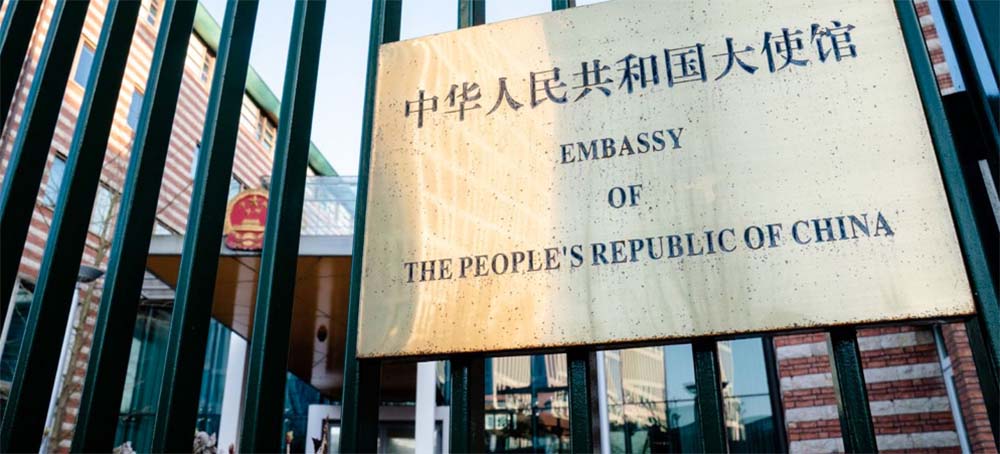 This picture taken on March 22, 2021, shows the entrance of the China embassy in the The Hague. The Netherlands, along with Ireland, has shut down the Chinese police station found on its territory. (photo: Bart Maat/ANP/AFP/Getty Images)
Madrid-based human rights campaigner Safeguard Defenders says it found evidence China was operating 48 additional police stations abroad since the group first revealed the existence of 54 such stations in September.
Its new release – dubbed “Patrol and Persuade” – focuses on the scale of the network and examines the role that joint policing initiatives between China and several European nations, including Italy, Croatia, Serbia and Romania have played in piloting a wider expansion of Chinese overseas stations than was known until the organization’s revelations came out.
Among the fresh claims leveled by the group: that a Chinese citizen was coerced into returning home by operatives working undercover in a Chinese overseas police station in a Paris suburb, expressly recruited for that purpose, in addition to an earlier disclosure that two more Chinese exiles have been forcibly returned from Europe – one in Serbia, the other in Spain.
Who runs the police stations?
Safeguard Defenders, which combs open-source, official Chinese documents for evidence of alleged human rights abuses, said it has identified four different police jurisdictions of China’s Ministry of Public Security active across at least 53 countries, spanning all four corners of the globe, ostensibly to help expatriates from those parts of China with their needs abroad.
Beijing has denied it is running undeclared police forces outside its territory, with its Ministry of Foreign Affairs telling CNN in November: “We hope that relevant parties stop hyping it up to create tensions. Using this as a pretext to smear China is unacceptable.” Instead, China has claimed the facilities are administrative hubs, set up to help Chinese expatriates with tasks like renewing their driver’s licenses. China has also said the offices were a response to the Covid-19 pandemic, which had left many citizens locked down in other countries and locked out of China, unable to renew documentation.
When approached by CNN last month about Safeguard Defenders’ original allegations, China’s foreign affairs ministry said the overseas stations were staffed by volunteers. However, the organization’s latest report claims one police network it examined had hired 135 people for its first 21 stations.
The organization also sourced a three-year contract for a worker hired at an overseas station in Stockholm.
Undeclared consular activities outside of a nation’s official diplomatic missions are highly unusual and illegal, unless a host nation has given their explicit consent, and the Safeguard Defenders report claims China’s overseas offices predate the pandemic by several years.
Their reports have prompted investigations in at least 13 different countries so far and enflamed an increasingly heated diplomatic tussle between China and nations like Canada, home to a large Chinese diaspora.
China isn’t the only superpower to be accused of employing extrajudicial means to reach targets for law enforcement or for the purposes of political persecution abroad.
Russia, for instance, has on two occasions been accused of deploying lethal chemical and radioactive substances on British soil to try to assassinate its former spies – allegations Russia has always denied.
In the United States, the CIA was embroiled in a scandal over the extraordinary rendition of terrorism suspects from the streets of Italy to Guantanamo Bay after 9/11.
Yet the suggestion of widescale repression of Chinese citizens in foreign countries comes at a pivotal time for a nation contending with its own unrest at home, amid fatigue at the country’s restrictive zero-Covid policy, as leader Xi Jinping’s third term in power gets under way. Last week, China indicated it would loosen some of its pandemic restrictions, three years after the onset of Covid-19.
As the second largest economy in the world, China has developed a deepening relationship with many of the countries where the new police stations have been allegedly found, raising awkward questions for national governments balancing commercial interests against national security.
China signs police patrol agreements with nations
Italy, which signed a series of bilateral security deals with China over successive governments since 2015, has kept largely silent during the revelations of alleged activities on its soil.
Between 2016 and 2018 Italian police conducted multiple joint patrols with Chinese police – first in Rome and Milan – and later in other cities including Naples where at the same time, Safeguard Defenders says, it has found evidence that a video surveillance system was added to a Chinese residential area ostensibly “to effectively deter crimes there.”
In 2016, an Italian police official told NPR that joint policing would “lead to a wider international cooperation, exchange of information and sharing resources to combat the criminal and terrorist groups that afflict our countries.”
The NGO determines Italy has hosted 11 Chinese police stations, including in Venice and in Prato, near Florence.
One ceremony in Rome to mark the opening of a new station was attended by Italian police officials in 2018, according to videos posted on Chinese websites, demonstrating the close ties between police forces in the two countries.